 United Kingdom Puccini, La bohème: Soloists, Northern Ireland Opera Chorus / Bryan Evans (music director and piano). Carlisle Memorial Church, Belfast, 16.5.2026. (RB)
Diva Opera are a touring and chamber opera company. They perform all their operas with the principal roles, reduced chorus and piano accompaniment. They stage their operas using an ‘in the round’ format with the audience seated on three sides of the performing area close to the artists. For this production of La bohème, they were joined by the Chorus of Northern Ireland Opera. The latter is a major part of Northern Ireland Opera’s artist development programme which provides training and performance opportunities to locally based singers. (For more background to this La bohème click here.) The venue, Carlisle Memorial Church, was completely sold out.
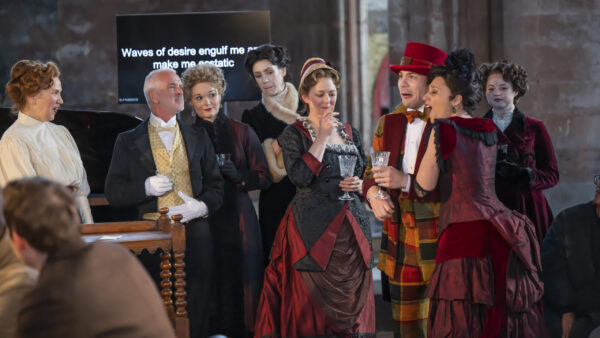
The set was minimal, consisting of assorted props such as a chaise longue, an artist’s easel and a table and chairs in the opening act and assorted tables and chairs in the café scene. Charlotte Hillier’s costumes were stylish and colourful, and they perfectly reflected the Parisian Latin Quarter in the mid-19th century. They helped to highlight some of the class distinctions in the Café Momus scene in the second act. The ensemble acting in this production was exceptional. The cast succeeded in bringing the various scenes to life in a highly vivid and extraordinary way. In the first act the production moved seamlessly from the camaraderie and high jinks of the four bohemians to the emotionally charged scene between Rodolfo and Mimì. In the second act the cast and chorus mingled with the audience. They did a brilliant job bringing the vibrant activities around the Café Momus to life while also making the audience feel part of the action. The third act was an emotional rollercoaster while the final act moved inexorably to desolation and heartbreak. The proximity of the performers to the audience amplified the emotional impact of the opera.
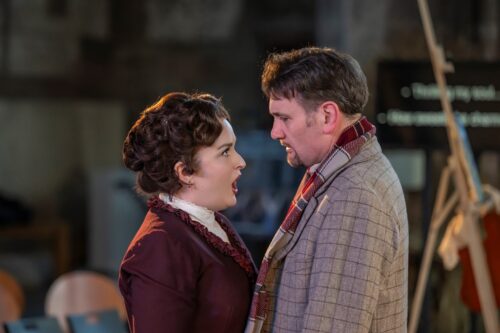
Robyn Lyn Evans and Mary McCabe were both terrific in the roles of Rodolfo and Mimì and the chemistry between them was palpable. Evans portrayed Rodolfo as a dashing, likeable character. He engaged in horseplay and banter with his fellow bohemians, enjoyed moments of enraptured tenderness with Mimì and was overwrought with guilt and grief in the final two acts. He brought a rich warmth and lyricism to the vocal line. ‘Che gelida manina’ was a gleaming, rapturous tour de force which brought the house down. On occasion, I would have liked the vocal line to sound a little more effortless as he soared up to Puccini’s top notes. McCabe struck the right balance between Mimì’s alluring qualities and her physical frailty. She injected a creamy lyricism into the vocal line and produced searing top notes in Act III. Her faltering pianissimo singing in the final act was heartbreaking.
Tereza Gevorgyan and Jean-Kristof Bouton acquitted themselves well in the roles of Musetta and Marcello. They did an excellent job depicting the combustible volatile nature of the relationship and their exchanges crackled with energy. Gevorgyan was spiky and coquettish in Act II, and she dominated the early part of the scene. On occasion, her performance was a little over emphatic, and I would have liked her to pare back slightly on the spiky aspects of the character. The shift to selfless compassion in Act IV was very well handled as she prayed for Mimì and sold her earrings to buy medicine. Gevorgyan sang the famous waltz, ‘Quando me’n vo’ with a polished, seductive, ringing tone. Bouton’s Marcello was loyal and dependable with his fellow bohemians while more animated in his relationship with Musetta. He sang with robust authority throughout, and he radiated power at the end of Act II when taking up the theme of Musetta’s Waltz.
The rest of the cast acquitted themselves well both vocally and dramatically. Michael Roche clearly showed he had a beautiful voice in Act IV’s coat aria although there is scope to make it even more touching. The Northern Ireland Opera Chorus excellently conveyed the bustle of activity around the Café Momus in Act II and they sang with gusto.
When I first learned that this production would only be accompanied by a piano, I had my doubts as to how far the pianist would be able to conjure up Puccini’s opulent score. Those doubts were dispelled by Bryan Evans’s superb performance. Evans did a wonderful job conjuring up Puccini’s rich and contrasting orchestral sonorities. I was struck by the clarity and polish of the playing and the highly structured way in which Puccini’s web of leitmotifs emerged. Evans was a sympathetic and flexible accompanist to the singers and was highly attentive to balance.
Overall, this was an intensely moving performance of Puccini’s timeless masterpiece.
Robert Beattie
Featured Image: [front r] Parpignol (Charles St John) and Musetta (Tereza Gevorgyan)
Creatives:
General director, Diva Opera – Anne Marabini Young
Artistic director, Northern Ireland Opera – Cameron Menzies
Stage director – Wayne Morris
Costume designer – Charlotte Hillier
Cast:
Rodolfo – Robyn Lyn Evans
Mimì – Mary McCabe
Musetta – Tereza Gevorgyan
Marcello – Jean-Kristof Bouton
Benoît / Alcindoro – Matthew Hargreaves
Schaunard – Jerome Knox
Colline – Michael Roche
Parpignol – Charles St John
Street Seller – Louise Mott
Absolutely brilliant. Very moving.