
 United Kingdom Mahler: Holly Teague, Iúnó Connolly, Sofia Kirwan-Baez (sopranos), Georgia Mae Ellis, Rhian Davies (altos), Jack Dolan (tenor), Conrad Chatterton (baritone), Jakob Mahase (bass), Coventry Cathedral Chorus, Coventry Cathedral Choir, Daventry Choral Society, Divertimento, Royal Leamington Spa Bach Choir, Spires Philharmonic Chorus, Warwick and Kenilworth Choral Society, Warwickshire Youth Choirs (chorus master: Laura Baillie), Leamington Sinfonia / Joe Davies (conductor). Coventry Cathedral, 16.5.2026. (CK)
Mahler – Symphony No.8
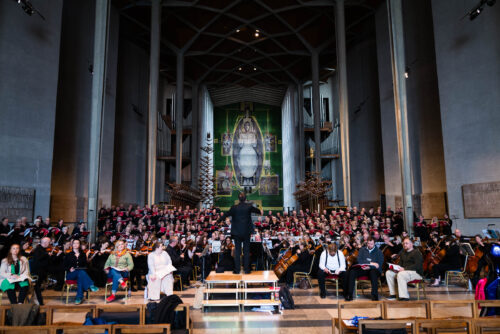
Come, Creator Spirit…Illuminate our senses, Pour love into our hearts! Last Saturday Pentecostal fire seemed to arrive a week early in Coventry Cathedral, the flames lapping around a great crowd of performers and audience (there was not a seat to be had): Joe Davies drove his baton skywards, the organ thundered, the orchestra roared, the vast chorus exploded into life, and a remarkable performance of Mahler’s Eighth was launched in a great burst of energy and joy.
When that opening blaze of sound quietened it was immediately obvious that Davies had assembled a superb team of young soloists. The ladies in particular excelled both individually and as a team; just where in some performances the tension sags or doubts creep in, we were borne along strongly on the tide of sound, through that rather sinister little march with its Berlioz-like bell, until rampant horns ushered in the incandescent eruption on full organ and chorus: Accende!
One of the inspiring things about this performance was its courage, its going for broke: never more so than here, where Davies held the comma daringly before unleashing the great flood of sound. It was superbly engineered: a moment that can easily misfire hit us with almost blinding force.
In the two previous Mahler performances I have heard from him Joe Davies favoured fast tempi, seeming to keep everyone together and on course by sheer physical energy, encouragement and force of will. So it was here: he plunged into the double fugue and pressed on to the end, so that the whole movement seemed borne on a single giant breath.
There are of course potential problems of balance and coordination here, especially in a cathedral acoustic (I remember Valery Gergiev’s 2008 performance with the London Symphony Orchestra in St Paul’s Cathedral being hopelessly blurred and congested; 30 years before that, a performance conducted by Sir Charles Groves in the vast Liverpool Anglican Cathedral fared rather better). A friend sitting at the back of Coventry Cathedral said that this opening movement had turned to mush by the time it reached her, and was not always together (Part 2, she said, was much better).
Joe Davies was a long way from the choruses, as were they from each other: inevitably there were small time lags, but nobody was left behind. One sensed that every one of the 500 performers was invested in the performance’s success: the commitment with which they tackled this fast and fierce music was moving in itself. The big moments came at us like tidal waves. I couldn’t see the children’s choirs, but I could hear them piercing the texture like a beam of light (Mahler said of one passage that he wanted them ‘to enter like a knife through butter’). And so, the first Part of what must be a candidate for the Fastest Ever Mahler 8 ended in almost levitational excitement, the extra brass adding to the tumult (seven trumpets!).
If Part 1 overwhelms us with its sheer mass, in Part 2 Mahler allows us to hear its component parts at our leisure. First, the orchestra: the marvellous throb of a dozen double basses playing pizzicato, the cool poise of the woodwind’s chant, the urgency and passion of the strings and horns. The antiphonal placing of the choirs made the hushed, echoing opening chorus effective, though here too they were fighting the acoustic. The soloists, together so impressive in Part 1, were even more so here, each of them rising to the challenges Mahler sets them. Conrad Chatterton was an ardent Pater Ecstaticus, Jakob Mahase a powerful Pater Profundus, both of them building to a palpable intensity that pushed the drama forward. The ‘Scherzo’ section that follows, featuring the voices of women and children, was fast and light, its brightness lifting it off from the preponderantly bass sounds that precede it. Jene Rosen was just lovely.
Listening to tenor Jack Dolan in Part 1 I had wondered whether he had the reserves for Doctor Marianus in Part 2: he had, and though I have heard more beautiful tenor voices I have heard few (if any) who coped with the part’s cruelly high tessitura as well as he did. I mustn’t labour the point, but everyone – including Davies – seemed to be going above and beyond in their desire to make the performance work, to give of their best and more. As the choir of angels had just sung, ‘If a man strives with all his heart, that man we can redeem.’
As we began the long pull towards transcendence the performance took on a glow of mounting expectation and intensity. The arrival of the Mater Gloriosa melody on the violins was sweetly played but not lingered over: I must pay tribute to the orchestra’s leader, Edward Boothroyd, whose violin darted like a flame in his solos.
I wish I had room to do justice to Holly Teague, the beauty and drama of her singing, her pp top C in the Chorus Mysticus attained and sustained with no loss to the purity of her sound; to Iúnó Connolly, touching as Gretchen, preparing the way for Mater Gloriosa; to Sofia Kirwan-Baez, Mater Gloriosa herself, singing radiantly from the pulpit above and behind the choirs, and looking so in a white dress (everyone else was in black); to Georgia Mae Ellis, a compelling presence in Part 1 and a passionate Mulier Samaritana; and to Rhian Davies, who entranced me with her singing of Zarathustra’s ‘Midnight Song’ in Davies’s performance of Mahler 3 in the Sheldonian earlier this year. She reminds me a little of Alfreda Hodgson, one of the finest Mahler singers I have ever heard.
Jack Dolan was back with the choirs for Blicket auf, sung with mounting fervour; the orchestra ratcheted the tension up further, Steve Bailey’s insanely high trumpet piercing the sky; and after the unexpected appearance of Mahler’s bizarrely beautiful celestial hurdy-gurdy (harmonium, celeste, piano and harps, with piccolo aloft) we reached fulfilment and journey’s end in the Chorus Mysticus. It didn’t start ppp, but it achieved a mighty fortissimo with the climactic Alles vergängliche, and several more f’s by the end. We in the audience rose to our feet.
It was a magnificent performance. We were left in no doubt of the role Joe Davies had played, in this his last concert as conductor of the Leamington Sinfonia, in making it happen – inspiring and enthusing players and singers but also tackling the logistical challenges an event like this poses. There was a large and effective team of helpers and organisers on the night, but in the days leading up to the performance I imagine Joe was everywhere.
Two reflections. Before the music started a member of the cathedral clergy welcomed us; he spoke of how, in an increasingly divided world, music unites us. Mahler isn’t the only composer whose music can do this, but the sheer scale and spiritual reach of his music has a community-building quality. Ten, twenty, fifty years from now, people will meet, discover that they were both in the audience at this performance, and feel a kinship.
With music-making of this scale and intensity, incidental flaws matter not a jot. I remember a critic, surveying the available recordings of Mahler’s Eighth, comparing two of them thus: ‘Solti’s is the better performance, Bernstein’s is the greater experience.’ It’s not often that one encounters an experience like that in Coventry Cathedral.
Chris Kettle
Wow! What a renarkably comprehensive review, many congratulations.
I, too, attended having followed the rehearsal schedule from January through ’till the weekend.
Have thoroughly enjoyed the Joe Davies tenure and his ongoing commitment to Mahler!