
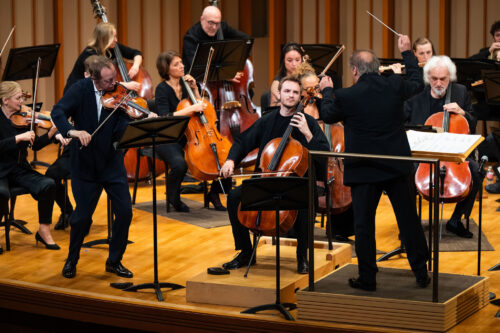
 United States ‘Radiance + Reverie: Martín + Marwood + Mozart’: Anthony Marwood (violin). Coleman Itzkoff (cello), Los Angeles Chamber Orchestra / Jaime Martín (conductor). The Wallis, Beverly Hills, 17.5.2026. (LV)
Mozart – Symphony No.35 in D major, K.385, ‘Haffner’
Christopher Cerrone – Selah (2026) for violin, cello and chamber orchestra (world premiere)
Tchaikovsky – Orchestral Suite No.4 in G, ‘Mozartiana’
The Los Angeles Chamber Orchestra’s Sunday matinee opened with a Mozart masterpiece, crested with a challenging world premiere and then subsided into a lightweight homage to Mozart by Tchaikovsky. One felt the architecture was working in reverse.
A brilliantly phrased trill in the timpani jump-started the real Mozart. The woody notes of the bassoons were a delight, and the clarinets infused their fast scale passages with tootling Alpine colors. What Jaime Martín and his crew did was just right – chamber-scaled yet never small. The second movement brought lovely phrasing and treatment that elevated the little appoggiaturas and grace notes, a function of the elegant bowings – an education in themselves – that emanated from concertmaster Margaret Batjer and the strings. And while the phrasing of the simple tune in the Menuetto felt not just ponderous but affected, the beauties of the Trio redeemed it beautifully.
The concert’s centerpiece was the world premiere of Christopher Cerrone’s Selah for violin, cello and chamber orchestra, co-commissioned by LACO and the Saint Paul Chamber Orchestra, with violinist Anthony Marwood and cellist Coleman Itzkoff as soloists. The work grows out of an earlier Cerrone piece, Canto Selah, itself inspired by a G.C. Waldrep poem – a meditation on silence, impermanence and identity. From the stage, Cerrone explained that selah (from the Book of Psalms) means pause, breath, a demarcator of silence, and that the central image of a voice staring at itself in a mirror had evolved in this new concerto from electronics into something physical and communal. He also mentioned, touchingly, that he became a father fourteen months ago. He described LACO as an orchestra of soloists.
The first movement opened with Marwood and Itzkoff ripping off sounds, joined by bells, gradually coalescing into kaleidoscopic turnings, leading to the two trading harmonics and scrunches as the full orchestra set into anxious, Morse-code-like motion. The second movement dug down into deep keening sounds before settling into stillness. The third broke slowly into a march-like tune with fragments, a clockwork section with strings pizzicato and violas swooshing. The fourth movement brought a Stravinskian outburst, the soloists trading fragments – what Cerrone calls ‘relentless hockets and snap pizzicatos’ – before cutting off sharply. The finale arrives without warning: a virtuoso celeste passage leads to five hollow bells, figurations speed up more and more – and then it’s over. Few hummable tunes overall but emotional nonetheless.
Tchaikovsky’s ‘Mozartiana’ closed the program with a neat and engaging performance, highlighted by Batjer’s urgent pyrotechnics in the last movement and Martín’s obvious delight on the podium. For an encore: Mozart’s Overture to his The Marriage of Figaro. The low strings and, particularly, the double basses revealed that their astonishing speed and precision in the finale of the ‘Haffner’ – one of the most demanding double-bass passages in the entire orchestral repertoire – had been no accident.
Laurence Vittes