 United Kingdom Garsington Opera 2026 [1] – Richard Strauss, Der Rosenkavalier: Soloists, Garsington Opera and Children’s Chorus, Philharmonia Orchestra / Finnegan Downie Dear (conductor). Garsington Opera at Wormsley, 30.5.2026. (CR)
Der Rosenkavalier (1911) is an opera noted – sometimes reviled – for conjuring a particular time and place (18th-century Vienna during the reign of Maria Theresa). Audiences don’t necessarily appreciate quite what it meant for Richard Strauss and his librettist, Hugo von Hofmannsthal, to recreate in their ‘sophisticated comedy’ that world at the beginning of the 20th century, in a blended late Romantic and neo-Classical idiom which rises far above pastiche. Productions sometimes place the opera’s world within the 18th century Ancien Régime on the eve of the French Revolution, or in an aristocratic setting at the time of its composition on the cusp of the First World War, even if composer and librettist couldn’t have known that brewing political tensions would erupt so cataclysmically within just a few years. Others, such as Harry Kupfer’s (review here), consciously hark back from a given present to an earlier Vienna, now irrevocably past. Such stagings maintain an essentially historical realist interpretation of the work.
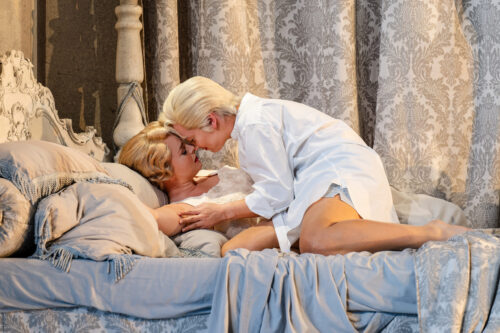
The cultural and social dialogue which Strauss and Hofmannsthal set up in their masterpiece, however, implies more complicated temporal conjunctions and disjunctions than a simply linear historical account of time, for example in the composer’s unapologetically anachronistic use of the waltz in the context of the 18th century, and sustaining a largely Romantic style in his music. Bruno Ravella’s production for Garsington taps into that dramaturgical sophistication brilliantly and entertainingly by playing around with notions of different eras and places as something of a comical fantasy, while remaining true to the work’s spirit of opera buffa and overt theatricality. The first act – in the Marschallin’s bedchamber – is set in a sober silvery room, though with outlandishly, inauthentically large rococo stucco work of palm leaves, and a rose hovering forebodingly over her bed. The reception room of the rich merchant Faninal’s palace in the next act uses the same setting but is opened up to create a yet bigger space, with ostentatious gilding in the decoration and furniture to denote the comparative vulgarity of new money that he represents. The servants’ dashing about and their precariously moving the sumptuous chandeliers into place prompt almost an Only Fools and Horses moment when they are nearly dropped.
The characters belong to neither the 18th century nor the fin de siècle however, but to the 1950s. From a strictly historicist perspective it can’t make much sense simply to place the scenario of Der Rosenkavalier in that decade so soon after World War Two, since the impoverished, even still ruined, world of aristocratic Vienna (as throughout Europe) won’t have been anything like the charmed world of the opera (think The Third Man for instance). It’s not exactly then that the action is just updated and set in the 1950s, but rather as though the glamour of the opera’s characters and their social setting are construed as the subject of an extravagantly escapist Hollywood film production of the 1950s which happens to have as its backdrop the luxury setting of the Old World, unperturbed by war.
That probably gives to an audience today a more recent and culturally accessible analogy for the creative, if also kitsch and comical, reimagining of an earlier period that Strauss and Hofmannsthal were engaged in, somewhat more than a hundred years ago. In this light it would be interesting to know if Ravella had in mind Oh…. Rosalinda!!, Michael Powell and Emeric Pressburger’s 1955 film adaptation of the operetta Die Fledermaus by the other Strauss, which updates that comedy to the Vienna of the immediate post-War period, although truer to reality. Indeed, the outside world doesn’t impinge on Ravella’s staging. It’s also worth remembering that Der Rosenkavalier itself was made into a film (review here) on which Strauss and Hofmannsthal worked to recalibrate the scenario and score.
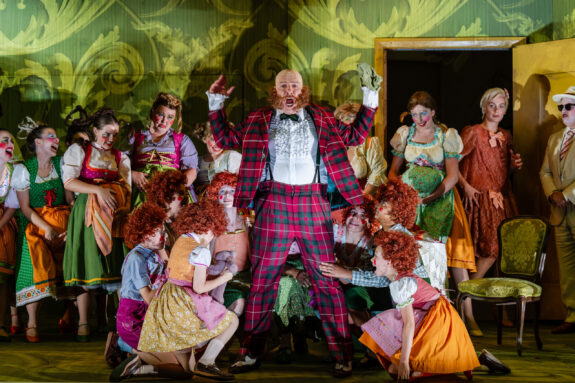
Seeing the drama as a fairly modern American perspective on older, socially stratified European society also tells its own particular story. Elements of the absurd, nostalgia, and cultural and social incongruity cohere in this depiction of ridiculous figure of Baron Ochs, a nobleman whose old rural estate places him and his antiquated status rather behind that of the modern metropolitan elite of the other characters. With bushy ginger hair and sideburns, here he is a Highlands laird in tartan suit, with the whiff of romanticised exoticism that background sometimes entails, particularly in the context of American film and drama, but also with the implication of his remoteness from real political relevance during the centuries of the United Kingdom’s existence. Even so, he also plays with roles and appearances at Faninal’s house in seeking to swap his idiosyncratic version of evening dress (red socks and cummerbund, co-respondent shoes) with the refinement of court dress by sporting a periwig. His retinue are a decidedly odd group of country bumpkins, two of them like huntsmen who have strayed in from Der Freischütz.
The tavern scene of Act III is cast as a bordello, becoming the setting for his attempted courting of Mariandel (Octavian in disguise) as well as for the feverish vision of cocottes and the brood of supposedly illegitimate children, like a surreal cross between Hogarth’s already satirical sequence Marriage A-la-Mode and Buñuel, again mixing different times and media. There is also ambiguity at the very end when Octavian and Sophie step out of the neon-framed set of the tavern/bordello when they ask themselves whether what they now experience is a dream. It seems that their relationship is also a fanciful delusion, and that the illumined frame confirms that they have simply played their parts in a film or drama, since they don’t actually address or engage with each other, except to walk demurely hand in hand back into that room – itself lodged within the bigger stuccoed room of the palace that is also now similarly framed to complete, in good theatrical fashion, the breaking of those fourth walls.
A further, endearing element of mythical fantasy arises from recasting the silent figure of the Marschallin’s servant Mohammed as the impish figure of Cupid, played with winning mischief by Kamari-J’siah Robinson. In authentic 18th-century dress and wig, he might also as well be a young, mercurial Mozart, the composer of bewitchingly enchanting music whom Strauss revered above all others, and whose Marriage of Figaro was the source of inspiration to him and Hofmannsthal for this opera. (One also thinks of the adorable portrait of the seven-year-old composer in the lilac suit given to him by the same Empress Maria Theresa in whose era the opera is rooted.)
It is in keeping with the production’s deliberate staginess that Niamh O’Sullivan and Soraya Mafi are bold and mature sounding as Octavian and Sophie respectively, rather than innocent, the latter by no means a submissive daughter but commanding her parents in what she wants. O’Sullivan adopts a seductively deep tone, as Octavian reflects philosophically in his post-coital dialogue with the Marschallin in Tristan-esque fashion on ‘I’ and ‘you’, before she switches seamlessly into a Germanised Cockney for the character’s female disguise.
But there is strangely little chemistry between the Marschallin (Matilda Sterby) and the randy, Cherubino-like Octavian in Act I, and even before the former becomes serious with thoughts of passing time, she is stiffer than he. There is a slight brittleness and reticence in Sterby’s voice, though she brings poise and radiance to the Trio and in many ways is an ideal Straussian soprano. But it’s curious when Sophie – lavish casting with Mafi in this comparatively small role – leaves a more decisive musical impression when it should be the Marschallin who has more charisma and presence.
Andreas Bauer Kanabas is an irrepressible Baron Ochs with a solid vocal core but which he overlays with coarse hollow vowels to express the character’s lack of refinement, compared with which Ben McAteer is a model of nervously held comportment in the role of the upwardly mobile bourgeois Faninal. Robert Murray and Siân Griffiths take on the parts of the informers Valzacchi and Annina with comical flair, and Egor Zhuravskii is an earnest, vocally urgent Italian tenor.
Finnegan Downie Dear conducts the Philharmonia Orchestra in Eberhard Kloke’s reduced transcription of the score. Their reading generally benefits from the instrumentalists’ nuanced and committed performances, and a certain flowing agility in the long continuous stretch of each act overall. Streamlined textures instil a luminous quality which brings the music somewhat closer to the galant elegance of the 18th century, and some delicate percussive sonorities more to the fore than usual, quite apart from the readily identifiable rose motif; smaller numbers perhaps also evoke somewhat more the bands of Broadway musicals and films which lie behind the 50s setting here. But I guess I am not the only listener who would have relished more opulence in the Trio.
Nevertheless, it is often too easy for Der Rosenkavalier to become an indulgent exercise in mere visual or choreographic luxury and nostalgia. This production maintains the opera’s air of high comedy alongside the sharp bite of satire and irony in its knowing interplay of time and memory which provokes us to remain alert and engaged and not settle for easy familiarity.
Curtis Rogers
Featured Image: Andreas Bauer Kanabas (Baron Ochs), Niamh O’Sullivan (Octavian), Robert Murray (Valzacchi) © Julian Guidera
Production:
Director – Bruno Ravella
Designer – Gary McCann
Lighting designer – Malcolm Rippeth
Chorus master – Sasha Johnson Manning
Cast:
The Marschallin – Matilda Sterby
Baron Ochs – Andreas Bauer Kanabas
Octavian – Niamh O’Sullivan
Sophie – Soraya Mafi
Herr von Faninal – Ben McAteer
Marianne Leitmetzerin – Gweneth Ann Rand
Valzacchi – Robert Murray
Annina – Siân Griffiths
An Italian tenor – Egor Zhuravskii
A Notary – James Geidt
A Commissar of police – Simon Wilding
The Marschallin’s major-domo – SangEup Son
Three noble daughters – Ana-Carmen Balestra, Llinos Haf Jones, Clover Kayne
A Milliner – Ceferina Penny
An Animal seller – Rhys Meilyr
Faninal’s major-domo – Alfred Mitchell
An Innkeeper – Tomos Owen Jones
Boots – Seán Purtell
Leopold – Samuel Collins-Webb
Cupid – Kamari-J’siah Robinson
Lackeys – Stephen Walker, Joe Matt Murphy, Benedict Munden, Ambrose Connolly
Waiters – Matthew Sotillo-Cooke, Rhys Meilyr, Sam Young, Joshua McCullough