 United Kingdom Longborough Festival Opera 2026 [3] – Verdi, Macbeth: Soloists, Longborough Festival Opera Chorus and Orchestra / Nil Venditti (conductor) Longborough, Gloucestershire, 1.7.2026. (CP)
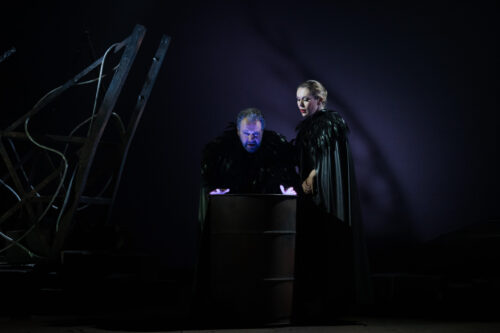
Two rising stars took the plaudits on opening night of Longborough’s first-ever production of Verdi’s Macbeth. Soprano, Viktoriia Balan made a stunning debut in the role of Lady Macbeth. With her glorious soprano voice she is an instant success. Deserving a special mention, too, is the star in the pit, namely conductor Nil Venditti. She has vast reserves of energy and achieves fine brass playing to compete with the busy percussion section and its dramatic concert bass drum. Excellent wind performers (oboe and clarinet); musicians capable of responding quickly to Venditti’s demands for change of tempo and changes of pace worked well during Lady Macbeth’s cabaletta ‘Or tutti sorgete’ and ‘Trionfai! Securi alfine’.
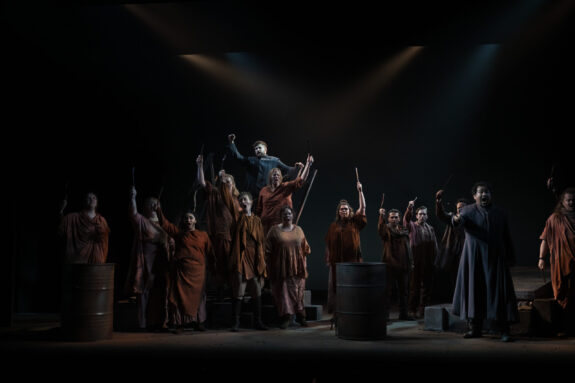
At times during dark moments on the stage the music challenges the players; at other times for audience members the music, is profoundly immersive. It was an exceptional night musically, in no small part due to the brilliance of the chorus, with the professionals, as witches, messengers and nobles, working seamlessly with the exceptional talent within the Longborough Youth Chorus and the Longborough Community Choir. Credit for such a cohesive operation must go to David Eaton, assistant conductor and chorus master.
Matching the voice to the characters of Macbeth (Mark Stone) and Banquo (John Molloy) is an achievement for which Director, Karolina Sofulak will be remembered. Stone and Molloy are known to Longborough audiences, they combine most effectively during their meeting with the witches as they commit to prophecies. Stone has the baritone voice Verdi spent much time searching for in the mid-1840s, months before rehearsals began in 1846. He gives a very thoughtful performance, notably his confessional ‘Pietà, rispetto, amore’ as he is made aware of the approach of Birnam (not Burnham!) Wood before the battle which heralds his demise. Molloy’s bass voice travels well, even when he reappears as a ghost toward the end of Act II whilst buried in the plinth which serves as a grave throughout the production – King Duncan was buried in this same plinth! Jung Soo Yun is the other male whose voice was memorable, singing the role of Macduff. His stage presence is significant, his tenor voice full at times of both beautiful colours and some dark emotional responses when mourning the death of his wife and children; his confrontation with Macbeth is a dramatic scene. Tenor and former Emerging Artist, Rhydian Jenkins is a youthful sounding Malcolm, the beneficiary of Macbeth’s death as he becomes King.
The star, the very talented soprano, Viktoriia Balan, makes a lovely pairing with baritone Stone, their quickfire exchanges echoed by the stimulated orchestra. Tenderness in her voice is sometimes replaced by chilling outbursts. With many more artists on the stage at one time than is usual at Longborough, Movement Director, William Byram deserves much credit. How he managed to fit artists into the skeletal cage-like feature was enterprising. Not only was there limited space but the danger of snagging costumes was a distinct possibility. Lighting designer, Ben Ormerod once again produced a creative lighting plot with contorted strip lighting to indicate flashes of lighting, a most effective feature. Two huge oil cans, used by the witches and messengers for various deposits; when necessary, these were illuminated to give a sense of fire. On just one occasion the actors were hidden from view in an oversupply of theatrical fog: apparently the smoke machine malfunctioned and the barrel was quickly removed from the stage to switch it off. The large chorus helps shape the performance using their movements, their spirited reactions to dramatic events and above all their impeccably well-drilled singing.
Act I opens with prominent woodwind playing as Macbeth and Banquo arrive to be hailed by the witches. The Macbeth and Banquo puppet show for those messengers whom Macbeth believes are the witches is designed to represent the manipulation of which he is capable. In Act IV the puppet show returns in a melodramatic scene with Macbeth acknowledging his failings, recognising the destruction wrought when ambition goes unchecked by moral constraints. Designer, Kimie Nakano is enjoying a remarkable season with LFO. Her clever, innovative skeletal cage-like structure, puppet show and apparition scene in Macbeth continue her Tristan und Isolde success (review here).
The music is an overwhelming triumph with LFO Orchestra Leader, Kirsty Lovie building the bridge between the conductor and the players, many of whom continue to enjoy success with Anthony Negus as performances of Tristan und Isolde continue until 18 July, still the hottest ticket in town!
With the success of the two new stars, this first production of Verdi’s Macbeth will give the LFO team encouragement to break new ground.
Clive Peacock
Featured Image: Longborough Festival Opera’s Macbeth © Matthew Williams-Ellis
Production:
Director – Karolina Sofulak
Assistant Director – Caro Lutz (Emerging Artist)
Designer – Kimie Nakano
Lighting designer – Ben Ormerod
Movement director – William Byram
Assistant Conductor and Chorus master – David Eaton
Cast:
Macbeth – Mark Stone
Viktoriia Balan – Lady Macbeth
Banquo – John Malloy
Malcolm – Rhydian Jenkins
Macduff – Jung Soo Yun
Herald – Lawrence Gillians
Lady in Waiting – Bernadette Johns
Doctor – Connor Baiano (Emerging Artist)
Apparition – Rachel Hughes (Emerging Artist)
Assassin – Fraser Robinson (Emerging Artist)
Servant to Macbeth – Howang Yuen (Emerging Artist)