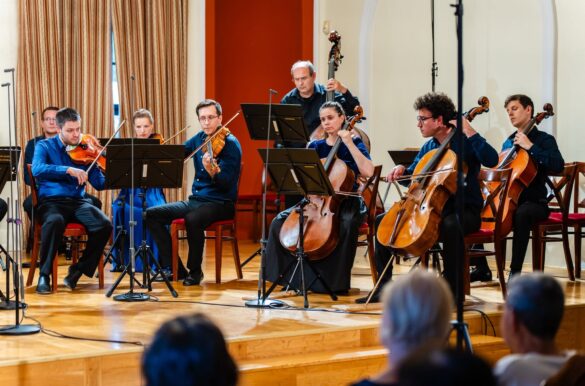
 Hungary Hommage á János Rolla: Otto Antikainen (violin), Anima Musicae Chamber Orchestra / László G. Horváth (leader). Óbudai Társaskör Budapest, 20.6.2026. (AK)
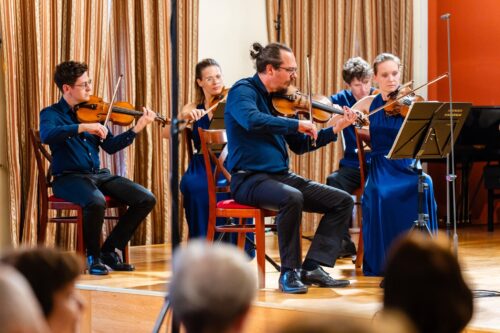
Haydn – Symphony No.1, D Major
Mozart – Violin Concerto in D Major, KV 218
Mendelssohn – String Quartet in A Minor, Op.13 (orchestral version)
The musical riches of Hungary, in particular of Budapest, are a marvel to behold at all times but it was especially so at my recent visit during the last week of June 2026. The three-day international Kurtág conference (18th-20th June) hosted several excellent musicologists as well as Kurtág concerts in the presence of the 100-year-old composer. And there were also the Wagner Days (18th-21st June), with Ádám Fischer apparently conducting his last Ring cycle (review here) …although hopefully not. At the same time, 19th-21st June, the Anima Musicae Chamber Orchestra hosted a celebration of chamber music while paying respect to important musicians, no longer with us, who shaped the progress of younger Hungarian chamber musicians.
The three-day Anima Musicae celebrations included talks about Rita Wagner, Frigyes Sándor, János Rolla, János Devich and András Mihály – each of whom had a full concert dedicated to their memory. Of these musicians, Frigyes Sándor and János Rolla are of particular importance to today’s Hungarian chamber orchestras.
The Franz Liszt Chamber Orchestra was formed by graduates of the Liszt Academy in 1963. Under the leadership by their former tutor Frigyes Sándor (1905–79) they soon emerged as an exceptional world-class chamber orchestra. In 1973, János Rolla – a member of the group from its foundation – became the leader of the orchestra and directed the group in cooperation with Frigyes Sándor until the latter’s death in 1979. The following four decades saw Rolla and the orchestra achieving qualities as well as fame which other chamber orchestras could have not even dreamt of.
Hats off to the Anima Musicae Chamber Orchestra for giving credit where credit is due. And, crucially, hats off to them for trying to follow in the footsteps of Rolla and his Franz Liszt Chamber Orchestra. The current Franz Liszt Chamber Orchestra seems to have changed direction from the old model: their priorities fall in line with the practicalities of the 21st century. I am not knocking their concerts – several of which I reviewed favourably – but their methods seem to have become extravert while Anima Musicae is more in line with Rolla’s introvert music making.
The concert dedicated to Rolla fell on Anima Musicae’s birthday – the group was formed on 20th June 2010. Anima Musicae’s intimate and unpretentious music making was a worthy tribute to János Rolla as well as to their leader László G. Horváth.
Their soloist for this concert, the 26-year-old Finnish violinist Otto Antikainen, is a different type of musician (although in Finland he studied with a Hungarian violin teacher). Bold, confident and not afraid of any musical statement, Antikainen has clear ideas of phrasing and happy with long solo cadenzas. He also has clear sense of musical humour which he tastefully displayed. Somewhat to my surprise, Antikainen played the concerto from music (that is from an iPad which he ‘pedalled’ for page turns). Did he play from music because the orchestra too played from music? Antikainen’s performance was beyond approach so I cannot complain. However, I enjoyed his encore – Bach’s C major Sarabande played beautifully from memory – more. Either way, Antikainen is likely to have a much-deserved soloist career.
Let me add my own comments to Anima Musicae’s thoughtful contribution to chamber music masters of the past. In my long decades of musical experiences, I have never come across anybody like Frigyes Sándor and, in particular, János Rolla. They were humble giants of music making at its best. RIP.
Agnes Kory
Featured Image: Anima Musicae Chamber Orchestra © 4K Media Studio Kft