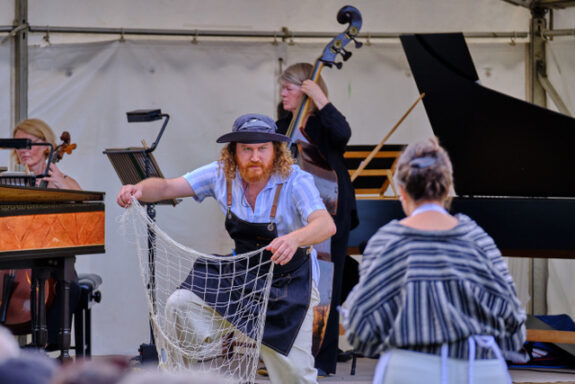
 United Kingdom New Chamber Opera – Haydn, Le pescatrici: Soloists, The Band of Instruments / Steven Devine (conductor). New College, Oxford, 1.7.2026. (CR)
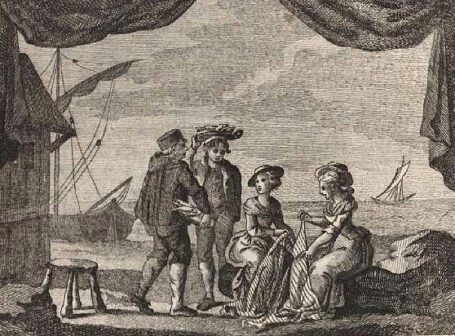
If it had not been for a fire at the Eszterháza court theatre which destroyed part of the score, Haydn’s delightful operatic comedy The Fisherwomen (1770) might be better known as a formative work in the emergence of opera buffa, not least as it sets a libretto by the literary pioneer of that genre, the Venetian Carlo Goldoni. It is thanks to the great Haydn scholar HC Robbins Landon that the work can now be performed at all, on account of his reconstruction of it in the 1960s.
New Chamber Opera’s annual summer garden production brought the work out into the open air at New College even if, in Oxford, it is nowhere near the sea. But the banner across the garden pavilion for Mastricco’s wharf-side restaurant which affirms ‘In cod we trust’ – in the same week that marks the 250th anniversary of the American Declaration of Independence – wittily reminds us of the marine business and location of the characters in this opera, set in Taranto. That theme affords the libretto’s translators no end of comical and satirical fun with those characters’ situation and pretensions, with almost endless opportunities for puns on the idea of fish and catching them, metaphors and proverbs on this subject used ironically, and rhymes on that word. Rather like the famous ‘tuna fish’ aria of Gassmann’s near-contemporary skit L’opera seria (review here) which sends up the format of the simile aria in that eponymous style of serious opera, so the text’s allusions here and the actions of the two humble pairs of lovers in exchanging catches of fish also satirise the high-minded conventions of that older genre, which was now largely supplanted by opera buffa with its down-to-earth characters and comic scenarios.
The quartet of singers who take the roles of those whimsical lovers relish the opportunities here for flirtatious jests with each other, and tantalise the audience ranged alongside their performing space with jokes and unexpected interactions beyond the notional fourth wall – Kate Semmens a wily and occasionally haughty Nerina, in love with Will Anderson’s dependable Burlotto who spoofs the coloratura of his first aria; and Áine Smith’s soaring, masterful virtuosity as Lesbina, partnered with Alex Haigh’s lighter-voiced tenor and more wilfully mischievous Frisellino as the other enamoured male. When Lindoro, Prince of Sorrento arrives, seeking the daughter and heir of the murdered Prince Casimiro, there is more cause for satire and buffoonery as the two young fisherwomen each imagine themselves to be that long-lost royal successor. Their boyfriends belittle their pretensions with a mock act of homage, satirising the courtly forms of Baroque dances and opera, just as Mozart’s Figaro will do in ‘Se vuol ballare’ when he apostrophises and demeans Count Almaviva. When, in the third act they seek to teach the girls a lesson for their willingness to abandon them in favour of Lindoro and seek to seduce them disguised as his alleged aristocratic cousins, their trial of that quintessentially 18th-century virtue of honour anticipates in miniature, by nearly twenty years, the scenario of Così fan tutte. (Given Lorenzo Da Ponte’s wide knowledge of Italian literature, especially in the republic of Venice where he worked before collaborating with Mozart, he must surely have known Goldoni’s libretto.)
The real heir is found in another fisherwoman, Eurilda, who had been adopted by Mastricco and kept in safety after her father’s throne was usurped by Oronte, before she is taken off by Lindoro as his partner, to be restored to her rightful position. Both Anneka Vetter and Mattias Lundberg have an appropriately restrained, earnest bearing in these noble roles which are effectively a hangover from the older tradition of opera seria. Vetter expresses a tenderness and delicacy that is leavened with some humour which prevents Eurilda from being a mere sentimentalised victim, while Lundberg brings a genial gravitas to the Prince, unruffled even in the swirling drama of his aria in which he reflects on Oronte’s crime (a rarity for such an opera at this time in that it is written in the minor key – it calls to mind Haydn’s equally forceful motet Insanae et vanae curae). As her adoptive father, Arshak Kuzikyan’s deep, sinewy baritone voice conveys fatherly reassurance with his darkly satin melodic lines.
Steven Devine and the one-to-a-part Band of Instruments impart an irresistible sparkle and vivacity to Haydn’s setting, which is no less than the music deserves. Although still a fairly early work in the composer’s output, many of the numbers are memorable and vocally idiomatic. With Haydn’s operas being still too little known and appreciated, this spirited production does the composer a tremendous service in bringing such a rarity to greater attention.
Curtis Rogers
Featured Image: New Chamber Opera’s Le pescatrici © Hugh Warwick
Production:
Director – Michael Burden
English translation – Gilly French and Jeremy Gray
Cast:
Eurilda – Anneka Vetter
Lindoro – Mattias Lundberg
Nerina – Kate Semmens
Burlotto – Will Anderson
Lesbina – Áine Smith
Frisellino – Alex Haigh
Mastricco – Arshak Kuzikyan