 United States The Glimmerglass Festival [4] – Spears, Fellow Travelers: Soloists, Glimmerglass Orchestra / Kelly Kuo (conductor). Alice Busch Opera Theater, Cooperstown, 19.7.2026. (RP)
With Gregory Spears and Greg Pierce’s Fellow Travelers, The Glimmerglass Festival examined a period when national security anxieties became intertwined with political persecution and personal surveillance: the Red Scare and its parallel campaign, the Lavender Scare.
The Red Scare was a period of intense fear and suspicion in the United States during the late 1940s and 1950s, when concerns about communism shaped national politics and public life. Politicians and government officials investigated and accused many Americans of communist affiliations, often with little or no evidence. Closely connected was the Lavender Scare, which targeted gay and lesbian government employees as supposed security risks based on the false belief that they could be blackmailed or manipulated by foreign agents. Thousands of people were denied employment, forced to resign or subjected to invasive investigations and harassment, demonstrating how Cold War anxieties were exploited to advance political agendas and discrimination.
Spears and Pierce based their opera on Thomas Mallon’s 2007 novel of the same name. The opera premiered at Cincinnati Opera in 2016 and has since been staged by more than 15 companies in the US and abroad. Real Washington powerbrokers populate the novel and opera, and a 2023 television adaptation has brought broader attention to the historical forces the opera explores.
Pierce distilled the novel’s essence into a libretto that preserves both the complexity of a love story between two male government employees and the era’s political and moral tensions. Timothy Laughlin, raised in Manhattan’s Hell’s Kitchen and shaped by both his Catholic faith and his sexuality, has a chance encounter with Hawkins ‘Hawk’ Fuller, a rising State Department official and scion of the WASP establishment. The opera’s tragedy lies in the fact that both men understand the danger surrounding them, yet they respond to that danger in fundamentally different ways.
For Tim, a man for whom sex and intimacy are inseparable, Hawk is a magnetic force – the great love of his life. Hawk’s feelings for ‘Skippy’, his pet name for Tim, are equally intense, but he is also a serial philanderer whose ambition demands compromise and deceit. After his secretary, Miss Lightfoot, reports him to the State Department’s M Unit, the secretive investigative group created to identify and remove employees suspected of homosexuality, Hawk is summoned for interrogation. The investigator asks him to walk across the room so they can judge whether he ‘minces’ or ‘sashays’, behaviors the unit considers evidence of homosexuality. Cool under pressure, Hawk passes the examination, revealing the absurdity of a system built on stereotypes and clichés.
To commemorate the opera’s tenth anniversary, Kevin Newbury, director of the original Cincinnati Opera production, reunited the creative team to create a touring production. The streamlined set is both functional and effective, establishing mood and place with economy.
Against gray, faux-marble walls, rotating bookshelves transform into wood-paneled offices. St. Peter’s Church, where Tim wrestles with his conflicting emotions after his first night with Hawk, is represented by a large crucifix flanked by hanging lamps.
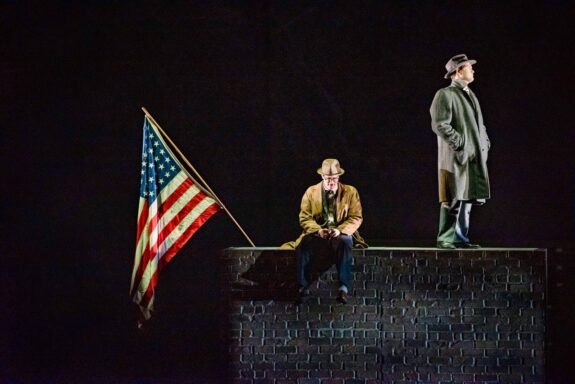
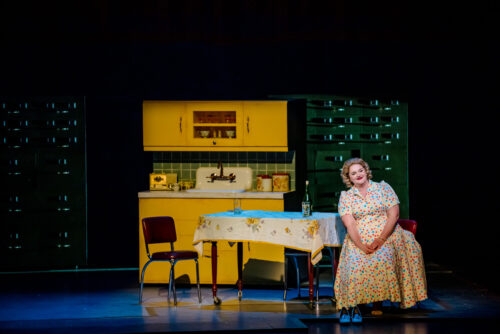
Mary Johnson, Hawk’s colleague and one of the story’s moral centers, confronts Tim about the dangers of pursuing the affair in a bright yellow kitchen. She becomes the opera’s clearest reminder that the Lavender Scare both destroyed individual romances and constrained the lives and ambitions of anyone who challenged the era’s prescribed identities. Tim and Hawk’s goodbye takes place on the roof of the Old Post Office Building, beneath the American flag, before Tim leaves to enlist in the Army and escape their all-consuming relationship.
Colin Atkins bares himself emotionally and physically in his portrayal of Tim. His ability to convey Tim’s passion, religious fervor and self-awareness through acting is matched in his expressive lyric tenor. Even at Tim’s most desperate moments, Atkins conveys the wonder and joy of having experienced unconditional love, even granting Hawk absolution for the devastating betrayal that ultimately separates them. Joseph Lattanzi created the role of Hawk and has performed it repeatedly since its premiere. He has refined Hawk’s brazenness, conceit and sexual confidence into a compelling stage portrayal. Guilt is not part of Hawk’s vocabulary, whether toward Tim or his wife, Lucy, yet Lattanzi reveals flashes of vulnerability beneath his implacable surface.
Keely Futterer’s Mary Johnson captures the conflicts facing a 1950s career woman raised as a proper Southern girl in Washington’s political world. Mary’s own sexual liberation carries consequences comparable to Tim’s struggles. Futterer brings compassion and self-awareness to the role with a beautifully direct, lyric soprano. Erik Nordstrom, who played Jud in Glimmerglass’s Oklahoma!, brings similar intensity – but greater cynicism – to Tommy McIntyre, Tim’s older colleague and superior. He serves as Hawk’s darker counterpart, embodying the gossip, ambition, fear and political survival instincts of the Red Scare era. Kaileigh Riess is brittle and malicious as the vigilante Miss Lightfoot, while Yichen Xue earns one of the production’s few laughs as Senator Potter, flashing the lights on his canes which inspires Tommy’s joking nickname, ‘Citizen Canes’.
In the pit, Kelly Kuo unites Spears’s contrasting musical languages – the heightened conversational quality of the vocal writing, minimalist impulses and early music and new-baroque echoes – into a cohesive whole. He is particularly effective in the minimalist passages, creating nervous tension through carefully shaped repetition, phrasing and articulation. His sensitivity as a conductor allowed moments of intimate tenderness to exist beneath a seething sense of suspense. The 17 musicians of the Glimmerglass Festival Orchestra performed with the same emotional commitment as the singers onstage.
The final scene unfolds against a montage of photographs of government employees and military personnel who were investigated, dismissed or excluded because of their sexual orientation during the Lavender Scare. Although outside the opera’s narrative, the images embody the Lavender Names Project’s effort to preserve the stories of those affected. The photographs show smiling people proud of their service to their country but excluded from America’s promise that all are created equal.
During a pre-performance panel discussion, Spears noted that when he began work on Fellow Travelers, the opera was an effort to resurrect an almost forgotten chapter of American history. Its renewed relevance reflects the persistence of debates about government policy, identity and belonging. Glimmerglass’s revival demonstrates why this opera continues to resonate: it transforms historical injustice into an intimate human story, reminding audiences that political decisions are ultimately lived through individual lives.
Rick Perdian
Featured Image: Colin Aikins (Timothy Laughlin) and Joseph Lattanzi (Hawkins Fuller) © Brent DeLanoy
Production:
Libretto – Greg Pierce
Director – Kevin Newbury
Associate director and Intimacy director – Sara E. Widzer
Sets – Vita Tzykun
Costumes – Devario D. Simmons
Lighting – Thomas C. Hase
Cast:
Hawkins ‘Hawk’ Fuller – Joseph Lattanzi
Timothy Laughlin – Colin Aikins
Mary Johnson – Keely Futterer
Miss Lightfoot – Kaileigh Riess
Lucy – Laura Santamaria-Mendez
Tommy McIntyre – Erik Nordstrom
Sen. Charles Potter / General Arlie / Bartender – Yichen Xue
Sen. Potter’s Assistant / Bookseller / Priest / Technician / Party Guest – Jose Olivares