 United States The Glimmerglass Festival 2026 [3] – Puccini, Madama Butterfly: Soloists, Glimmerglass Festival Chorus and Orchestra / Joseph Colaneri (conductor). Alice Busch Opera Theater, Cooperstown, 19.7.2026. (RP)
Beneath clear blue skies, it was a doubleheader at the Glimmerglass Opera Festival on Sunday; the weather-delayed premiere of Gregory Spears and Greg Pierce’s Fellow Travelers would follow that evening. Forgive the baseball pun, but Cooperstown is home to the National Baseball Hall of Fame and Museum, which attracts more than 500,000 visitors annually.
First up was Puccini’s Madama Butterfly in Francesca Zambello’s powerful and provocative 2014 production. Zambello tells the story largely from the perspective of the American expatriate community in Nagasaki. For the Americans, Japan is largely an exotic interlude where the men pursue fleeting romances with few consequences or responsibilities. For the Japanese, however, it is a period of profound political, social and economic transformation following Commodore Matthew Perry’s arrival in 1853 which ushered in Japan’s opening to the West.
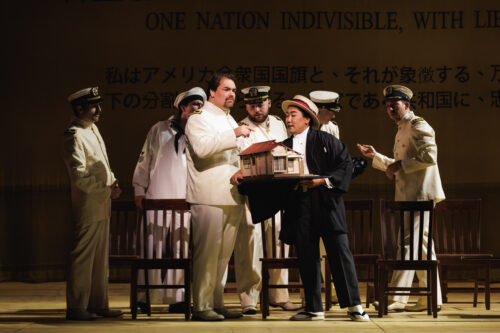
The production’s most significant departure comes in Act I, where the action shifts from the traditional Japanese hilltop house specified in the libretto to the American consulate. Rather than inspecting his new home, Lt. B. F. Pinkerton admires the scale model that Goro has provided. The resulting tension between libretto and staging is evident but ultimately proves less jarring than one might expect. Cio-Cio-San is one of many Japanese women seeking the attention of the American authorities. While she eagerly prepares to marry Pinkerton, the other women – many accompanied by small children – appear to be seeking information or financial support from their former American husbands. It foreshadows the fate that awaits Cio-Cio-San.
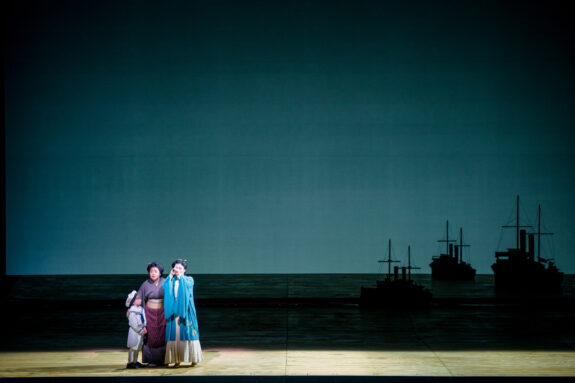
Apart from the consulate office, the set is spare yet evocative, suggesting Japanese architecture and design with a few carefully chosen elements. Large banners resembling shoji screens divide the stage. Lighting plays an essential role in shaping the atmosphere, whether in the warm blush tones of the Flower Duet, a moon veiled by clouds during the Humming Chorus, the gentle sunrise following Cio-Cio-San’s futile night-long vigil or the lurid crimson that floods the stage after her suicide. The costumes anchor the action in the mid-nineteenth century while subtly charting the cultural changes reshaping Japan. Goro eschews traditional Japanese dress in favor of fashionable Western attire. The American presence looms over the production, nowhere more strikingly than in the silhouettes of warships anchored in Nagasaki Harbor.
Japanese soprano Eri Nakamura’s Cio-Cio-San was an exquisite creation. Her movements were flowing and graceful at first but grew agitated as her hopes were extinguished. Ultimately, they became the desperate fluttering of a trapped butterfly, the fate she had feared from the outset. Maestro Joseph Colaneri’s grasp of the drama permitted ‘Un bel dì, vedremo’ to emerge organically from the score, and Nakamura transformed it into an anthem of hope.
Nakamura fully realized the collapse of Cio-Cio-San’s dreams, not only in a searing ‘Tu, tu, piccolo iddio!’ but also in the pivotal scene that precedes it. Rather than investing her words to Kate Pinkerton with warmth, Nakamura sang them with an intensity that resonated with both bitterness and the code of honor that defined her. The inscription on her father’s tanto reads: ‘He who cannot live with honor must die with honor’.
Eric Taylor’s callous Pinkerton shirked responsibility yet eagerly anticipated the sensual delights that awaited him on his wedding night. His full-bodied, gleaming tenor, glowing with ardor, was equally seductive. The vacuousness of Taylor’s Pinkerton made his final cries of ‘Butterfly’ all the more harrowing. Filipino-Chinese mezzo-soprano Michelle Mariposa brought out Suzuki’s warmth, nobility and humanity as she stoically stood beside Cio-Cio-San. Her vibrant, open sound conveyed deep feeling and contrasted beautifully with Nakamura’s more silvery voice and her emphasis on clarity, line and expressive nuance.
Troy Cook’s amiable Sharpless indulged Pinkerton’s romantic escapades, albeit with growing unease, before becoming openly critical as his worst fears came to pass. His forthright baritone anchored Pinkerton’s ‘Addio, fiorito asil’, and it was devastating in the intensity of emotion with which he, Mariposa and Taylor sang, matched by equally impassioned playing from the orchestra. Randy Ho’s Goro was as much a Yalie as a Japanese marriage broker, while refreshingly avoiding the schtick so often associated with the role. Woosik Nam’s Bonze exploded onto the stage with the appropriate fury, while Joseph Park’s vocally and physically imposing Yamadori teetered on geta, the traditional Japanese wooden sandals. In keeping with the tenor of the production, Erin Alford’s Kate Pinkerton had an air of entitlement rather than sympathy.
Colaneri conducted with his customary mastery, drawing equally committed playing from the orchestra. Like the singing, the orchestral and choral performances were rich in emotional immediacy, capturing both the beauty and brutality of Puccini’s score. Together with Zambello’s compelling, thought-provoking production, it made for a profoundly affecting Madama Butterfly.
Rick Perdian
Featured Image: Michelle Mariposa (Suzuki) and Eri Nakamura (Cio-Cio-San) © Brent DeLanoy
Production:
Original director – Francesca Zambello
Revival director – Joshua Horowitz
Sets – Michael Yeargan
Costumes – Anita Yavich
Lighting – Robert Wierzel
Chorus director – Katherine Kozak
Cast:
Cio-Cio-San – Eri Nakamura
Pinkerton – Eric Taylor
Suzuki – Michelle Mariposa
Sharpless – Troy Cook
Goro – Randy Ho
Yamadori – Joseph Park
Bonze – Woosik Nam
Kate Pinkerton – Erin Alford
Commissioner – Yichen Xue