
 United Kingdom Edinburgh International Festival [9] – Verdi, A Masked Ball (Un ballo in maschera): Soloists, Dancers, Chorus and Orchestra of Zurich Opera / Gianandrea Noseda (conductor). Edinburgh Festival Theatre, 26.8.2026. (GT)
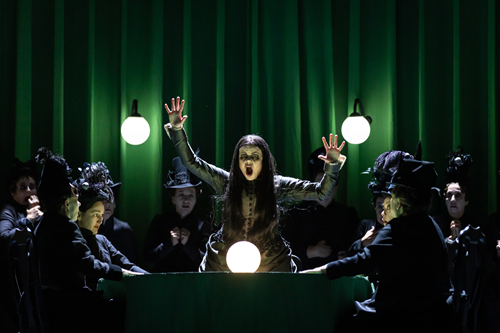
One of the highlights of the final week of the 2026 Edinburgh International Festival: Zurich Opera’s production of Verdi’s Un ballo in maschera presented four evenings in a fully staged production. Certainly, the two operas in concert at the Usher Hall, Mozart’s Don Giovanni and Richard Strauss’s Elektra, were among the most successful musical events in the 2026 Festival; nevertheless, it was a relief to visit top-class opera at Edinburgh’s Festival Theatre, with its excellent acoustics and huge stage facilities at the heart of the final week here.
Verdi’s un ballo in maschera was embroiled in legal issues after its composition, with the regicide at its heart drawing the wrath of the Rome censors; instead of being set during the reign of Gustav III in Sweden in 1792, Verdi and his librettist Antonio Somma moved the setting to America in the 1600s, with Richard, the Earl of Warwick, as the main protagonist and his assassination at the finale. In this 2024 production, rather than setting it in the 16th century, Adele Thomas’s staging is in the late 19th century in Boston following the Civil War, during the Gilded Age.
Thomas made a major change in the composer’s opera by showing us the dissection of Riccardo during the opening overture. As the first bars of the overture were heard, the curtains opened to reveal an autopsy in an operating theatre, with the black clothed chorus watching the surgeon remove the bullet from the corpse of Riccardo. We see Amelia burst in horrified, and Riccardo’s assassin, Renato, present. The director obviously believes she knows better than the librettist and, indeed, Verdi, how this opera should be shown. After this shocking scene, it could only improve, and thankfully it did, providing some of the finest singing of Verdi for some time here in Edinburgh. One has to question Thomas’s reasoning, however, and perhaps she believes that she is being overly clever, or is it another search for headlines?
Of the cast, we were fortunate that the production employed true Verdian singers in the main roles; Elena Stikhina’s Amelia was outstanding, with a rich soprano that reached the high notes and, when needed, a mezzo-voce. Her characterisation was sensitive, playing the role of a loyal wife, yet portrayed wrongly as Renato’s lover. The Ulrica of Yulia Matochkina was memorable for her powerful performance both vocally and in acting; her richly endowed mezzo-soprano voice was remarkable in its deeply exuberant tones. Especially memorable was her scene as the fortune teller in a bizarrely set, yet intriguing scene. Her first appearance here was as the soloist in Prokofiev’s ‘Alexander Nevsky Cantata’, from which she developed a fine career at the Bolshoi Theatre in Moscow.
Stephen Costello’s Riccardo was a highlight of the whole show with his complete portrayal of this complex role; he has a fluent tenor able to reach the most colourful notes and an actor with his voice. The Renato of Dalibor Jenis displayed fine acting and a subtle baritone, while Oscar was engagingly portrayed by Rebeca Olivera with her luxuriant coloratura, and another vocal highlight was the outstanding performance of Brent Michael Smith’s Samuel, portraying the evil, wicked character with a tremendous voice. He was matched by Stanislav Vorobyov’s Tom in a fine character performance of a villain. The other secondary roles were all performed with both great characterisations and voices. Gianandrea Noseda brought out all the beauty of Verdi’s score and captured the most sensitive elements of this outstanding opera, giving his singers every opportunity with marvellous and precise accompaniment. At the heart of the opera was the magnificent chorus, directed by Klass-Jan de Groot, who dominated every scene from the opening through to the final tragedy.
The sets and costumes by Hannah Clark were overwhelmingly dominated by dark greens and blues, assisted by Franck Evin’s subdued lighting that gave a tragic balance to the whole show. The costumes vary from the fin de siècle in the third act and the dance scene to the Folies Bergère ball scene. The revolving stage made the whole production easily effect a fast-moving transition from scene to scene. Emma Woods’s choreography was outstanding and another highlight of the whole evening; the dancing ranged from cartwheeling and tricks in Act II to the riotous Can-Can in the final scene of Act III
Zurich Opera in this visit to Scotland, underlined its outstanding status as one of Europe’s finest companies, and most of all, this production will be remembered for the vibrant singing by the soloists and the magnificent chorus and dancing, rather than for the opening scene. To bring the 2026 event to a close, there was much to admire and applaud, with some of Europe’s finest singers in a staging that avoided the garish Eurotrash productions presented by some of Europe’s most prestigious opera companies.
Gregor Tassie
Production:
Direction – Adele Thomas
Assistant Director – Steve Whiting
Choreography – Emma Woods
Lighting – Franck Evin
Sets and Costumes – Hannah Clark
Video – Tieni Burkhalter
Chorus director – Klass-Jan de Groot
Dramaturgy – Fabio Dietsche
Cast:
Riccardo – Stephen Costello
Renato – Dalibor Jenis
Amelia – Elena Stikhina
Ulrica – Yulia Matochkina
Oscar – Rebeca Olvera
Silvano – Steffan Lloyd Owen
Samuel – Brent Michael Smith
Tom – Stanislav Vorobyov
Judge – Martin Zysset
Servant – Tautvydas Slizauskas