
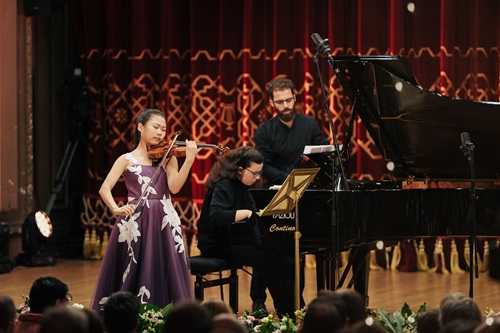
 Romania George Enescu Competition 2026 [3] – Various: Jenny Hyeonjeong Lee (violin), Marie-Ange Nguci (piano). Romanian Atheneum, Bucharest, 16.9.2026. (ES-S)
Ravel – Sonata No.2 in G major for Violin and Piano, M.77
Ysaÿe – Caprice d’après l’Étude en forme de valse de Saint-Saëns, Op.5
Beethoven – Fantasia in G minor, Op.77
Liszt – Années de pèlerinage, troisième année, S.163: ‘Aux cyprès de la Villa d’Este I (Thrénodie)’ and ‘Les jeux d’eaux à la Villa d’Este’
Prokofiev – Piano Sonata No.6 in A major, Op.82
Encore: Ravel – Cadenza from the Piano Concerto for the Left Hand
The 2026 George Enescu International Competition has featured a number of distinguished musicians appearing both as jurors and performers. On Wednesday night, Marie-Ange Nguci, a member of this year’s piano jury, appeared in recital with 15-year-old South Korean violinist Hyeonjeong Lee who became the competition’s youngest-ever runner-up when she won second prize and the Audience Prize at just 13 in 2024.
The program had an unusual format. Lee joined Nguci for Ravel’s Second Violin Sonata and Ysaÿe’s Caprice d’après l’Étude en forme de valse de Saint-Saëns – the latter not much more than a pendant to the substantial Ravel. After Lee’s departure, Nguci continued alone, with Beethoven and Liszt leading to Prokofiev’s Sixth Sonata.
There was an intriguing contrast between the two musicians. Despite her age, Lee projected the seriousness and reserve of a traditional interpreter while Nguci seemed the freer, more playful presence, approaching the music with a slightly ironic eye. In Ravel, however, these differences became an asset: the opening Allegretto often has violin and piano pursuing independent lines rather than engaging in conventional dialogue. Lee’s remarkably full tone combined restraint with assurance and her technique appeared faultless; Nguci was an acutely attentive partner. Blues brought a more overtly theatrical exchange, its banjo-like pizzicatos, sliding violin line and displaced accents playing against the piano’s dry, syncopated interjections. In the Perpetuum mobile, separation finally gave way to convergence, the violin’s near-continuous stream of semiquavers propelled by the piano towards a headlong conclusion.
In Beethoven’s Fantasia in G minor, Nguci resisted the temptation to turn the work’s fragmentary, improvisatory character into mere caprice. Through its abrupt changes of tempo, key and character, ideas and gestures temporarily found common ground only to diverge again, creating a sense of spontaneity without sacrificing an underlying logic. The succession of fleeting thoughts eventually gave way to the more sustained theme and variations, bringing a measure of stability to Beethoven’s restless Fantasia.
Nguci doesn’t seem content simply to adopt established interpretative conventions without passing them through her own sensibility. In the two selections from Liszt’s Années de pèlerinage, troisième année, she pared back the Romantic rhetoric without draining the music of color. Related yet distinct, the two pieces took on markedly different characters: ‘Aux cyprès de la Villa d’Este I (Thrénodie)’ was dark and introspective, its funereal character conveyed with austere restraint but without heaviness; ‘Les jeux d’eaux à la Villa d’Este’ opened into a more luminous world, its fluid sonorities acquiring a distinctly pre-Debussyan delicacy.
The recital’s pièce de résistance was its final work, Prokofiev’s Sixth Sonata. Nothing in its formidable technical demands seemed to trouble Nguci, but virtuosity was never an end in itself. The opening movement had plenty of bite and snarl, yet beneath its abrasive surface she repeatedly uncovered an unexpected vein of poetic sentiment. The second movement’s brittle, grotesque humor was sharply characterized without becoming percussive, while the slow waltz of the third unfolded with a dreamlike tenderness, its lyricism never quite free of unease. In the finale, the music’s ludic quality gradually acquired an eerie edge, its fractured dance rhythms at moments seeming to carry fleeting echoes of Prokofiev’s ballet music. As in the Ravel Sonata heard earlier, material from previous movements resurfaced, but here its return had a darker purpose, disrupting the finale’s forward rush and casting a shadow over the closing pages.
For her encore, Nguci returned to Ravel with the solo cadenza from the Piano Concerto for the Left Hand – an unconventional choice that neatly brought the evening full circle.
Edward Sava-Segal