 Germany Verdi, Rigoletto: Soloists, Chorus of Cologne Opera, Gürzenich Orchestra / Matteo Beltrami (conductor). Cologne Opera, 17.10.2026. (SRT)
The good burghers of Cologne have been without their opera house for the last 14 years, the house on Offenbachplatz having been shut for refurbishment at a rumoured cost of 1.5 billion euros. It reopened last month to a fairly ghastly new production of Der Rosenkavalier, whose musical virtues didn’t make up for an ill-fated Konzept staging. However, it runs in tandem with this revival of their 2019 Rigoletto, and this is the one to see. In fact, there is more drama in one scene of Verdi’s opera than there was in nearly five hours of Richard Strauss’s.
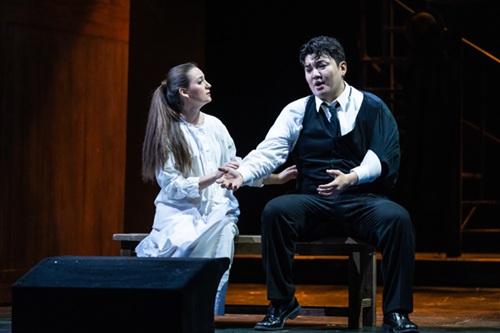
That is because this Rigoletto is built around a towering central performance of the title role. Korean baritone Insik Choi is very young for the part – too young, in truth, to have a daughter Gilda’s age – but that very youth is what makes Choi’s Rigoletto so interesting. He lacks the world-weary bitterness that more experienced baritones bring to the part, but in its stead he brings vigour, power and total identification with the role. The duality of the loving father and the cruel jester takes him to extremes in the first act, and the pity that he summons up in front of the courtiers in Act II is terrifying. The production wisely steers clear of any overt Oedipal connotations with Gilda, but they would be there to probe if a director chose to.
Gilda herself is sung with delicacy and fragility by Enkeleda Kamani, whose solos err on the side of safety, swerving some of the most exposed coloratura in Caro nome, but she is marvellous in the father/daughter duets, summoning up heartfelt pathos in Act I as well as doomed agency in Act III. Filip Filipović’s tenor isn’t a subtle instrument, and he sings most of his numbers like a bull at a gate, but all the notes are there, and he makes the love duet sound unusually exciting. Adriana Bastidas-Gamboa honks her way through Maddalena’s music with an alarming lack of nuance, but William Thomas booms convincingly as a black-voiced Sparafucile, and I like the way he emerged from and returned to the orchestra pit in his first appearance.
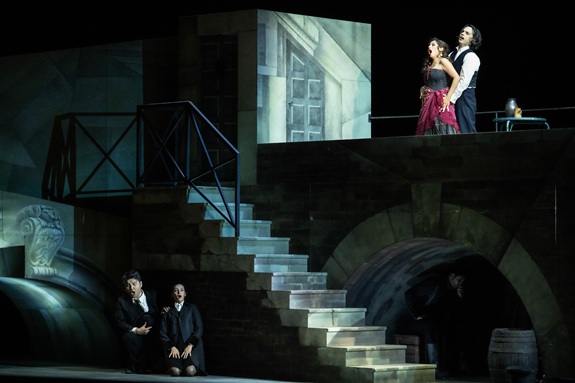
Katharina Thalbach’s production largely plays it straight, with the Duke’s palace given topsy-turvy sets to reflect the reverse morality of the court. Rigoletto’s house couldn’t be clearer, however, and Sparafucile’s multi-level hut has a convincing riverside setting. For the final duet, the entire set disappears leaving only Rigoletto and Gilda alone in the void; the effect is overwhelming.
The Gürzenich Orchestra play with forthright energy, and Matteo Beltrami conducts the score with Italianate vigour while bringing plenty of light and shade to bear in the support of his singers. The chorus sing with power throughout.
So with great singing, straightforward storytelling and vigorous dramatic power, this is a hit and deserves to be around for many more revivals.
Simon Thompson
Featured Image: Insik Choi (Rigoletto), Enkeleda Kamani (Gilda), Adriana Bastidas-Gamboa (Maddalena) and Ioan Hotea (Duke) © Matthias Jung
Production:
Director – Katharina Thalbach
Set and Costume designs – Ezio Toffolutti
Lighting design – Andreas Grüter
Choreography – Nadine Schori
Chorus master – Rustam Samedov
Cast:
Duke – Filip Filipović
Rigoletto – Insik Choi
Gilda – Enkeleda Kamani
Sparafucile – William Thomas
Maddalena – Adriana Bastidas-Gamboa
Giovanna – Regina Richter
Count Monterone – Christoph Seidl
Marullo – Tobias Lusser