
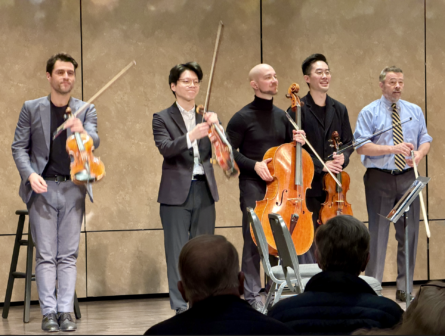
 United States Various: Edgar Meyer (double bass), Dover String Quartet (Joel Link, Bryan Lee [violins], Hezekiah Leun [viola], Camden Shaw [cello]). Cal Performances, Herbst Theatre, San Francisco, 27.3.2026. (HS)
Mozart – Divertimento in D major
Edgar Meyer – 2 Duets for Cello and Bass; Quintet for Strings
Mendelssohn – Quartet No.6 in F minor
Double bass virtuoso Edgar Meyer is also a formidable composer, and he has been at it for a while. His recital with the redoubtable Dover String Quartet looked back on some of his music from the 1990s – relatively early in his compositional life.
Meyer’s recent writing may be more refined, but the two Duets for Cello and Bass in the first half and the Quintet for Strings after intermission demonstrated just how fertile his compositional imagination has always been. His comfort with bluegrass (and sometimes jazz) gestures balances intriguingly against judicious use of grating dissonance, aspects which certainly set his music apart from the Mozart and Mendelssohn that surrounded it. His signature rhythmic vitality and irrepressible storytelling were already present in both pieces.
The short duets, written for performance with Yo-Yo Ma (and recorded on two well-selling albums), rely on offbeat time signatures (14/4 in the first, 5/2 in the second) that somehow manage to flow smoothly. Meyer and Camden Shaw, Dover’s cellist, bounced along merrily against tuneful melodies which shift from one to another so easily that most listeners probably don’t notice anything unusual. That put the focus on the lithe melodies and sweet counterpoint which sketched a range of pleasing harmonies. In the first duet, the players often finished each other’s tunes against lively syncopations. The second opened with a hymn-like intertwining of melodies, then loped along with a bluegrass-inspired rhythm that remained fresh due to the unusual time signature.
The two pieces sat happily between the opening Mozart Divertimento in D major and Mendelssohn’s String Quartet No.6 in F minor. The Mozart also reveled in dancelike rhythms and, atypical for the usually elegant Mendelssohn, his quartet was filled with agitation and occasional anger.
The Mozart felt unusually aggressive. First violin Joel Link and second violin Bryan Lee went for outward intensity, much of it louder than what one usually hears. The program note pointed out that Mozart’s hand did not write the title ‘divertimenti’ for the three pieces (of which this was one) in the original score. Scholars argue over whether the piece might have been meant for a string orchestra, given the inclusion of double bass. The way the Dover chose to play it did give us a taste of how a whole orchestra might have sounded, thanks to a robust articulation.
The rendition of the Mendelssohn also dug into the music with an intensity that replaced the buoyancy we usually associate with the composer. This emphasized the shifting moods, some of it serene but most of it grabbing one by the lapels. Meanwhile, violist Hezekiah Leun (filling in for Julianne Lee, who divides her time with the Cleveland Orchestra) fashioned lines that seemed to aim for elegance.
Surrounded by these mostly forceful interpretations, Meyer’s duets, despite their intricate rhythms, felt like taking a few soothing breaths. His quintet, written for the Emerson Quartet, premiered in 1995 and was recorded in 1998 with Meyer performing in both. Meyer’s idea in the first movement, a theme-and-variations crossed with a sort of passacaglia, seems to change tempos by juggling meter instead of actually speeding up and slowing down. The effect, under the guise of a pretty tune, was mesmerizing if occasionally cantankerous.
Meyer’s bass established a sort of bluegrass groove in the second movement to underline a tune that wandered into quarter tones from time to time. Unsettling as this could have been, it kept righting the ship enough to retain focus and finished with virtuosic flourishes on the bass. The third movement introduced fragments of a tune that did not quite join up into a full melody until more than halfway through, then finished with the melody finding its way through all 12 key signatures.
As intellectually-driven as most of this sounds, Meyer’s flair for melody and rhythm keep the gentle momentum. The finale, a bumptious, syncopated dance, veered this way and that before ending with admirable authority.
Harvey Steiman