
 United Kingdom Beethoven, Prokofiev, Sibelius: Boris Giltburg (piano), Bournemouth Symphony Orchestra / Mark Wigglesworth (conductor). Lighthouse, Poole, 25.3.2026. (CK)
Beethoven – Leonore Overture No.2
Prokofiev – Piano Concerto No.2
Sibelius – Symphony No.2
Concerts adhering to the traditional pattern – overture, concerto, symphony – are not as common as they used to be, a good thing, I think, and often a consequence of adventurous programming. It still works, of course, perfectly well: this was certainly the case in Bournemouth Symphony Orchestra’s ascending sequence of No.2’s in Poole.
To begin at the end. Sibelius’s Second Symphony was the work that bowled me over as a teenager: I wore out my prized Ace of Clubs LP performance by Anthony Collins and the London Symphony Orchestra. Strangely, I have only heard a few live performances: the last was given by Mariss Jansons (much missed by many) and the Concertgebouw – a performance which failed to ignite (or perhaps I was not in a receptive mood). This account from Mark Wigglesworth and the BSO was like a homecoming: the symphony as I have always imagined it, alive in every bar, in its full panoramic splendour.
Following hard on the heels of a fine recent performance of Mahler 5 (conducted by Karl-Heinz Steffens, review here), Sibelius’s relatively modest means (double woodwind, standard brass, timpani) were in stark contrast to the crowded platform for the Mahler, and a reminder of the famous exchange between the two composers about the symphony: Sibelius emphasising the importance of ‘severity of form’ and ‘profound logic’, Mahler countering ‘No! The symphony must be like the world. It must contain everything.’ Yet the ‘world’ of Sibelius 2 is as complete and all-encompassing as Mahler’s. As Michael Kennedy neatly remarked, Mahler breathed new life into the symphony by expansion, Sibelius by compression.
Mark Wigglesworth has conducted some magnificent symphonic performances with the BSO this season – Zemlinsky’s Lyric Symphony, Berlioz’s Symphonie Fantastique and Elgar’s Second Symphony spring to mind – and this Sibelius Second belongs among them. His style is a remarkable fusion of passion and discipline (and personal commitment – as with the Elgar, he wrote a programme note full of fresh insight). The orchestra is with him all the way. It was entirely right that at the end he brought the eight woodwind players to their feet first, before the superbly craggy brass; yet it is the strings who seem an extension of Wigglesworth’s heart and soul. The violins are capable of wonderfully soft sounds as well as steely, tensile brilliance; and I was struck by how often the violas and cellos seem to be the engine of Sibelius’s expressivity.
The first great 20th-century symphony (pace its exact contemporary Mahler 5), or, in the American composer Virgil Thomson’s provocative words, ‘vulgar, self-indulgent and provincial beyond all description’? I incline to the former; and this spacious, powerful and passionate performance (conducted from memory by Wigglesworth) put me more in mind of Bernard Levin’s memorable phrase (misquoting the Bard): hot ice and wondrous burning snow.
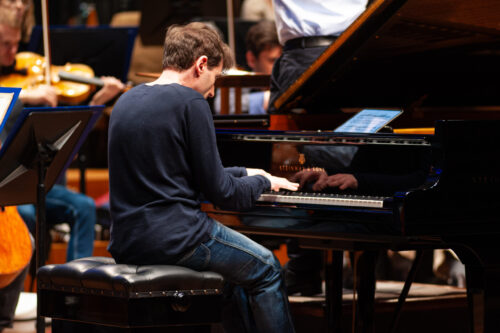
It would be a crime, though, to allow the BSO’s marvellous Sibelius to squeeze Boris Giltburg’s astonishing Prokofiev out of the space it deserves here. Prokofiev must have been one heck of a pianist – wrists of steel and all that (he wrote that while he was practising this concerto his neighbour was driven to building bookshelves so that his hammering would drown the sound of the piano). The Second Piano Concerto was soon overshadowed by the Third (brilliant and apparently less taxing); but to hear it in the hands of a pianist like Giltburg is a rare treat. Especially the first movement, which heats up from a deceptively pastoral opening and an almost Rachmaninovian eloquence towards the mother of all cadenzas (marked Colossale at its climax). Giltberg’s clarity was extraordinary, his energy unstoppable: it was jaw-dropping, hair-raising pianism.
So was the Scherzo, a brilliant moto perpetuo for the pianist, an unbroken torrent of scurrying semiquavers. The opening of the Intermezzo may put us in mind of the strutting Montagues and Capulets: Giltburg played up the grotesquerie – the music taking on a stealthy, hypnotic, snake-like character before building up a terrific head of steam. The finale (Allegro tempestuoso) is spacious – perhaps too much so – and mercurial: Giltburg was more than equal to its challenges, looking as fresh-faced and boyish at the end as he had when he walked on. Conductor and orchestra (who have their own challenges in this work) supported him to the hilt.
The concert had opened in bracing fashion with Beethoven’s Leonore Overture No.2, written for the original, abortive production of Fidelio (then called Leonore) in 1805. A properly theatrical performance: the offstage trumpeter, appearing at a side door above the choir to take his bow, was greeted with a rousing cheer.
Chris Kettle