 United States The Met: Live in HD – Wagner, Tristan und Isolde: Soloists, Chorus and Orchestra of the Metropolitan Opera / Yannick Nézet-Séguin (conductor). Broadcast live (directed by Gary Halvorson) from the Metropolitan Opera, New York, 21.3.2026 and viewed at Everyman Cinema, Chelmsford, Essex, 24.3.2026. (JPr)
My first Tristan und Isolde was at Covent Garden in 1980 (with Jon Vickers and Berit Lindholm); but it was in 2007 that I saw and heard an opera broadcast in a cinema for the first time and that was Nikolaus Lehnhoff’s 2003 Glyndebourne production of it (last revived there in 2024). I do urge anyone with an interest in what could possibly have ‘inspired’ the mise-en-scène of Yuval Sharon’s new Tristan at the Met to either seek out a recording of what was put on at Glyndebourne or look at the pictures available from it.
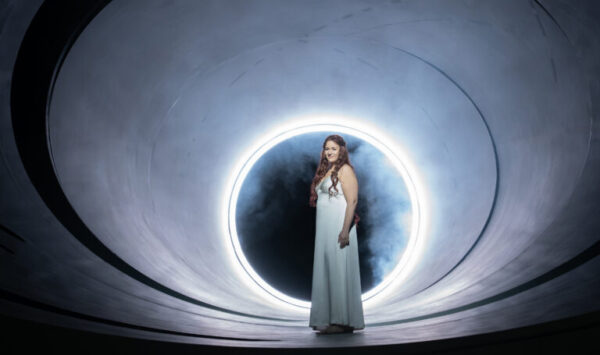
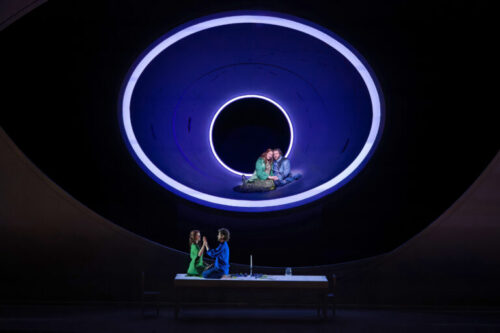
As a Konzept a (time) tunnel is not a new idea (remember Götz Friedrich’s Deutsche Oper Ring which began in 1984?). Via Glyndebourne, this now comes to the Met stage as something of an iris opening onto a mythical world towards the rear of the stage and separating ‘this world of the table and this world of the fable’ as Sharon explained. That ‘table’ was towards the front of the stage where actors silently mimicked what characters were singing about (sometimes swapping with the actual singers) or helped clarify certain scenes. This was particularly effective at the end of Act II when Tristan asks Isolde to follow him to the ‘wondrous realm of Night’ – that Tristan envisions for his mother as she died giving birth to him – and he snuffs out the individual lights of a candelabra, just as Isolde does during her reply. Clint Ramos’s costumes are suitably colour-coded – Tristan in blue for the sea and Isolde in green, presumably for Ireland – and elaborately bejewelled for the ‘fable’ and somewhat plainer at the ‘table’.
I was reminded of the famous quote from the John Ford Western The Man Who Shot Liberty Valance, ‘When the legend becomes fact, print the legend’. For me while Sharon had two goes revealing his thoughts about Tristan in pre-recorded films, I did not really learn a great deal. Interestingly he focussed on the two themes of the Prelude, ‘We have this yearning theme and this chromatic theme and they collide with each other and in that collision, which musicologists have called the “Tristan Chord” [there are] two themes that want to unify and can’t, and in that dissonance, that infamously takes 4½ hours to resolve, that is what the entire piece is about, Tristan and Isolde trying to integrate with each other and become one’. For Sharon ‘the opera is about rebirth; life and death are this one circle’.
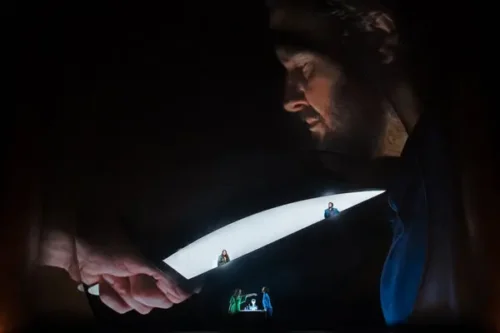
I believe what we see is the origins – in more contemporary days – of Tristan who was raised by King Marke after his mother’s death juxtaposed against events leading to his conception. For me as Es Devlin’s ingenious set separates during the Act II Love Duet into a round shape (Isolde) and an oval one (Tristan) I imagined the female egg and male sperm merging; though I am probably overthinking this. There were some arresting visuals in Sharon’s Tristan (atmospherically lit by John Torres) even if there was narrative confusion. I suspect – often because of Live in HD director Gary Halvorson’s detailed camerawork – the cinema audience experienced the staging at its best. Notably towards the end of Act I, as the set partially closes to the huge open silhouette of a knife blade we see the actor-Isolde hold at the actor-Tristan’s throat in a projection (from Jason H. Thompson, with video by Ruth Hogben) which filled the stage, while at the table the singer-Isolde threatened singer-Tristan with it (if confused see picture below). Elsewhere there were images of other close-ups of singers or actors, a raging sea, an eclipse, a shattered plate, a sunset and much besides. Less successful was the use of a movement group as sailors miming lowering sails in Act I and as angels (possibly?) in Act III with Tristan seemingly in god’s waiting room above whilst simultaneously on the table below and being operated on (again singer and actor exchanged from time to time).
I have to admit that my wife and I never stayed to the end of Glyndebourne’s Tristan in 2007; was it because of the production (!), the singing or transmission issues, we can’t remember. To his credit Sharon’s highly cinematic Tristan held our attention through to his emphasising his thoughts on what the opera is about by having the present-day Isolde shown giving birth while the Liebestod (Verklärung/Transfiguration) is sung. King Marke leaves with the boy (presumably?) and with his (re)birth the story has come full ‘circle’ it seems.
Act II had what is often described as the ‘traditional cut’ of several minutes in the Love Duet but this is absolutely unforgiveable in 2026. This apart, musically this Tristan was a treat for the ear and showcased Lise Davidsen’s much-anticipated Isolde. She had made her role debut in Barcelona in January (review here) with two others from the current cast (Ekaterina Gubanova’s Brangäne and Tomasz Konieczny’s Kurwenal). Endearingly, in a brief backstage interval interview, it appeared Davidsen’s thoughts were more on her twin boys who are only about 10 months old rather than her singing. Davidsen’s phenomenal vocal technique outshone her acting which was more rudimentary and it was good that Sharon’s staging often just moved her from place to place on the stage to simply stand, emote and sing. That Davidsen’s acting could have more nuance was seen at the start of the second act when Isolde’s signal is a single candle which she eventually blows out with a playful expression, almost winking at the audience.
Everything Davidsen sang sounded glorious and was imbued with all the emotional torment about love – initially repressed, and then haplessly expressed – that Wagner demands of his Irish princess. Davidsen can scale down her voice at crucial moments and her deeply affecting ‘Mild und liese’ began softly before her voice road the crest of its long arc only to end very softly again. Truly transcendental!
There was more vocal beauty from Michael Spyres’s role debut as Tristan which was a credit to how much he has obviously prepared the role. Spyres is a self-proclaimed ‘baritenor’ because of his incredible range; he has a fine legato and is clearly a successor to the legendary Alberto Remedios as a lyric-Heldentenor. Rarely can Tristan have been sung so effortlessly; whether in the ecstasy at the end of Act I; the fervour of the Love Duet; or the agonies of the Act III death throes. Ryan Speedo Green sang with a powerful and resonant voice and his forthcoming Wotan in a new Met Ring should be something to listen out for if his dignified and emotionally vulnerable King Marke (more King Midas what with all the gold!) which had great stage presence is anything to go by. There was excellent support from the remaining cast: Ben Brady (Steersman), Thomas Glass (Melot), Jonas Hacker (Shepherd), Ben Reisinger (Sailor) and kudos to Pedro R. Díaz who played the cor anglais on the stage.
Yannick Nézet-Séguin clearly had a firm grasp of Wagner’s score which Sharon described as ‘oceanic’ and it was matched by the ebb and flow the conductor brought to the music. He kept things moving and it seemed quicker than usual (cut notwithstanding) but not especially so. Nézet-Séguin was well-served by the outstanding instrumentalists of the Met Orchestra as he underlined the euphoria of the love scenes and whipped-up the tension in moments of high drama and angst, as well as bringing refinement to the more chamber music-like passages.
Jim Pritchard
Featured Image: Lisa Davidsen (Isolde) at the end of Act III © Karen Almond/Met Opera
Production:
Director – Yuval Sharon
Sets – Es Devlin
Costumes – Clint Ramos
Lighting – John Torres
Projection – Jason H. Thompson
Videos – Ruth Hogben
Choreographer – Annie-B Parson
Chorus director – Tilman Michael
The Met: Live in HD Host – Lisette Oropesa
Cast:
Isolde – Lise Davidsen
Tristan – Michael Spyres
Brangäne – Ekaterina Gubanova
Kurwenal – Tomasz Konieczny
King Marke – Ryan Speedo Green
Steersman – Ben Brady
Shepherd – Jonas Hacker
Sailor – Ben Reisinger
Melot – Thomas Glass
Isolde doubles – Cecily Campbell, Caitlin Scranton
Tristan doubles – Tim Bendernagel, Simon Catillon
English horn solo – Pedro R. Díaz
I think Tristan und Isolde has some of Wagner’s most beautiful music. It is long, but engaging! I hated this production. I want a traditional production. Act I should be on a ship, with projections of the sea.
In the end Isolde should be singing over Tristan’s body, with passion. Did Wagner envision Isolde’s pregnancy? A baby? Really? Ryan Speedo Green has a magnificent voice, and I think he will sing a great Wotan. But braided Afro hair for King Marke. A no no. I want a story true to history. I dread Yuval Sharon’s new version of the Ring.
Back to Isolde, Lise was simply beautiful. I look forward to her Brünnhilde. But please, no trickery, or modern images. Let’s enjoy Wagner’s wonderful music, with historical accuracy.
Wonderful singing and orchestra at the Met on 2 April, but for me too many visual distractions. It’s a pity that the reviewer did not see the end of Glyndebourne’s 2007 Tristan: Renewal there was embodied by Isolde, as her electric blue dress shone into the descending darkness.