 Spain Wagner, Tristan und Isolde: Soloists, Coro and Orquesta Sinfónica del Liceu / Susanna Mälkki (conductor). Gran Teatro del Liceu, Barcelona, 27.1.2026. (JMI)

Tristan und Isolde, the great Richard Wagner opera, has returned to the Barcelona Liceu stage where it was last seen in 2017 in performances conducted by Josep Pons. On this occasion, the Liceu has presented a new production, directed by Bárbara Lluch, the granddaughter of Nuria Espert, who is continuing the family tradition.
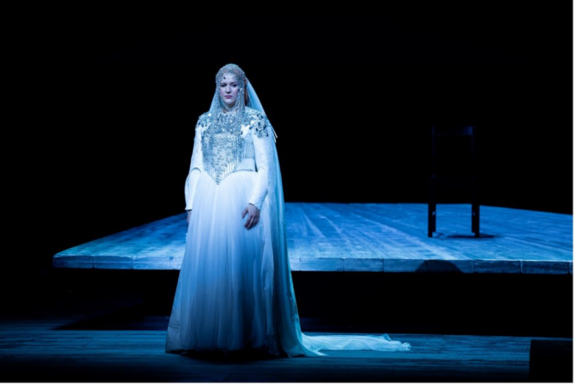
The stage is quite simple and consistently dark, both on Tristan’s ship and in King Marke’s castle as well as in the Kareol ending. In Act I, there is a large table at which Tristan’s soldiers are eating and are joined by Isolde and Brangäne. In the second act, the stage is occupied by a revolving bench where the great ‘O sink hernieder’ love duet between the protagonists unfolds, followed by the appearance of King Marke and his soldiers. It culminates in Tristan’s duel with Melot when the hero allows himself to be wounded and is severely injured. Finally, Act III presents a kind of rock formation where Tristan rests, crowned by a dark disc that disappears with his death. It is a simple production, never disturbing, and it faithfully recounts what is written in the libretto
The musical direction was entrusted to Finnish conductor Susanna Mälkki, who debuted at the Liceu three years ago with Puccini’s Il trittico, which also featured Lise Davidsen. Mälkki’s conducting seemed quite good to me, with several noteworthy moments, most notably in Act II. There was a good response from the pit by the Liceu Symphony Orchestra as well as from the Chorus in its brief appearance in the first act.
Soprano Lisa Davidsen is making her debut in the full role of Isolde here and delivered an exemplary performance. She has a beautiful voice, consistent throughout its range, and a vocal power I cannot recall from any other soprano in recent years. It is not easy to find a tenor to accompany her, given the sheer power of her voice and a height that few tenors can approach. It was a triumphant debut.
Tristan was sung by tenor Clay Hilley who was excellent – I would even say he is one of the few vocal interpreters of Tristan who truly does the character justice. His voice is that of a genuine spinto-dramatic tenor, perfectly projected, and he is a remarkable performer. He was spectacular in Tristan’s third-act ravings.
I have always considered King Marke to be the third major character in the opera, but for that you need somebody like René Pape, undoubtedly the best in the role in recent years. Here it was bass Brindley Sherratt, whose interpretation of the always much-anticipated monologue can be described as adequate though not brilliant.
Mezzo-soprano Ekaterina Gubanova as Brangäne did well in terms both of singing and acting. Her middle register lacks amplitude although it opens up well in the upper register. I liked her always anticipated “Einsam wachend’ warnings in Act II. Kurwenal was sung by baritone Tomasz Konieczny, who was excellent – he has a full and warm voice and gave a magnificent interpretation.
In the supporting roles, Melot was sung well by tenor Roger Padullés. Albert Casals made a fine Sailor and Shepherd, and Milan Perisic was convincing in the part of the Helmsman.
José M. Irurzun
Featured Image: Lise Davidsen as Isolde in Act I © S. Panizo
Production:
Director – Bárbara Lluch
Sets and Lighting – Urs Schônebaum
Costumes – Clara Peluffo
Dramaturgy – Yvonne Gebauer
Chorus master – Pablo Assante
Cast:
Tristan – Clay Hilley
Isolde – Lise Davidsen
Brangäne – Ekaterina Gubanova
King Marke – Brindley Sherratt
Kurwenal – Tomasz Konieczny
Melot – Roger Padullés
Shepherd / Sailor – Albert Casals
Helmsman – Milan Perisic