
 United Kingdom Three Choirs Festival 2026 [7] – Dupré, Ravel, Ospital: Thomas Ospital (organ). Gloucester Cathedral, 30.7.2026. (JQ)
Marcel Dupré – Symphonie-Passion, Op.23
Ravel – Le tombeau de Couperin (orchestral suite, trans. Ospital)
Thomas Ospital – Improvisation
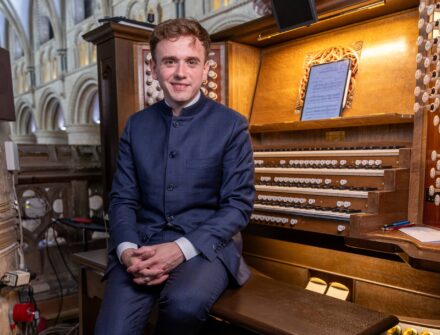
Forgive me for commencing this review with an outrageous pun: in engaging the French organist, Thomas Ospital to give a celebrity recital, the Three Choirs Festival truly pulled out all the stops. Ospital is only in his mid-thirties (he was born in 1990 in Ayherre in the Pyrénées-Atlantiques department) and he already has established himself among the world’s leading organists. Among those with whom he has studied are Thierry Escaich and Olivier Latry, the titular organist of Notre-Dame de Paris. Ospital was appointed co-titular organist of the Parisian church of Saint-Eustache in 2015 and he is a professor both of organ and of keyboard harmonisation at his alma mater, the Paris Conservatoire. At the launch event for the 2026 Three Choirs Festival, I heard Adrian Partington, Gloucester Cathedral’s Director of Music, describe Ospital’s playing as ‘dazzling’. More recently, I heard Jonathan Hope, the Cathedral’s Assistant Director of Music, wax lyrical about Ospital’s skills as an improvisor (interview here). The prospect of hearing this gifted French organist put the new Nicholson organ through its paces was enticing, to put it mildly.
Introducing the recital, Rev. Craig Huxley-Jones, the cathedral’s Precentor reminded us that during the festival week we’ve already had opportunities to hear the new organ in two of its functions: in its role in the cathedral liturgies and as a key element during concerts involving orchestra and chorus. Now we were about to experience it for the first time as a recital instrument. This is a new organ but I believe that it has been designed with due respect for heritage. A great deal of care has gone into it and a number of features from the cathedral’s previous organs have been replicated or retained; crucially, the magnificent seventeenth-century double organ case has been superbly restored. As Huxley-Jones expressed it, in an excellent turn of phrase, the new instrument is ‘a love letter to all the organs that have gone before.
Ospital opened his recital with Symphonie-Passion by Marcel Dupré (1886-1971). Just recently, when researching a completely different work, by Joseph Jongen, I was surprised to learn the origins of this profound piece for solo organ. On a visit to the USA in 1921, Dupré was one of the distinguished organists who gave a recital on the famous Wanamaker organ in the huge Grand Court in what was until quite recently the Macy’s department store in downtown Philadelphia. As part of that recital, Dupré created a substantial improvisation. Subsequently, he composed the Symphonie-Passion based on that improvisation; it was published in 1924. I don’t know how closely the Symphonie-Passion matched the 1921 improvisation but the published work is on a very large, ambitious scale; it plays for around 36 minutes. It is cast in four movements, each of which makes significant use of a relevant plainsong theme. Thus, in ‘Le monde dans l’attente du Sauveur’, the ancient hymn ‘Jesu redemptor omnium’ is, in effect, the second subject of the movement. Then, in ‘Nativité’, Dupré makes use of ‘Adeste fideles’, though it’s some time before that melody is heard. ‘Crucifixion’ is, understandably, the most darkly dramatic of the movements; eventually, use is made of ‘Stabat mater dolorosa’. Finally, in ‘Résurrection’ the music is based wholly on the Eucharistic hymn ‘Adoro te devote’.
Ospital’s performance was nothing short of superb. In ‘Le monde dans l’attente du Sauveur’, he established hushed tension from the outset; it was noticeable that the Nicholson organ spoke with fine definition when he played it quietly. The music moved into a toccata-like passage and here I admired the precision of the staccato playing. Throughout the movement Ospital made significant and creative use of dynamic shading and imaginative colouring. He had only a few hours with which to familiarise himself with the instrument but even at this early stage in the recital it was evident that he intended to exploit its resources to the full. The movement ends with four vast chords, the last of which resolves into the major key. Two things were worthy of note here; one was the massive power of the chords themselves and the other was Ospital’s quickly-acquired understanding of the cathedral’s acoustic which meant that he timed the pauses between each chord to perfection, allowing the sound of each chord to resonate imposingly around the building. ‘Nativité’ began calmly, the music – and playing – slow and thoughtful. After a while, the music opens up into what sounds like an antique dance; the way Ospital voiced this episode made me wonder if it was a depiction of angels hovering and dancing round the stable. ‘Crucifixion’ inevitably brings a significant change of mood. There was a dread sense of foreboding in the deep pedal notes at the very start. The music proceeds from there in a way that is slow, dark and intense. Once again, Ospital used a tremendous range of colours and each one seemed to me to be discerningly selected. The way he built up to the movement’s climax was gripping and then the climax itself was overwhelming. The final movement, ‘Résurrection’ is subtle in that it does not open with an immediate explosion of joy; rather, the music is initially almost pastoral; Ospital voiced this perfectly. He masterfully increased the tension until an exuberant toccata broke forth. From here, the movement evolved and grew in volume until the joyful conclusion when once again the immense power of the organ was fully utilised. This was a stupendous account of one of the great works in the 20th-century French organ repertoire; I won’t forget it in a hurry.
In a very shrewd piece of programme planning, Thomas Ospital moved from the intensity of Dupré’s huge symphony to the more rarified realms of Maurice Ravel. He offered us his own transcription of Ravel’s four-movement orchestral suite, Le tombeau de Couperin. Ravel’s music is delectable in itself but Ospital’s transcription proved to be a veritable box of delights. I was deeply impressed by the way that he managed to create a suite which sounded for all the world as if Ravel had conceived it for the organ, while at the same time fully respecting the orchestral music. So, in the opening ‘Prélude’ I loved the way he used sparkling flute stops in a most delicate piece of playing. The textures he produced were consistently transparent and there was lightness and dexterity throughout. I smiled at the elfin ending. ‘Forlane’ emerged as graceful and subtle. I thought that, arguably, this movement was the very best of the four in terms of fidelity to the spirit of the orchestral score – though that is not to suggest that elsewhere such fidelity was not in evidence. ‘Menuet’ was tranquil and gracefully sophisticated. I thought Ospital’s registrations were wonderfully imaginative as he re-wove Ravel’s spell in terms of the organ. The concluding ‘Rigaudon’ with its toccata-like music was very well suited to the organ; I wondered if it was this movement which first inspired Ospital to make his transcription. I thought Ospital once again displayed great affinity with Ravel’s original. His extrovert performance of this ebullient music was a delight. The transcription as a whole was a conspicuous success and superbly played.
To conclude, Thomas Ospital gave us an example of his skills as an improvisor. He had no prior warning of the challenge that would be set until we saw on the CCTV picture the cathedral’s Assistant Director of Music, Jonathan Hope hand him a single sheet of paper on which was written out the chosen theme(s). Ospital looked at it, gave a few nods and smiles and then spent no more than a couple of minutes in thought, during which he adjusted one or two stops. Then he was off!
It turned out that he had been asked to improvise on two themes, the choice of which could scarcely have been more apposite. One was a quintessential Three Choirs theme; the melody of ‘Praise to the Holiest’ from The Dream of Gerontius. The second paid tribute to the 250th anniversary of the Declaration of Independence: ‘The Star-Spangled Banner’, the original tune for which was written by a Gloucester-born man, John Stafford Smith (1750-1836), whose father was Organist of Gloucester Cathedral. Ospital treated us to a dazzling improvisation on these two melodies, which lasted some nine minutes by my watch. He packed a huge amount of invention into this quite short space of time. He used all manner of musical devices, and along the way, he gave the organ itself a thorough workout. It was fascinating to watch him on the excellent CCTV relay and see him deploying different stops as a new idea came to him. The result was a staggering display of technical prowess, musical intellect, and fertile imagination. At the very end Ospital wrapped his themes in some amazing harmonies as he brought the improvisation to a tumultuous end, using the organ’s full power. Wisely, he didn’t overplay his hand; the improvisation was sufficiently concise that he obeyed the old adage: always leave them wanting more.
This was a simply phenomenal recital. Ospital demonstrated a staggering technique and an equally staggering degree of musicality. Amazingly, he only had about four hours of practice beforehand: I know he began practicing at around 10pm the previous evening after the main concert had finished and I gather he finished at 2am. In this short space of time, he had clearly acquired a tremendous understanding of the organ; he made it speak exactly as he wanted it to do. I noticed a number of employees of Nicholson & Co in the audience, as well as Paul Hale, the consultant to the project to build the new instrument. I am sure they were thrilled at what they heard – and proud, too. I was delighted that after he had taken his first bow Thomas Ospital summoned James Atherton, Nicholson’s Head Voicer, to share in the applause; that was a very generous and well-deserved gesture.
I have no doubt that distinguished organists will be queuing up to give recitals on this magnificent organ. The trouble is, Thomas Ospital has now set the bar very high. I can only think of one word to sum up this recital by this supremely gifted French organist: Magnifique!
John Quinn