
 United Kingdom Three Choirs Festival 2026 [8] – Schubert: Mark Padmore (tenor), Christopher Glynn (piano). St Nicholas’ Church, Gloucester, 30.7.2026. (JQ)
Schubert – Winterreise, D 911
The venue for this recital was St Nicholas’ Church, which is just a short walk from Gloucester Cathedral. I don’t believe the church is regularly used for worship these days, though it is open to visitors. I had not attended a concert here previously and the building proved to have excellent acoustics for an intimate recital such as this, though there are a couple of potential drawbacks. One is the risk of external noise from passing traffic – though that didn’t prove much of an issue – and another is the very uncomfortable pews on which the audience is obliged to sit. However, an unsympathetic seat proved to be a small price to pay for the chance to experience this performance. The church was packed; I wasn’t surprised, because these two artists are renowned recitalists, though I don’t recall hearing them perform as a team before.
Some years ago, Mark Padmore made a very fine recording of Winterreise with the pianist Paul Lewis; it was one of a series of discs they made together which included all three of Schubert’s great song cycles/collections. I greatly admire their recording, but it came as something of a shock to be reminded that it came out as long ago as 2009. Happily, the recording is still available and it is very well worthwhile seeking it out (review here). I had seen them perform it together at the Cheltenham Festival the previous year (review here). I made a conscious decision not to revisit that recording in advance of today’s performance.
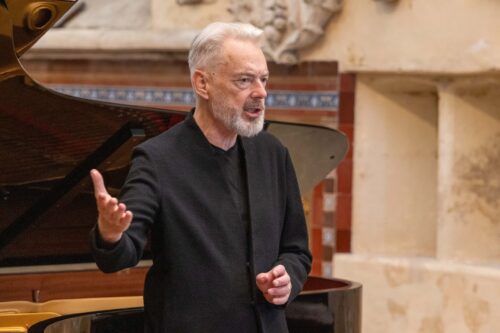
In his perceptive programme note, Richard Bratby recalled that, in early 1828, after Schubert had finished writing his cycle of twenty-four songs to poems by Wilhem Müller (1794-1827) he summoned some friends to hear him sing and play what he termed ‘a cycle of frightening songs…They have taken more out of me than any songs I’ve ever written’. The challenge for singers taking on Winterreise is that they must avoid unwarranted histrionics while doing full justice to the dramatic intensity of the words and music. Padmore undoubtedly succeeded in this respect. A consistent feature of his performance was subtle but telling hand gestures, most of them with his right hand. Sometimes I find gesticulation an unwelcome distraction in a song recital, not in this instance. Padmore’s gestures were economical and always seemed to fit with the words he was conveying. One might expect similar gestures from a narrator relating a story and, of course, that is exactly what Padmore was doing: he was telling the story and drawing us into it.
I was completely drawn in even before he and Glynn had finished the second song. In my notes, I see the words ‘intense’ or ‘intensity’ cropping up again and again, because intensity was the hallmark of this performance. In addition, the reading was characterised by urgency. By that, I don’t mean urgency of pace; all the songs were given at ideal tempi; I am referring to the urgency of utterance, both vocal and pianistic. Padmore and Glynn brought each song vividly to life.
So, for instance, I appreciated the variety of moods that were on display in ‘Der Lindenbaum’. There was biting urgency in ‘Rückblick’. ‘Frühlingstraum’ was an object lesson in how performers should put across the varying moods of this song. In the first stanza, there was innocent lightness but then, in an instant, Schubert – and these performers – pivoted into biting intensity for the second stanza, followed by deep melancholy for the third; then, of course, the formula was repeated for the second half of the song. In ‘Die Krähe’, Padmore conveyed the sinister malevolence of the bird in an ideal fashion. Later, in ‘Der Wegweiser’, the audience was confronted by the sorrow of the isolated traveller.
The last few songs see Schubert move to an even deeper plane of eloquence. ‘Das Wirtshaus’ was introduced quite wonderfully by Glynn; each chord was perfectly weighted; then singer and pianist conveyed the deep, dark stillness of Schubert’s music. Padmore led us through the sad narrative and then, in the last lines, there was defiance in his singing. After our traveller has gathered his mental and physical strength one last time in ‘Mut’, the story moves to its sorrowful ending. ‘Die Nebensonnen’ is a strange, otherworldly song – and poem; Padmore and Glynn were compelling here. Then we, and the traveller, encounter that strange being, ‘Der Leiermann’. For this extraordinary setting Padmore fined his tone right back; there was a drained, haunting quality to his voice; his subdued delivery was not only involving of itself but also it meant that the full-on delivery of the last two lines came as a real cry from the heart.
This account of Winterreise was an experience of searing intensity. Padmore grasped his audience’s attention from the outset and never let up. Inevitably, perhaps, I have concentrated on the singer because it’s he who has to put across the melodic line and, critically, the text. I mustn’t, though, relegate Christopher Glynn to the background. Long gone are the days when we would talk about a recitalist simply ‘with X at the piano’. A series of interpretatively gifted pianists, of which Glynn is assuredly one, have ensured that over the last few decades audiences have come to appreciate that in a recital the pianist is an equal protagonist. Today, I had the very definite sense that this performance of Winterreise was a joint enterprise. Glynn’s pianism was vitally important; not only was he ‘with’ his singer at all times but, in addition, the way he voiced the piano parts in the various songs was insightful and added to the drama we were hearing.
I said that I had not revisited Mark Padmore’s 2009 studio-made recording prior to today’s recital. However, there was one characteristic of his singing which made me curious. Today, his voice seemed to me to have an edge to it. I stress that is no criticism; it seemed to me to be entirely appropriate to the intense style of the interpretation. However, when I got home, I listened to a few songs from the earlier recording; the intensity was still there but the sound of the voice was somewhat rounder. Of course, Padmore is some seventeen years older now and I sense that the voice has darkened. Furthermore, with yet more experience of living with the cycle it is almost certain that the way he approaches singing it has evolved. I don’t express a preference; I still greatly admire the Winterreise of 2009 and I was enthralled by this 2026 live account.
This was a compelling Winterreise; it was a privilege to hear it.
John Quinn