
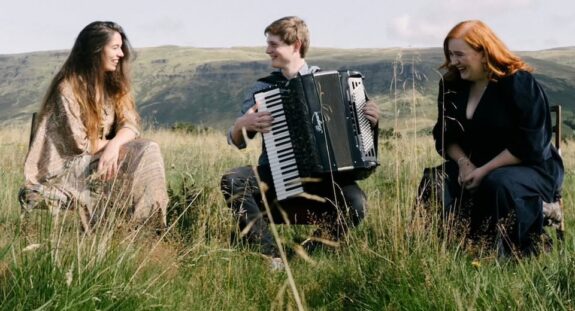
 United Kingdom QUINES: Celebrating Scotland’s Women: The Bubblyjock Collective (Neil Sutcliffe [accordion], Rosie Lavery (soprano], Anna Michels [piano]). Ledger Recital Room, Royal Conservatoire of Scotland, Glasgow 6.3.2026. (PC)
Claire Liddell – Five Orkney Scenes (1975)
Marie Dare – The Spanish Shawl (arranged for accordion and piano) (1935)
Isobel Dunlop – Six Songs to poems by William Soutar (1944)
Helen Hopekirk – Serenade in F-sharp major, for solo piano (1891)
Lisa Robertson – QUINES (2026) (world premiere)
Formed in 2023, the Bubblyjock Collective is an ensemble dedicated to promoting and performing music from the 19th century to the present day by composers born or based in Scotland. The ensemble’s mission is to highlight and champion neglected works, to commission new pieces from Scottish composers and to celebrate the breadth and range of Scottish chamber music and art song. As a showcase for the performers’ intentions and ambitions, their early evening recital entitled ‘QUINES: Celebrating Scotland’s Women’ could not have been more apt or impressive. Presented as part of the conservatoire’s week-long celebrations of International Women’s Day, the finely balanced programme juxtaposed instrumental works with song cycles and culminated in the first performance of a substantial piece written especially for the trio.
The music-making began with a song cycle by Glasgow-born pianist and composer Claire Liddell (b.1937). One of her few published works, Five Orkney Scenes (1975) is a collection of evocative, subtly hued settings of texts by Stromness-born poet and author George Mackay Brown (1921-1996). The poems reflect ordinary moments in Orkney life in a series of finely drawn vignettes and the musical treatments retain and enhance the intimacy and directness of the verse. Rosie Lavery invested the vocal lines with warmth and spirit, while Anna Michels provided nuanced and responsive piano accompaniment. Both performers conveyed each song’s individual character, bringing compelling spontaneity to the narrative drama of the scena-like ‘Old Fisherman with Guitar’, encased by ‘strummed’ keyboard arpeggios, and catching the tenderness of the flowing, folk-like setting of ‘Country Girl’. The light-hearted ‘Beachcomber’ exuded rhythmic energy and bluff humour, while ‘Fisherman’s Bride’ was hushed and still, Michels delicately pointing up the ticking figuration in high register that frames the song. A brisk and nimble reading of the airy setting of ‘Roads’ brought this colourful work to a gently upbeat conclusion.
Neil Suttcliffe joined Michels in an arrangement for accordion and piano of The Spanish Shawl (1935) by the composer and cellist Marie Dare (1902-1976), who was born in Newport-on-Tay in the north-east of Fife. The players caught the wistful longing and subtle exoticism of this piquant miniature with its habanera rhythms and subtle harmonic shifts. Their polished, alert account embraced the music’s fine balance between languor and intensity.
Lavery and Suttcliffe then performed Six Songs to poems by William Soutar (1944) by the Edinburgh-born composer, violinist and arts administrator Isobel Dunlop (1901-1975). Written in Scots dialect, the verse is directly communicative and the musical treatments are comparably straightforward, sincere and effective, though not without depth of feeling. The most affecting song, ‘The Tryst’ was a forlorn slow air, to which Lavery brought an unforced dignity. There was a lively, bustling account of the whimsical setting of ‘The Gowk’ with its onomatopoeic cuckooing and a hearty exuberance in the folk-like ‘At Tibbermuir’, but the overriding initial impression of the set was one of refinement and restraint, the composer taking great care to preserve and heighten the essence of the text.
Anna Michels took the spotlight for the Serenade in F-sharp major for solo piano by Edinburgh-born concert pianist and composer Helen Hopekirk (1856-1945). Written in 1891, this lavishly scored, late-Romantic piece was graced with florid, decorative figuration and driven by bold, rhetorical gestures, especially in the dynamic central section, which was deftly recalled in the closing bars. The writing had the assurance and sweep of a skilled executant and Michels responded keenly to the material’s expressive range with considerable interpretative flair.
To end their recital, all three performers took to the stage for the world premiere of QUINES, for soprano, piano and accordion (2026) by West Highland composer Lisa Robertson (b.1993). The title, an old Aberdonian word for women, is taken from a poetry collection of the same name by Gerda Stevenson which was written in tribute to women of Scotland and their diverse contributions to Scottish history and society. The five poems from that collection featured in the song cycle were superbly read by Stevenson in a pre-concert event, briefly raising the concerning question of whether music could add anything further to these fully rounded portraits. In the event, Robertson’s beautifully judged settings complemented and enriched the texts, adding extra layers of texture and meaning. Her generous-spirited music allowed plenty of space for the words and the painterly contributions of all three instruments to make their mark in each song.
With the scope and immediacy of a full-fledged aria, the opening number, ‘Diva’ paid homage to Mary Garden (1874-1967), an international opera singer, who was born in Aberdeen and who created leading roles in operas by Debussy, Massenet and Prokofiev, among others. The song began simply and atmospherically with the accordion’s breathing sounds and bare piano chords preceding the diva’s stark declaration ‘I am granite’. In the sonorous central section, as her Parisian public begs her not to leave them, the diva’s soaring line bloomed over florid piano figures and the accordion’s surging bellows shakes. The compelling closing bars, as the singer’s final note faded ‘into devastating silence’, were especially effective, Rosie Lavery’s hypnotic delivery reminding us that, for all her pride and fabled eccentricities, Garden was a star and consummate artist, ‘the Mélisande Debussy hardly dared to hope for’.
‘My ain countrie’ gave voice to Violet Jacob (1863-1946), who was a novelist, poet, writer and botanical artist from the county of Angus on the east coast of Scotland. At the heart of the song, the piano imitated the call of the geese, a fine example of the composer’s gift for incorporating the sounds of nature within her music. Jacob’s only child, a son, died in World War I and the setting ended poignantly with painful memories of that time giving rise to the witnessing of a figure, ‘a wraith in the still air’. Enhancing the deeply personal nature of the writing, Lavery hummed quietly and then spoke the line, ‘ma eye taks up a traiveller, whustlin doon the brae’ before the accordion breathed gently. This hushed and spaciously conceived closing passage took its cue from the simple dignity of the text.
‘Horsehead Nebula Speaks’ celebrated Williamina Paton Fleming (1857-1911), a Dundee-born astronomer who moved to American and died in Boston, Massachusetts. Her discovery of the Horsehead Nebula in the constellation of Orion was uncredited as her name was removed from Harvard’s list of astronomical discoveries, but the text of this setting gave due acknowledgement to this ‘woman with eyes like burning stars’ with a ‘quiet gift for seeing light’. This song was delivered from the perspective of the small dark nebula of the title. It began expansively as sustained drone chords suggested the immensity of space and the piano’s repeated triplet figures conveyed a signal hurtling through the cosmos. In the following spirited section, the Horsehead was playfully invoked by galloping figures from all three performers, while shimmering accordion vibratos contributed to the unworldly atmosphere. An intensely human story lay at the song’s core and, in an unexpected and particularly inspired stroke, the instrumentalists delivered the mocking spoken lines of the Harvard professors as they claim the discovery for themselves.
‘Òran / Song’ honours Mary MacPherson (1821-1898) from the Isle of Skye, who was known as ‘Màiri Mhòr nan Òran’, or ‘Great Mary of the Songs’. A Gaelic poet and singer-songwriter, she was falsely accused of theft, for which she was imprisoned. The text is in the voice of a song which has been lying fallow for fifty years before rising up at the injustice of the musician’s captivity. Inventive touches such as requiring the piano strings to be plucked gently and a recurring, quirky, march-like figure taken up by each performer in turn caught the ear, but the strength of this setting was its forceful, unbroken narrative and in the second half of the song, words and music built inexorably to a gloriously cathartic climax as the song’s cry for justice is ‘carried down the years’.
The final number, ‘The Flyting of the Red Shoes and the Blue Shoes’ saluted Dunfermline-born ballerina and actress Moira Shearer (1926-2006). As well as her famous role in the cinema classic The Red Shoes, she also starred in the comedy film, The Man Who Loved Redheads, in which she dances the Charleston in blue shoes. ‘Flyting’ is a Scots word for an argument or debate and in the song a vigorous competition was staged between the elegance waltz of the red ballet shoes and the playful, jazzy exuberance of the Charleston’s ‘slick, blue beat’. Complementing the dance rhythms, the text had a strong metre and structure with the recurring line ‘we tease, cajole, but the lady’s in control’ always accompanied by both players tapping their instruments percussively. The setting, and the whole work, rose to a climactic peak as the eager witnesses of this dance-off beg the lady, ‘Encore! Reprise!’.
Enthusiastically received by the audience, QUINES made a strong impression at its concert debut. Lisa Robertson’s vivid settings of Gerda Stevenson’s rich texts shaded, underlined and embellished the words in unfailingly imaginative ways and The Bubblyjock Collective relished the various expressive opportunities of music written expressly for them. A tremendous success for all concerned, this memorable song-cycle brought to a satisfying close a well-chosen programme presented by an engaging trio of accomplished and searching musicians.
Paul Conway