
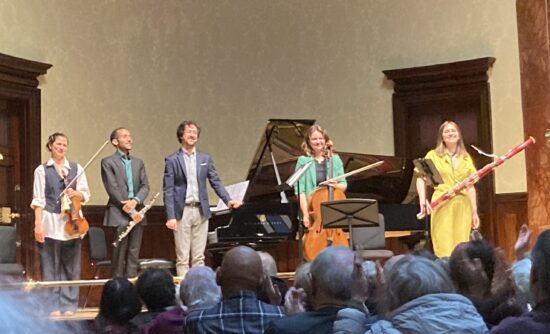
 United Kingdom De la Guerre, Beach, Dring, Fanny Mendelssohn: The Kaleidoscope Collective (Armand Djikoloum [oboe], Amy Harman [bassoon], Elena Urioste [violin], Laura van der Heijden [cello], Tom Poster [piano]). Wigmore Hall, London, 8.3.2026. (LJ)
Élisabeth Jacquet de la Guerre – Trio Sonata in B-flat (c.1695)
Amy Beach – Invocation, Op.55 (1904)
Madeleine Dring – Trio for oboe, bassoon and piano (1971)
Fanny Mendelssohn – Piano Trio in D minor Op.11 (1847)
Sunday 8 March was International Women’s Day (IWD). And, as the IWD website states, it aims to ‘celebrate women’s achievement’, ‘raise awareness about discrimination’, and encourage people to ‘take action to forge gender equality’. Most encouragingly, it ‘belongs to all who care about gender equality’. During the Kaleidoscope Chamber Collective’s Sunday morning concert, there was an overwhelming sense that IWD belonged to all in attendance at Wigmore Hall. Not only did the Collective themselves include three excellent female instrumentalists, but all of the music played was composed by female composers. Some of these composers are happily known and celebrated amongst music lovers whereas others, no doubt due to their gender, have been relegated to the margins of music history.
Seventeenth-century French composer Élisabeth Jacquet de la Guerre and twentieth-century English composer Madeleine Dring are not names that are commonly seen on a concert programme. This rare chance to hear exquisite compositions by neglected female composers is precisely what initially attracted me to this recital. More familiar are the works of American fin de siècle composer Amy Beach and nineteenth-century composer Fanny Mendelssohn (sister of Felix).
This programme of short pieces by women composers holds together nicely if we remember the IWD’s pledge to ‘celebrate women’s achievement’. It seems that the Collective were aware of this when devising the set list as, according to the online programme note, pieces were selected following a determination to ‘combat and overcome self-serving male prejudices’.
This thematic approach is interesting to read and think about, but, musically, it can lead to a bit of a pick ‘n’ mix. But is this necessarily a bad thing? The performers, after all, are called the Kaleidoscope Chamber Collective – their style is colourful, textured, and imaginative. As a group, their clear aim is centred on the principle of ‘diversity and inclusion’, which can, in part, be achieved thanks to Tom Poster’s excellence as an arranger. Accordingly, they play varied music that broadens the chamber repertoire for audience members who are open to expanding their personal musical encyclopaedias. In a world where so many things smack of a sense of ‘the same old’, the Collective offers a refreshing perspective on the traditional, without losing the central tenets of what has and always will constitute a good recital.
De la Guerre was renowned in her lifetime as a musician and composer at the court of Louis XIV. She built her reputation as a harpsichordist and, upon hearing the Trio Sonata in B-flat (c.1695) performed on violin, cello, oboe, and piano, the harpsichord was sorely missed (it was originally scored for two violins, bass viol and continuo). This is not to undermine Poster’s excellent playing, but the modern instrument simply cannot dance the same dance as that of the harpsichord and thus the character of the French baroque seems just out of reach. From the beginning, Laura van der Heijden positioned herself as the engine behind the piece, playing with attentiveness and drive throughout. Oboist Armand Djikoloum was expressive and characterful, his playing embodied and light. Violinist Elena Urioste played with aplomb. Her sound is bold and there is no mistaking her inclination as a soloist known for giving recitals with world famous orchestras.
The Collective then performed fresh arrangements of Beach’s Invocation Op.55 (1904), which featured violin, bassoon, and piano, and Dring’s Trio for Oboe, Bassoon and Piano (1971). In both works, Amy Harman impressed with her characteristic dynamism. Her reputation as a bassoonist is noteworthy with a list of works written for her, frequent live performances as both soloist and part of chamber groups, and in her role as a sought-after teacher (she was a professor at the Royal Academy of Music from 2013 to 2024). Unsurprisingly, then, Harman delighted the audience with her justly front-and-centre performance.
Whilst both Beach’s and Dring’s Trios harked back to an earlier, more Romantic musical mode, it was Dring’s Trio that left a lasting impression because it sparkled with newness. Born in England and schooled at the Royal College of Music, Dring specialised first in the piano and then violin. She received tutoring from Ralph Vaughan Williams and expressed a fondness for Rachmaninoff. In 1947, she married Roger Lord, who would become the principal oboist for the London Symphony Orchestra. This inspired her to compose for the instrument, hence the Trio for Oboe, Bassoon and Piano.
In this Trio there were echoes of the English pastoral (George Butterworth, Ivor Gurney, John Ireland, and, of course, Vaughan Williams). There were also sounds from more distant lands with the piano part taking inspiration from Rachmaninoff (those unmistakable descending chords), Aaron Copland (the cool, jazz-inspired Piano Concerto from 1926), and Rimsky-Korsakov (especially his Scheherazade from 1888) in the dreamily Arabian-sounding second movement (Dialogues: Andante sostenuto). Djikoloum, Harman, and Poster were particularly good when playing this second movement, giving it character and shape whilst holding back from sentimentality. Although this piece is not brimming with originality and, as indicated above, draws heavily on the styles and sounds Dring most admired, it is a charming work that deserves a second hearing. (A recording of this Trio is available on the 2024 Chandos CD, Complete Works for Oboe by Madeleine Dring, which features Harman on bassoon.)
For the final piece, Poster was joined once more by van der Heijden and Urioste. They played Fanny Mendelssohn’s Piano Trio in D minor Op.11, which was originally composed as a birthday present for her sister Rebecka in 1847. Only one month after its completion, Fanny died of a stroke. In the second and third movements (Andante expressive and Lied: allegretto), van der Heijden played with tenderness and introspection, fitting for a piece that, in retrospect, foreshadows the composer’s untimely death. Notably, there is no scherzo, because this piece possesses a more song-like quality, reminiscent of Felix Mendelssohn’s Lieder ohne Worte (1829-45). This was not exactly matched by Urioste, whose playing, though beautiful, might have benefitted from less virtuosity. The final movement (Finale: allegretto moderato) is almost improvisatory, recalling the lyrical second theme from the first movement. It was superbly shaped by Poster whose playing was full of character. Here, the three musicians came together beautifully, playing with resounding charm and Romanticism.
Overall, the Kaleidoscope Chamber Collective fulfilled International Women’s Day’s mission to ‘celebrate women’s achievements’. As Poster said before playing a delightful encore with his fellow musicians (Dina Suisse’s ‘My Silent Love’): ‘This music deserves to be played every day not only on a particular occasion […] it deserves to be heard far more.’ It is only fitting, therefore, that I close this review with a thank you to the Collective for introducing me (and, most likely, many other audience members) to the work of Madeline Dring. What a wonderful discovery!
Lucy Jeffery