
 United Kingdom Mahler: Rhian Davies (alto), Oxford Millennium Chorus, Oxford Youth Choirs (musical director: Benedict Goodall), Oxford Millennium Orchestra / Joe Davies (conductor). Sheldonian Theatre, Oxford, 6.3.2026. (CK)
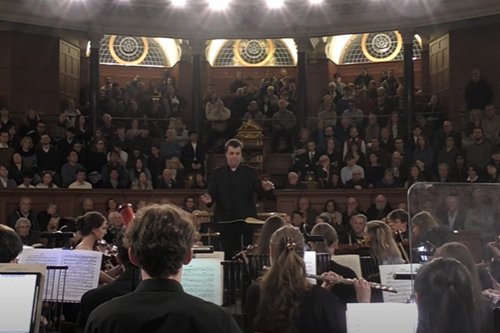
Mahler – Symphony No.3
‘Ah but a man’s reach should exceed his grasp!’ So wrote Neville Cardus (quoting Browning) at the end of his chapter on Mahler’s massive Third Symphony, applauding the composer’s courage in attempting to embrace the whole of creation and to express the inexpressible. One could say the same of those who attempt to perform it – especially student and amateur musicians, those who do it for love.
It is not necessarily the most polished performances of music one loves that move and excite one the most. And I do love this music; and have done since I heard Barbirolli conduct it on the radio and Horenstein in the concert hall. One of the highlights of my two years in America was a day in the Pierpont Morgan Library in New York with the 1896 autograph manuscript.
As I took my seat in the Sheldonian there was a little voice inside my head – which I tried to ignore – saying ‘Oh my goodness, what if they murder it?’ All such thoughts were blasted into oblivion by the fortissimo horn call that opens the first movement: the Sheldonian’s floorspace is not large, and Davies had his nine horns (yes, nine) seated above and behind the orchestra in a gallery (the women’s chorus was in another; and the children’s chorus in yet another). There is often a sense of theatre in a performance of a Mahler symphony, and the horns made the most of their spectacular setting. There was nothing tentative about their opening fanfare – bold, assertive, almost raucous: we’re going for this, they roared and never mind the occasional split note. It set the agenda: it proved to be a microcosm of the performance as a whole.
Throughout the gigantic first movement – Pan awakes, Summer Marches In and so on – it was abundantly clear that a great deal of work had been done in rehearsals; also that Joe Davies had a very clear conception of how and where he wanted to symphony to go, and that he had successfully communicated this to his players: the rapport between them was palpable and dynamic.
Despite its Dionysian heft, this movement sprouts tiny solos in all directions. And three big ones: Leo Lee played those taxing trombone solos with aplomb, making them more than structural markers: he gave them a personality and a voice, different each time, as Mahler intended. All the wind principals played their part: Mark Murphy’s trumpet tirelessly accurate, Jake Pawson’s horn scarcely less so; Madeleine Ratcliff’s flute, well remembered from her playing in Mahler’s Seventh a year ago; John Fung’s oboe, beginning the flower Minuet with relaxed charm; Alicia Li’s eloquent clarinet, Adam Vasilko’s characterful bassoon – and I must not fail to mention Tom Dixon and Alex Buckley, their E-flat clarinets as shrill as any I have heard. Caleb Kosciecha, the orchestra’s leader, was unfailingly sweet-toned in his moments in the spotlight.
The third and fourth movements brought two more remarkable solos. Perry Wade’s posthorn – actually a flügelhorn – was bright and clear, with just a hint of nostalgia; only just offstage – ‘in the distance’ would have been hard to coordinate – but very effective. The fourth movement brought a revelation I shall not soon forget. With the right soloist in Mahler’s setting of Zarathustra’s ‘Midnight Song’ this movement can seem not merely the next stage in the music’s ascent of the Chain of Being, but the pivot around which the entire 100-minute symphony revolves; it was so here.
It wasn’t simply the excellence of Rhian Davies’s performance – her voice suggesting both an Erda-like gravity of utterance and a touchingly human vulnerability – but her whole demeanour, her stillness: it was most moving – the heart of the performance, its still point, and at the same time a quantum leap into the dimension of human consciousness, preparing us for the lightness and grace of the brief fifth movement and the glories of the sixth (What Love tells me). Plaudits, too, to the horns, who support the alto soloist pianissimo; and to John Fung (oboe) and Bridget Riley (cor anglais) for respecting Mahler’s much-debated instruction hinaufziehen in their lonely bird-cries.
Es sungen drei engel was brightly sung by the chorus of ladies, and it was good to see and hear a large children’s choir bimm-bamming away. Rhian Davies was again touchingly human in her plea Ach komm und erbarme dich über mich!, and the orchestra came into its own in the central section where the jaws of hell gape briefly. Near the end there was a missed entry by two trombones, but they can be forgiven for their excellence elsewhere.
And so to the finale, where some performances lose their way: but the strings – including a full section of ten cellos – played splendidly, maintaining a clear line and sustaining tension throughout, until that final chain of climaxes locked us securely into D major eternity. Sensitive playing from flute and piccolo, leading us towards the summit; and from the brass, who have to sustain that soft chorale, ppp sehr langsam, at the end of a long and tiring evening.
It was Joe Davies, of course, who made sure that that moment of arrival was as overwhelming as it should be. With such huge forces to control and coordinate it was unsurprising that in general he favoured speeds on the brisk side: this worked well in the tumultuous first movement, but he might have given us a little more light and shade in the second, a little more time to smell the flowers. The third movement loped along agreeably, Ohne hast; and I for one enjoyed his flowing tempo for the finale, his clear sense of direction towards the goal. And the achievement of the goal was gloriously emphatic.
A word about the percussion: that thrilling ceremonial tattoo by the two timpanists at the end was the last of many vivid moments from a section that Mahler uses with brilliant resourcefulness and imagination. An emphatic bass drum in the first movement, and a commanding side drum beating the retreat to usher in the recapitulation; a properly audible ruthe in the second movement, like a startled bird flushed from the undergrowth; a terrifying clamour as Pan rears up again at the end of the scherzo; bright bell sounds accompanying the angels in the Wunderhorn song.
Joe Davies, a young man of extraordinary energy as well as talent, is currently preparing for a performance of Mahler’s even bigger Eighth Symphony – the so-called ‘Symphony of a Thousand’ – in Coventry Cathedral in May. His vibrant performance of the Third suggests that the Eighth will ring and resound gloriously in that wonderful space: I am eagerly looking forward to it.
Chris Kettle