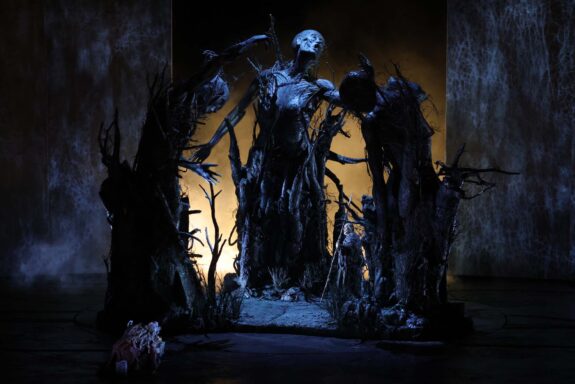
 Italy Wagner, Siegfried: Soloists, Teatro alla Scala Orchestra / Simone Young (conductor). Broadcast live (directed by Anna Gettel) from La Scala, Milan, 13.6.2025 and available on demand on LaScala TV. (JPr)
Having seen and heard Sir David McVicar’s begin his new Ring cycle for Milan’s La Scala with Das Rheingold (review here), I then saw Die Walkϋre (review here) but then completely forgot to follow the tetralogy to its conclusion with Siegfried last season and a recent Götterdämmerung. I found Rheingold ‘puzzling’ but Walkϋre more ‘traditional’. La Scala is currently in the middle of two full Ring cycles and I caught up with Siegfried which is available with the first two operas on LaScala TV, and hopefully Götterdämmerung will be back on demand there again soon.
I will repeat (yet again) that in his younger days McVicar was opera’s enfant terrible – a veritable provocateur if you will – yet in more recent times there has been more ‘cosiness’ and lack of controversy in his work. At the end of Rheingold however there was a flashback to McVicar’s blood-soaked early productions when a figure – who I described as ‘looking as if he had been flailed within an inch of his life’ – writhed at the bottom of steps leading up to Valhalla. Nothing like that reappeared in Die Walküre, nor now in Siegfried. Give or take this was another traditional staging with an Act I – a cross-dressing Mime and moth-eaten bearskin notwithstanding – that could have been inspired by an Arthur Rackham illustration. There was a working forge on one side of the stage (with an anvil, source of water and bellows) with a well-appointed kitchen on the other. This Siegfried is odd in that – apart from some colourful projections later on – the stage pictures are universally gloomy and sometimes extremely oppressive. Again I repeat myself; how there is nothing wrong with faithfully retelling the story – without any discernible message – though that is very unusual in the 2020s. Perhaps all will be clearer about what the Ring meant to McVicar if I get to see Götterdämmerung.
The ‘take’ in ‘give or take’ refers to an annoying feature of how McVicar presents the story as in Act I when it (ludicrously) requires three, very conspicuous, dark-clad puppeteers for the ‘bear’. There are seven in total and all are needed to awkwardly manipulate the huge Fafner skeletal dragon/scorpion with a human skull in Act II. There are also a further three bare-chested extras involved from time to time: notably with one accompanying the Woodbird in Act II with a small bird on the end of an extended fishing rod and even more risibly at the opera’s denouement when one represents Brϋnnhilde’s Grane and crosses the stage looking very tall on bouncy stilts and with the mask of a horse’s head. Perhaps some of this was changed in the current Ring cycles, if not it should have been.
The media have revisited recently how much textile waste the fashion industry generates annually and with Milan as the global fashion capital, perhaps the raggedy clothing all the characters seem to be wearing means McVicar is saying something to us here. Siegfried wears the remnants of a bemedalled biker’s jacket; Mime with his blue eye shadow is either in his filthy long johns or in a dress, tiara and leopard print fur-trimmed coat; the Wanderer is in dark robes and with a spear that (both) have seen better days and looks like Dickens’s Ghost of Christmas Yet to Come; Alberich trundles along a child’s trolley and dons a battered gold crown at one point whilst wearing a mash-up of uniforms with epaulettes and medals. It is left to Brϋnnhilde to just have a simple blue dress.
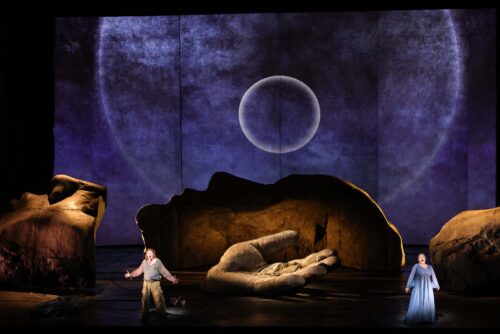
Act II features a forest with gnarled, black (charred?) trunks that are humanoid figures (women?) on a revolve which often slowly turns. Francesca Aspromonte as a sweet-voiced Woodbird sports a Mohican and has the agitated bird-like movement that mimics the small puppet of a bird she is making move the same way too. When scorpion Fafner is despatched, Ain Anger rises from below the stage as Fafner on stilts, with his large head and hands as in Rheingold. The set for Act III is even simpler beginning rather bare except for the large earth-like globe, cracked and banded, from Walkϋre (I have no more ideas about it now than I did then) for the Erda/Wotan confrontation. A screen then comes down with a more colourful ring of fire before the final scene has a huge profile of a face – that I thought was a man before but may be a woman – and another is spilt in two on opposite sides, as well as the large hand that Brünnhilde is awakened on. The final duet for Siegfried and Brünnhilde takes place with them far apart before they embrace centre stage as the image is seen of two planets (or nuclei?) colliding at the rear of stage.
I saw several performances with Klaus Florian Vogt in his earlier years without imagining him as Tristan (review here) or Siegfried as here. But it was quite a revelation to have the role sung so lyrically and effortlessly. It was of course not entirely easy for him though he retained the air of boyish bewilderment throughout, and he set about his ‘real’ forging of Nothung in Act I enthusiastically given the demands of what he has to sing: and the sparks fly, literally. Wolfgang Ablinger-Sperrhacke’s Mime has no redeemable features and was so very strongly characterised and sung that it made his one of the better assumptions of the role since that of the much missed Graham Clark. This Mime takes his frustration out on some dough in the first act and has a comical rough and tumble with Alberich in the second one; with Ólafur Sigurdarson as a dour, bitter and baleful Alberich both in his portrayal and voice. The odd thing about this Siegfried is that the cast listed Anna Kissjudit (seen at the curtain call) as Erda but the figure in more rags and with a long train – and who was bemused at the events which had happened while she slept – looked and sounded like Christa Mayer who Kissjudit was supposed to be replacing. I was not entirely convinced by Camilla Nylund’s Brϋnnhilde, for whilst she perfectly acted her initial disgust at Siegfried’s passionate pursuit, her singing was very mannered despite all her high notes having laser-like brightness.
The heroes of this Siegfried were conductor Simone Young and the Wanderer/Wotan of Michael Volle. Young’s account of the score would have been well under 4 hours had it not seemed (to me) to become rather becalmed during the three duets in Act III, but that did not spoil anything really. Overall, it was full of darkness and shadow, atmosphere and threat, while the journey of Siegfried up the mountain and through the fire was a suitably incandescent interlude. Young clearly relished the support of the superb La Scala Orchestra surrounding her in the pit.
Then there was the incomparable Michael Volle who – vocally, if not physically – is aging like fine wine as it is clear certain ‘rocks’ are only on the stage mainly for him to rest on occasionally. The resentment of his Wotan at the fate of the gods was clear in everything he sang with his usual accomplished Lieder-like delivery. For some reason McVicar botches the final fight with Siegfried; Wanderer/Wotan does not have the hat as in the libretto but a cowl and instead of continuing to bar the way to the mountain with his spear as he starts off doing, Siegfried just seems to chip a bit off the end of it. This summed-up this new staging; so good in parts but which fails in others.
Jim Pritchard
Featured Image: Siegfried Act II © Teatro alla Scala/Brescia e Amisano
Production:
Staging – Sir David McVicar
Sets – David McVicar and Hannah Postlethwaite
Costumes – Emma Kingsbury
Lighting – David Finn
Video and Projections – Katy Tucker
Choreography – Gareth Mole
Master martial arts / Circus performance – David Greeves
Cast:
Siegfried – Klaus Florian Vogt
Mime – Wolfgang Ablinger-Sperrhacke
The Wanderer / Wotan – Michael Volle
Alberich – Ólafur Sigurdarson
Fafner – Ain Anger
Erda – Anna Kissjudit
Brünnhilde – Camilla Nylund
Voice of the Woodbird – Francesca Aspromonte
So many critics of the just-concluded Ring at La Scala bemoan the fact that puppeteers were required for some costumes – the bear, the dragons, the toad. I’ve seen not a single reference to the source of this remarkable interaction among humans and ‘monsters’: the traditional Bunraku of Japan. You don’t need to like bunraku – maybe you really do think it is weird to have puppeteers visibly handling puppets. Maybe your imagination can’t handle the idea that a person dressed in black is invisible, is to be ignored, is not really there. But surely you can recognize the art form! Condemn McVicar. But at least acknowledge that what he has done is a legitimate incorporation of an ancient art form into a modern one. See it, understand it, and then, if you must, reject it. But I, for one, thought it was a brilliant use of deception in a story about…deception.
JP replies: Anthony Minghella’s Madama Butterfly is Bunraku at its best, McVicar’s Bunraku in Siegfried – if that is was it is supposed to be – leaves a lot to be desired!