
 United Kingdom Britten, War Requiem: Philippa Boyle (soprano), Gwilym Bowen (tenor), Daniel Tate (baritone), Lewisham Choral Society, KölnChor, Rheinischer Kammerchor Köln (chorus master, conductor: Wolfgang Siegenbrink), The Emerald Choir (chorus master: Clare Caddick), Forest Philharmonic Orchestra / Dan Ludford-Thomas (musical director, conductor). Goldsmiths Great Hall, University of London, London, 25.4.2026. (JR)
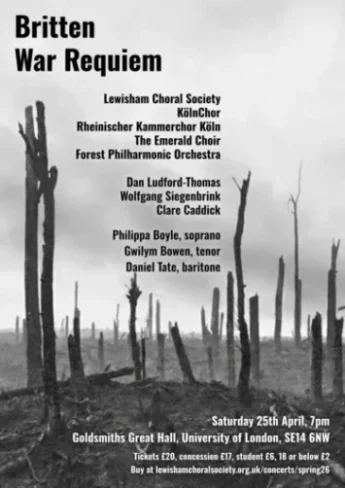
Lewisham Choral Society valiantly took on Britten’s harrowing choral masterpiece at Lewisham’s Goldsmiths College, in the Hall of the Grade II listed Richard Hoggart Building. (Not to be confused, as I did initially, with Grade I listed Goldsmiths Hall in the City of London or UCL’s historic Great Hall which was destroyed by bombing in 1940.) Founded in 1950, Lewisham Choral Society describes itself as a ‘lively, friendly, diverse, community-based choir, with over a hundred singers’. It is now one of the largest amateur choirs in South London, and non-auditioned.
The War Requiem proved quite a challenge for them, although they rose to the occasion. They were joined by about twenty members of two German choirs from Cologne, with whom they had sung the same work in Germany last year. Their chorus master Wolfgang Siegenbrink came over to direct the chamber orchestra.
The choir dealt with changes of dynamics and projection of text well; intonation was well-controlled. Too many singers, though, had their heads buried in their scores so when the conductor changed tempo towards the end of the ‘Dies irae’, things went awry. Volume was also not always overpowering, given the number of singers. Altos in particular were not loud enough when opening the ‘Recordare’ section, but final ‘Amens’ were beautifully held. All credit to the chorus for tackling this complex piece.
The soloists were a fine trio. Philippa Boyle had plenty of steel and volume, with secure top notes, and both male soloists revelled in their diction, projecting and phrasing the beautiful lines of Wilfred Owen’s wartime poetry with aplomb. Britten saw the Nazi concentration camp and its aftermath at Bergen-Belsen, where Yehudi Menuhin played for the survivors. It was hard not to have a lump in the throat when the tenor and baritone sing ‘…but slew his son. And half the seed of Europe, one by one’. Both male singers matched each other to perfection in their duet; they have sung together before and it told. When Bowen sang ‘move him into the sun’ it was tear-jerking.
The children’s’ choir, quite a small number of girls and a few boys, were conducted at the side of the stage. I would have preferred them on the upper gallery or even out of sight. They are supposed to be heavenly angels. They did a competent job, nothing though can compare to the Highgate School Boys Choir on the Britten-Decca recording (non-impartial disclosure: I sang in that choir back in the 1960s).
The orchestral accompaniment was provided by the Forest Philharmonic. I remember them from Central London concerts in the 1970s when Frank Shipway was their Chief Conductor and a Mahler, Wagner, Bruckner or Richard Strauss work under his direction could easily be compared in quality with the very best. (Shipway, one of Klemperer’s assistants, and a demanding stickler for orchestral excellence, married the orchestra’s oboist and moved to Germany in the early 1990s). The orchestra has sadly now become much less prominent since Shipway’s departure though they also suffered from the withdrawal of sponsorship by Securicor and the major and second-tier orchestras (Orchestra da Camera and London Mozart Players for example) taking over the space of accompanying leading amateur choirs. The orchestra for this War Requiem only had two rehearsals, and with section leaders in the chamber orchestra, they came over as rather insipid. The principal trumpet had an off-night.
Dan Ludford-Thomas is the current chorus master of the Lewisham Choral Society and the National Children’s Choir of Great Britain; he conducts a wide variety of other choirs and is Head of Vocal Studies at Dulwich College. He held the 130 singers (I can’t be exact with that number, there was no list in the programme) together well, his clear conducting style aided the choir immeasurably.
The chamber orchestra was excellent, and the flowing conducting by Wolfgang Siegenbrink thoughtful and palpable. Siegenbrink wrote the foreword in the programme, mentioning the relevance of this work at a time when wars in Ukraine and the Middle East are bringing death, suffering and displacement to so many. This performance of the War Requiem left its mark.
John Rhodes
In 1966, aged 16, I sang O rest in the Lord in a performance of Elijah, in which the 22 year old (Sir) Thomas Allen sang Elijah, at John Howard School for Girls, Hackney, a state Grammar School which provided the ripieno choir for St Matthew Passion at the Royal Festival Hall every year. I haven’t stopped singing since, as I hope neither will the children of the Emerald Choir, drawn from state primary schools in the Borough of Lewisham.