 United States Barber, Vanessa: Soloists, Heartbeat Opera Band / Jacob Ashworth (conductor). Heartbeat Opera, Baruch Performing Arts Center, New York, 14.5.2026. (RP)
There is a constant drip of dire news about the state of opera in America, and then there is Heartbeat Opera bucking the trend. Its revelatory take on Samuel Barber’s Vanessa was universally acclaimed when it premiered at the Williamstown Theatre Festival last summer. The ticket demand for its New York debut run has been so great that additional performances have been added, not once but twice.
Vanessa premiered at the Metropolitan Opera in January 1958. It was a triumph for Barber as well as for Gian Carlo Menotti, the composer’s lover and lifelong partner, who wrote the libretto and also directed the production. Cecil Beaton designed the sets, and Dimitri Mitropoulos conducted a starry cast that included Eleanor Steber as Vanessa, Rosalind Elias as Erika and Nicolai Gedda as Anatol. It was mounted regularly through 1965, the company’s last season at the Old Met, but never again since the company’s move to Lincoln Center the following year.
Jacob Ashworth, Heartbeat’s Artistic Director, streamlined the libretto to expose the core of Menotti’s story of unrequited love, deception and resignation. Vanessa has spent 20 years in self-imposed isolation, awaiting the return of her former lover, Anatol. His son, also named Anatol, feels driven to meet the woman whose name scorched his mother’s lips and lit his dead father’s eyes with longing. The cash-strapped young Anatol is an opportunist who grasps for low-hanging fruit – in this case, Vanessa. After their marriage, they embark on travels, perhaps never to return. Erika, Vanessa’s niece, who was also ensnared in the tangled web of love and deceit, will now wait in isolation and solitude as her aunt did.
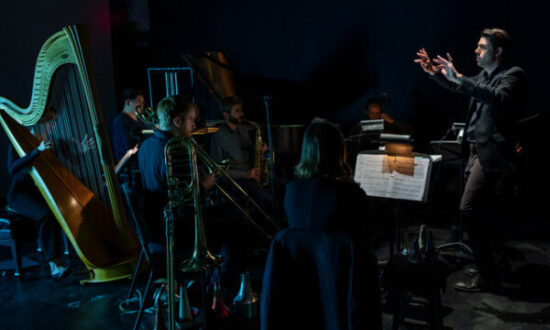
Dan Schlosberg’s adaptation of Barber’s score is the stuff of genius. It captures all of the lushness of the original while amplifying the protagonists’ follies and brittle calculations with clarity and bite. There is some edgy Weimar frenzy in Schlosberg’s reimagination of the score that doesn’t sound much like Barber but adds to the constant fever-pitched stream of emotions generated both in the pit and on stage.
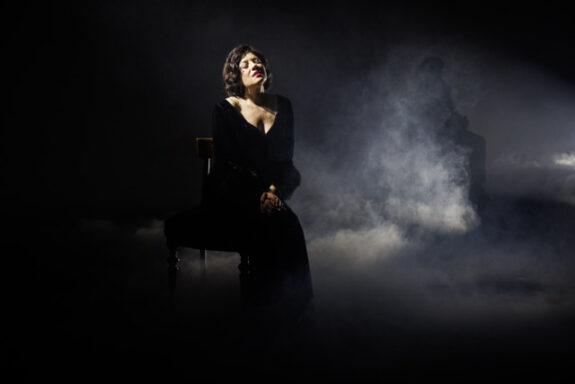
Equally brilliant is R. B. Schlather’s stark staging which puts the singers under the microscope. The stage, backed by an expanse of white, is bare except for a few chairs. The opera begins as it ends, with a traumatized Erika seated alone on stage. Lighting is an essential element in creating a constant hot-house atmosphere akin to a Tennessee Williams play. Vanessa’s entrance is augured by her oversized, looming shadow stretching across the stage – the first of many powerful instances where the lighting delivers a dramatic punch to the gut.
Inna Dukach was reprising Vanessa, a role she inhabits completely vocally and dramatically. She is the epitome of glamor, whether wearing a simple black dress with a string of pearls or a black velvet, fur-cuffed gown. Beneath the chic veneer, Dukach’s Vanessa is often coltish with awkward, angular movements, as if the torrents of emotion coursing through her needed to be released with the same physical intensity as they were vocally.
Dukach sang Vanessa’s greeting to Anatol, ’Do not utter a word’, with a chilling, blazing intensity, but her most compelling moment came at the end of the opera when she bid goodbye to Erika. Her Vanessa softened as she implored Erika to explain her actions on the night her engagement to Anatol was announced. Erika demurred, explaining it as a foolish thing that marked the end of her youth. For a few minutes, Dukach touched your heart as she revealed a Vanessa who was clear-eyed, tender and vulnerable.
Kelsey Lauritano as Erika and Freddie Ballentine as Anatol were new to the cast. Lauritano, sitting alone on stage in silence, made an instant connection with the audience, visually evoking the hungry deer of which she sings so hauntingly in the opera’s best-known aria, ‘Must the winter come so soon?’ In every scene, Lauritano’s penetrating voice was as captivating as her detailed characterization in which she captured a young girl’s vulnerability to Anatol’s smooth seductiveness as well as her defiance to accepting his transactional approach to love.
Ballentine’s movements were as sinewy and bewitching as his tenor voice which flowed like rich, amber-colored honey. The temperature on the stage rose exponentially every time he or his shadow appeared. His Anatol was a cad through and through, but there were moments when a few shreds of decency appeared in his dealings with Erika.
Mary Phillips reprised the role of the Baroness, as did Joshua Jeremiah as the old family Doctor. Phillips can express more with a glance than most people can with words. Her Baroness came off as an inflexible termagant but there was compassion too, revealed when she struggled to keep silent rather than give voice to her feelings. As the Doctor, Jeremiah was robust in voice and physique, unabashed to wallow in nostalgia. By the end of the opera, all of the Doctor’s illusions were shattered while the Baroness embraced a frigid, impenetrable silence.
Menotti’s libretto evokes 1950s Hollywood storytelling and Gothic romance. On opening night, Dukach, Ballentine and Jeremiah leaned into the melodrama, at times almost to giddy excess. It was delicious and the juiced-up audience egged them on. Who could fault them, especially since the emotional extremes are all in Barber’s score which Ashworth and his Band expressed so vividly.
Rick Perdian
Featured Image: Inna Dukach (Vanessa) © Maria Baranova
Production:
Libretto adaptation – Jacob Ashworth
Music arrangement – Dan Schlosberg
Director and Scenic design – R. B. Schlather
Sets – Jiaying Zhang
Costumes – Terese Wadden
Lighting – Yuki Nakase Link
Intimacy/Movement/Fight Coordinator – Skye Bronfenbrenner
Dramaturg – Peregrine Teng Heard
Cast:
Vanessa – Inna Dukach
Erika – Kelsey Lauritano
Anatol – Freddie Ballentine
Baroness – Mary Phillips
Doctor – Joshua Jeremiah
Musicians:
Clarinet/Saxophone – Louis Arques
Trombone – Sam George
Piano – Eliot Goldmund
Cello – Thapelo Masita
Harp – Deanna Cirielli
Trumpet – Grace O’Connell
Violin – Sunny Sheu