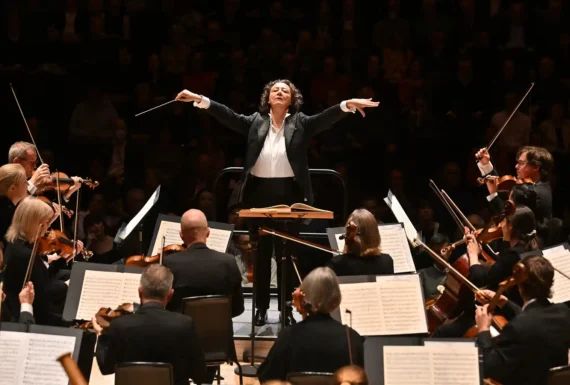
 United Kingdom Beethoven, Wagner, R. Strauss: Leif Ove Andsnes (piano), London Symphony Orchestra / Nathalie Stutzmann (conductor). Barbican Hall, London, 14.5.2026. (AV-E)

Beethoven – Piano Concerto No.3
Wagner – Overture Rienzi
Richard Strauss – Der Rosenkavalier Suite
The consummate and commanding Nathalie Stutzmann launched the evening with a buoyant and flamboyant reading of Wagner’s resplendent Rienzi Overture, guiding the London Symphony Orchestra through a sweeping narrative that fused noble grandeur with dramatic urgency.
The performance leaned into a brilliant, colourful palette of textures, never sounding bombastic but rather full of buoyancy and theatrical kineticism. The gleamingly brazen brass chorales possessed a staggering sonic weight and radiant solar light; indeed, I have never heard the LSO brass play with such intoxicating brilliance as I did on this occasion. Not forgetting the percussion, who played with great panache and supreme aplomb to drive the gripping performance to its thrilling heights. With this single, structurally immaculate performance, Stutzmann proved herself to be a pre-eminent Wagner conductor of today, effortlessly steering the overture’s notoriously wide-ranging dynamics from its hushed, prayer-like string opening to the terrifyingly precise, explosive fortissimo climaxes with absolute clarity.
Turning to Beethoven’s Piano Concerto No.3 in C minor, Op.37, the Allegro con brio saw solarist-soloist Leif Ove Andsnes deliver a flawless performance from his very first entry, shaping the line with an absolute sense of inevitability rather than overt theatrical display. Andsnes’s fleeting playing favoured an alert keyboard precision and structural understanding over empty virtuoso flash. Even in the most turbulent, restless passages, his tone remained finely controlled, clean, and purposeful, while Stutzmann’s accompaniment was highly attentive, sharpening and impelling the inherent drama of the score.
The Largo emerged eloquently as a radiantly resplendent slow movement where the playing possessed a haunting, delicate evanescence. Andsnes’s incisive interpretation here was deeply nuanced, spinning the long melodic lines so that they shimmered with a blinding, pristine celestial radiance and a tender introspection. The LSO woodwinds responded with exceptionally close, empathetic chemistry, offering beautifully blended support that allowed the piano’s path to feel beautifully organic.
Quicksilver energy was restored to the Rondo: Allegro, where Andsnes handled the complex exchanges between soloist and orchestra with deft, crisp rhythmic precision. His flawless technique brought wit and a high-spirited buoyancy to the playful turns, making the music’s conclusion feel both triumphant and profoundly satisfying. Throughout the concerto, the LSO accompanied with a gritty muscularity, driven by weighty strings, pointed woodwinds, and solid, crisp timpani. Stutzmann’s conducting was a paragon of perfection.
The disappointingly short evening culminated in an elegant and exuberant rendition of Richard Strauss’s Der Rosenkavalier Suite. Stutzmann’s conducting of the score was, for me, on par with Carlos Kleiber’s legendary interpretations of the opera, matching his signature approach with its infectious sense of lilting-grace, incandescent elastic élan, and rhythmic sensuousness. The perfumed performance exploded into life during the Act I Prelude and First Waltzes with great swagger and exuberant hunting horns.
Stupendous Stutzmann revelled in the opulent orchestration, drawing a lush, unhurried pacing from the syrupy LSO strings that perfectly captured the late-Romantic spirit. During the Presentation of the Silver Rose, the musical texture shifted beautifully into a stylish, suave, and debonair atmosphere, with shimmering woodwinds and celesta rendering the famous silver rose motif with an exquisite, crystalline clarity. Baron Ochs’s Act II Waltz Theme was delivered with robust, comedic swagger, which dissolved seamlessly into the mischievous, fast-paced hubbub of the Act III Prelude and Pantomime. Finally, the heartbreakingly tender strains of Ist ein Traum and the Final Trio dissolved into a lilting grace, balancing Viennese bonbon charm with a saccharine-wrenching nostalgia that captured the precise twilight of the Habsburg era, as Stutzmann handled the transitions smoothly, sweeping the orchestral fantasy into its raucous, grand-scale Waltz Reprise conclusion, which unleashed a wave of ecstatic joy and unbridled adulation from the captivated audience. Yet again, it was the brass that stole the show, playing with breath-taking panache and ecstatic exhilaration, bringing tears to the eyes.
Theodor Adorno was right to state that Strauss’s Rosenkavalier was ‘the celebration of the bourgeois way of life’ for it is a sumptuous manifestation of The Bourgeois Condition. Watching the captivated audience bask blissfully in the plush, velvet textures and sybaritic richness of Strauss’s score — submitting completely to its narcotic, silver-spun hedonism — one cannot help but think of today’s revolutionary left, who are subliminal aspirants to The Bourgeois Condition — it is their subconscious guilty pleasure. Der Rosenkavalier is the ultimate musical mirror for this unacknowledged hypocrisy of the so-called ‘far-left’; it is radicalism that ultimately surrenders to luxury.
The only criticism I have of this benchmark concert is that it was a mere 65 minutes in total which is completely unacceptable. The programme could have easily included Die Frau ohne Schatten Suite (21 minutes) following after Der Rosenkavalier Suite (21 minutes); while still only bringing the second half of the concert to 54 minutes (including the Wagner).
However, this was undeniably one of the most sublime concerts I have ever experienced for world-class conducting and instrumental mastery, and it was a crying shame that it was not broadcast on BBC Radio 3.
Alexander Verney-Elliott
Featured Image: Natalie Stutzmann conducts the London Symphony Orchestra © Mark Allan/LSO