
 United Kingdom Beethoven, Benjamin, R. Strauss: Veronika Eberle (violin), BBC National Orchestra of Wales / Alexandre Bloch (conductor). Hoddinott Hall, Cardiff, 14.5.2026. (LJ)
Beethoven – Violin Concerto in D major, Op.61 (1806)
Sir George Benjamin – Concerto for Orchestra (2021)
Richard Strauss – Death and Transfiguration, Op.24 (1889)
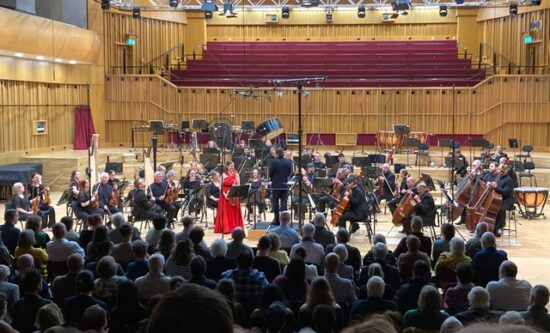
German violinist Veronika Eberle walked onto the stage at Cardiff’s Hoddinott Hall to perform Beethoven’s Violin Concerto with the BBC National Orchestra of Wales, conducted by Alexandre Bloch (best known for his longstanding role as Music Director of the Orchestre National de Lille). Beethoven’s concerto is often considered the sine qua non of the four major violin concertos, the other three being those by his compatriots: Mendelssohn, Brahms, and Bruch. This fame is somewhat in spite of the fact that the work was largely dismissed when it premiered on 23 December 1806.
Eberle’s performance of Beethoven’s concerto must not suffer the same unfortunate fate! It was fresh and exciting, in part because she performed new cadenzas for the piece that were composed by Jörg Widmann in 2020. During an interview with Interlude in December 2024, Eberle described how these cadenzas make Beethoven’s concerto seem ‘present’, ‘up-to-date’, and ‘very modern’. I would add that these heavily textured, virtuosic passages intentionally destabilise and distort whilst remaining in contact with Beethoven’s at once sensitive and powerful score.
At times, Widmann’s phrase leans into gypsy and jazz rhythms, yet each cadenza remains connected to the musical theme from which he quotes. In Eberle’s performance, there was foot stomping, pizzicato, col legno bowing. There were even harmonics to be found amidst a range of challenging bowing techniques and quicksilver runs. These cadenzas were exciting, especially when trios emerged with the timpani (Steve Barnard) and double bass (David Stark). The duet with first violinist Tom Aldren (who led the orchestra for this piece) was challenging in all the right ways as it made the audience question Widmann’s points of departure from and return to Beethoven’s score. In these moments, Eberle lifted the music out of its Romantic context just enough for renewed colour and dynamism to radiate.
For the audience, it was almost as if we were hearing this concerto for the very first time. Eberle’s verve and the BBC NOW’s energy demanded our attention. Key to achieving this heightened focus was the tempo taken by Bloch. To be highly critical, perhaps it was taken a little too quickly with Eberle needing a little more space within the bar. But this quick tempo allowed for expressive phrasing in the wind section, an eagerness within the percussion section, and a sense of flow within the string sections – neither plodding in four beats nor hurried.
After the interval, the positive collaboration between conductor and orchestra was evident with Bloch and the BBC NOW returning to perform Sir George Benjamin’s Concerto for Orchestra (2021) and Richard Strauss’s tone poem Death and Transfiguration, composed in 1889.
Benjamin’s Concerto for Orchestra was written for the composer and conductor Oliver Knussen, who passed away in 2018. When speaking of Knussen, Benjamin remarked that he ‘maintained the closest of friendships for 40 years’, suggesting that the piece contains a personal depth that cannot be fabricated. He added that it attempts ‘to conjure a trace of the energy, humour, and spirit’ of his late friend. In the course of one movement lasting around 15-17 minutes, Benjamin engages all sections of the orchestra with each instrument having the spotlight, if only for a brief moment. It is a richly textured work that is at times light and at other times turbulent. The BBC NOW demonstrated technical skill as they performed this determinedly roving work with a structured sense of pace where each soloist (including tuba player James Tavares) shone.
The final piece of the evening was Strauss’s Death and Transfiguration. It is about a dying man reflecting on his life, with the final movement (Moderato) depicting his last moments. As the anecdote goes, Strauss told his daughter-in-law on his deathbed that ‘dying is just the way I composed it’, referring to this very piece, which, ironically, he composed when he was just twenty-five.
Whilst it has been said that Strauss was influenced by Wagner’s Tristan und Isolde (1865), Strauss’s piece is not of epic proportions. Rather, it is evocative of the embers between life and death. As such, it does not represent dying (death itself is signified by a glissando followed by a solitary gong); it creates a soundscape that evokes the transfiguration between this world and that which lies beyond our consciousness. When interviewed on stage by Shân Cothi, Bloch said that Strauss suggests ‘death [is] not the end but a passage to something different’. In his conducting, Bloch was excellent at bringing long phrases to their conclusion. His attentiveness to each section of the orchestra and sensitivity to the dynamics within each phrase were key to achieving the expectant finish of Strauss’s piece.
The BBC NOW performed Death and Transfiguration for the 2014 Proms under the baton of Thomas Søndergård (review here). Bloch’s interpretation brought out the sense of agitation and intensity within the transfiguration part of the work. The string section performed very well with the final bars replete with a sense of wonder, abandon, and flight. Interested readers can hear the full concert by tuning in to BBC Radio 3 In Concert on 29 June.
Lucy Jeffery
Yes Bloch was at Lille for 10 years but Casadesus did 40 years!!!! He is a very fine conductor.