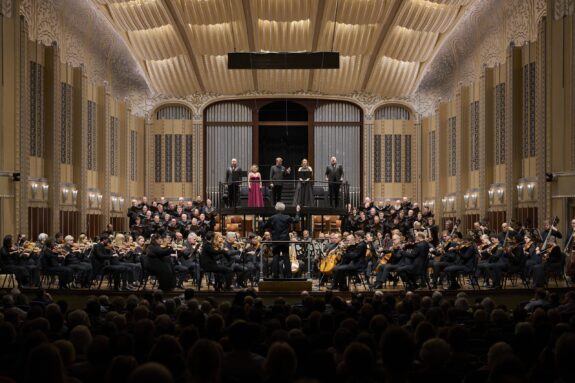
 United States Beethoven, Fidelio: Soloists, Cleveland Orchestra Chorus (director: Lisa Wong), Cleveland Orchestra / Franz Welser-Möst (conductor). Mandel Concert Hall at Severance Music Center, Cleveland, 15.5.2026. (MSJ)
The key event of this year’s Mandel Opera and Humanities Festival was the launch of the first of three scheduled performances of Beethoven’s stirring Fidelio, in a concert performance enhanced by the presence of the Cleveland Orchestra as the ‘pit band’. Not that they were in the pit, a rarely-used feature that Severance Music Center does, in fact, have. The hall was originally built with a pit in hopes of regular inclusions of opera productions in its future.
The reality turned out to be rather different. After a handful of productions during music director Artur Rodzinski’s tenure in the 1930s – including the US premiere of Shostakovich’s Lady Macbeth of Mtsensk – opera productions were abandoned as too expensive. Lorin Maazel attempted a few in the 1970s and Christoph von Dohnányi led some opera performances in the 1980s and 90s, but it has been a key accomplishment of Franz Welser-Möst’s directorship that opera has finally secured a yearly place as an anchor of the season’s culmination, the Jack, Joseph and Morton Mandel Opera & Humanities Festival. This has varied between creative semi-staged productions and more stripped-down concert performances, but the very presence of operatic repertory keeps this orchestra in touch with a vital part of the classical music world.
What is arguably best about this year’s installment is the willingness to take a stand. Welser-Möst made no bones about it in a statement included in the delightfully in-depth program for the festival: ‘Any staging of Fidelio joins a long history of political performances’. With the United States embroiled in the most extreme political divisions it has seen in decades, Welser-Möst decried the impassivity of current leaders: ‘Civic courage is not the strength of our time. People on both sides of the political spectrum tend to go with the flow without considering the consequences’. He contrasts that with the character of Leonore who risks her life to infiltrate the prison where her husband is being held as a political prisoner. The conductor stated that he wished to do concert presentations of Fidelio in order to put the emphasis on Beethoven’s philosophical idealism which sees the true ‘action’ of the work in the music. This kind of presentation also made the presence of the Leonore Overture No.3 as an extended prelude to the final scene feel natural, as the star of this performance was, above all else, the Cleveland Orchestra itself, given dramatic license here to light up an incendiary performance.
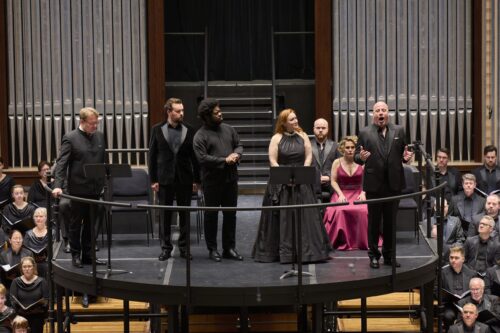
That being said, there were some outstanding vocalists singing above the orchestra, quite literally, on a platform over the orchestra and chorus who filled every other inch of the stage. Soprano Sara Jakubiak was the only soloist who sang from the score, but it did not prevent her from launching ardently into the role of Leonore with a burnished voice and agonized intensity as she sought to make her way into the prison dungeon. Her tawny, powerful tone contrasted clearly with soprano Ashley Emerson’s bright-voiced Marzelline. Emerson scored the comic aspects of Marzelline in the opening scene without exaggeration, matched by tenor Owen McCausland’s perky Jaquino. Bass Raymond Aceto was particularly adept at bridging jailor Rocco’s wide-ranging material: he showed keen comic timing in the first scene, while effectively portraying both his queasy toadying to his boss, Don Pizarro, and his empathetic support of Leonore in the prison dungeon. All of that acting skill was paired to a singing voice that showed the same multiple shades of meaning.
Welser-Möst joked in his program note that the hall may need another renovation after bass-baritone Tomasz Konieczny sang the part of Don Pizarro, and he wasn’t far off! Beethoven gave the singer quite a challenge to make himself heard in passages that would have the pit orchestra playing at full strength. In this case, it was the Cleveland Orchestra, up on the stage with him, a formidable foe indeed. Remarkably, Konieczny had the sheer power to still be heard atop the orchestra who were not being held back as Welser-Möst so often does. The music demanded full fire, and the conductor knew he had a Don Pizarro who could take it. All this with a full stage presence and vocal nuances down to the softest tones made Konieczny’s performance a triumph.
The opera’s Florestan has the challenge of going unseen and unheard during the long first act, then opening up Act II with the character’s sole aria. But tenor David Butt Philip showed how it is done, vaulting off a creepily characterized orchestral opening with a despairing ‘Gott!’ that started from a breathy attack but built unstoppably to a ringing fortissimo. His subsequent interactions with Leonore surged with warmth, both singers convincingly inhabiting the passionate connection between the characters. Bass-baritone Dashon Burton brought his glorious voice and energy to Don Fernando, the prison inspector who comes to stop Don Pizarro’s political misconduct. Choristers Ronnie Dailey and Francisco Prado stepped out proudly for passing commentary from the prison inmates, fervently voiced by the men of the Cleveland Orchestra Chorus. They were joined by the women of the chorus, both behind them onstage and overflowing into the dress circle to represent the townspeople who gather in celebration. And what a celebration it was, with Lisa Wong’s crisp, vibrant chorus joining such outstanding singers and one of the world’s finest orchestras in the thrilling release of energy that crowns the opera, particularly with the Leonore Overture No.3 in place. Welser-Möst can be reluctant at times to unleash Beethoven’s supposedly abstract symphonies but, with a clear license for high drama, he proved how exciting he and this orchestra can be.
As for narrator Tony Sias, I must give full disclosure and admit my bias: I have performed the narration for this opera myself for a regional production and have my own ideas about how it should be presented. Suffice it to say that I found Sias more melodramatic than dramatic, despite the obvious glories of his speaking voice and stage presence which we have happily experienced many times previously in Cleveland Orchestra concerts. There also seemed a confusion at the end of the first act when Sias advanced to his stand just as Welser-Möst ended the act. Regardless, the narration is still a welcome guide through the opera and was appreciated.
In sum, it was a glorious performance and an important, defiant statement about freedom, justice and love, especially at a time when such things are under attack from many quarters. One last question, though, remains hanging in the air, something that occurred to me because of my own background in theater. In ancient drama, if the action of the play became almost hopelessly convoluted, the playwright could always resort to the deus ex machina ending. Literally, a ‘god on a machine’ would be lowered by rope to sort out the problems and dispense justice. Beethoven and his librettist do just that in this opera: Don Pizarro is about to execute Florestan when trumpets are heard offstage announcing Don Fernando’s arrival to save the day. In performance, it was stirring, as always.
But who is going to show up to save us today?
Mark Sebastian Jordan
Featured Image: [rear l-r] Owen McCausland (Jaquino), Ashley Emerson (Marzelline), Tomasz Konieczny (Don Pizzaro), Sara Jukubiak (Leonore) and Raymond Aceto (Rocco). Cleveland Chorus and Orchestra and conductor Franz Welser-Möst © Roger Mastroianni/TCO
Production:
Stage manager – Lucy Guillemette
English supertitles – Sonya Friedman
Cast:
Narrator – Tony F. Sias
Jaquino – Owen McCausland
Marzelline – Ashley Emerson
Rocco – Raymond Aceto
Leonore – Sara Jakubiak
Don Pizzaro – Tomasz Konieczny
First Prisoner – Ronnie Dailey
Second Prisoner – Francisco Prado
Florestan – David Butt Philip
Don Fernando – Dashon Burton