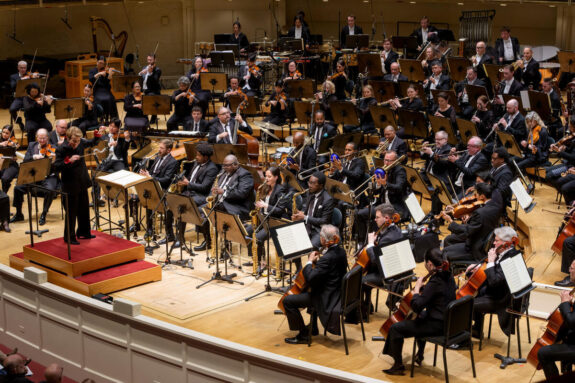
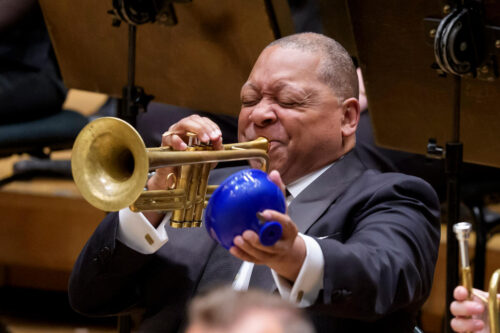
 United States Various: Wynton Marsalis (trumpet), Jazz at Lincoln Center Orchestra and Chicago Symphony Orchestra / Marin Alsop (conductor). Orchestra Hall, Chicago, 4.6.2026. (ZC)
Adams – The Rock You Stand On
Copland – Suite from Appalachian Spring
Wynton Marsalis – Selections from Symphony No.4, ‘The Jungle’
The Chicago Symphony Orchestra opened its month-long celebration of America’s 250th anniversary with a program that traced a century of the nation’s musical lineage. The concerts to follow will feature an eclectic lineup, from pianist Conrad Tao and mandolinist Chris Thile to Leonard Bernstein’s The Age of Anxiety. By uniting the voices of John Adams, Aaron Copland and Wynton Marsalis in its opening program, the CSO is establishing a clear baseline for its audience: here is how our country’s orchestral style has evolved under the talents of its artistic voices.
In Copland, one finds the midcentury ideal: a cultivated European training transformed into an expansive, distinctly American language. Adams marks the late-twentieth century turn away from the more abrasive strains of academic modernism toward a broader, more accessible musical vocabulary. Marsalis has spent much of his career arguing for straight-ahead jazz as a serious American art form, one deserving a place beside the nation’s other traditions.
The task of drawing those disparate strands into a coherent evening fell to Marin Alsop, who received an enthusiastic welcome back to Orchestra Hall. She has been chief conductor at the Ravinia Festival for long enough that Chicago audiences have claimed her as one of their own. Her deeper credential, though, is her record as an interpreter of American music. She studied with Leonard Bernstein and has produced acclaimed recordings of his orchestral works as well as Samuel Barber’s. When it comes to this particular repertoire, Alsop is not guessing.
That experience made her an especially apt interpreter for John Adams’s new The Rock You Stand On, which the composer wrote for her; it received its Chicago premiere in Orchestra Hall. The piece, about ten minutes long, is a sort of reunion with Adams’s earlier self. There is a bounce here that recalls Fearful Symmetries and, as the composer has suggested, even something of a big-band spirit – a fitting if unintended nod to the Marsalis work in the second half of the program. But The Rock You Stand On is also unmistakably contemporary Adams: the textures form gradually, the form stays loose, the music thickens by accumulation. It has the concision of A Short Ride in a Fast Machine without quite the propulsive charge. Alsop and the CSO gave it a clean, capable performance. Though it deserved a little twitchier energy – more of the rhythmic volatility that distinguishes Adams at his best – the piece is a welcome addition to his catalog.
This jazzy undercurrent made it a natural companion to selections from Wynton Marsalis’s Symphony No.4, ‘The Jungle’. To call ‘The Jungle’ a symphony is to stretch the genre’s definition. A full performance runs well over an hour, and the work sits more comfortably in the space between a suite and a concerto grosso – specifically for jazz band and orchestra.
Alsop led the CSO and the Jazz at Lincoln Center Orchestra through four of its six movements. Because the movements operate as self-contained vignettes of New York City, omitting sections does not disrupt the piece’s spirit. ‘The Big Scream (Black Elk Speaks)’ depicted indigenous struggles with weeping glissandos and restless, unsettled rhythms. ‘La Esquina’ attempted to weave in Afro-Latin grooves, though it felt the least distinctive of the four movements with Marsalis trying to evoke a community outside his core jazz vocabulary. ‘Us’ offered a far more engrossing, sensuous portrait of urban intimacy while ‘Struggle in the Digital Market’ drove forward with machine-like energy before dissolving into a spectacular cadenza played by Wynton Marsalis himself.
The CSO largely served in an accompaniment role, augmenting and supporting the Lincoln Center musicians. There were long stretches where the orchestra had little to do. Alsop functioned more as traffic manager than interpretive guide. Given the material, it was probably the right instinct, but it left the balance feeling off. The jazz musicians provided most of the heat. The concert’s one frustration was that the CSO’s considerable brass, wind and string resources never quite got to show what they could do in tandem with the Lincoln Center players, rather than simply behind them.
Sandwiched between the Adams and the main event was Copland’s suite from Appalachian Spring. One hesitates to say too much about a piece this familiar. Copland was shaped by Nadia Boulanger in Paris and the European cultivation shows, but the music has become so bound up with American identity that its origins are almost beside the point.
The CSO’s strings were fine under Alsop, warm and attentive to phrase, but what made the performance sing were the woodwinds. In this score, Copland’s wind writing is where the American character actually lives – the fluid lines and spare solos, the famous ‘Simple Gifts’ theme that is introduced with unassuming grace. Principal clarinet Stephen Williamson, principal oboe William Welter and their colleagues are among the best in the business. They proved it here.
Zach Carstensen
Featured Image: Marin Alsop leads the Chicago Symphony Orchestra Marin Alsop leads the Chicago Symphony Orchestra and the Jazz at Lincoln Center Orchestra © Todd Rosenberg Photography