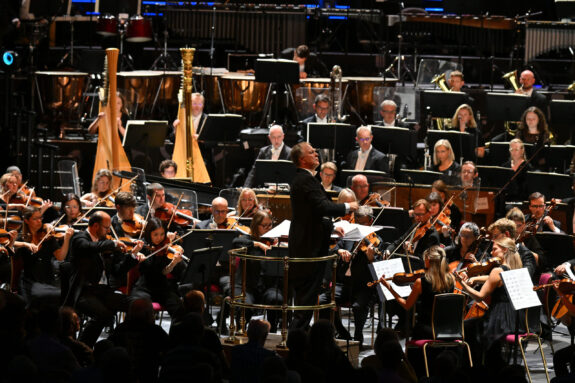
 United Kingdom BBC Proms 2026 [3] – Kurtág, Mahler: BBC Symphony Orchestra / Sakari Oramo (conductor). Royal Albert Hall, London, 22.7.2026. (JR)
Kurtág – Stele, Op.33
Mahler – Symphony No.6
György Kurtág reached his 100th birthday in February – and is still composing! For much of his composing life, Kurtág was known for his fragmentary works, very short pieces, very few notes, hardly any orchestral pieces. In the early 1990s Claudio Abbado asked Kurtág to be Composer-in-Residence at the Berlin Philharmonic. Kurtág agreed to write a new piece for orchestra, and this became Stele (‘tombstone’ in Italian), a memorial to a close friend.
Kurtág did not do things by halves, it is scored for a huge orchestra, woodwind in fours, a Wagner-sized brass section, tuned and untuned percussion, the Hungarian cimbalom, two pianos and a full complement of strings. If you then had expected a huge outburst of sound, you would have been disappointed. Only once in the 13-minute work does a tutti in the faster second movement briefly raise the roof, a moment of orchestral grief; for the most part we hear the composer’s penchant for fragments. At the start, we hear what sounds like the beginning of the Fidelio overture, smeared and muddied with glides and microtones. The mood is mournful. Wagner tubas evoke Bruckner. The finale is different altogether – ominous gong-like and luminous reverberations conjure up a vision of another world. A work of extreme economy (although the score on the conductor’s desk was vast) and of communicative power.
I am not keen on intervals in concerts after thirteen minutes of music but after the Kurtág one could not launch straight into Mahler, the mind had to be cleansed, the throat with a drink. Some would argue a monumental symphony such as this should stand on its own and I would not disagree.
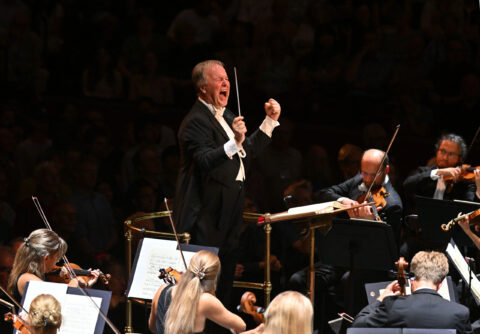
The BBC Symphony Orchestra will perform twelve concerts this season, they really are the backbone of the BBC Proms, along with the other BBC orchestras. The orchestra is audibly on top form, firing on all cylinders. It helped that Sakari Oramo knew this symphony inside out. Tempi and dynamics were faultless, the interpretation coherent, and the orchestra clearly very well-rehearsed. This was a muscular reading; I would perhaps have liked more savagery at the very outset: Oramo displayed tenderness when required. Woodwind bells were frequently raised to cut through the Royal Albert Hall’s rather woolly acoustics. Many principals deserve special mention: Clara Andrada (flute), Alison Teale (oboe), Adam Lee (clarinet), Nicholas Korth (horn) – all splendid.
Oramo played the Scherzo before the slow movement: I think Mahler got it wrong when playing the slow (Andante moderato) movement second. A third hammer blow towards the end of the massive Finale was unusual, but it does no musical damage, except to the floor of the stage. The distant offstage cowbells were a mite too distant for me, they improved later in the symphony and the percussionist went to town (or rather alp) when playing them on the stage.
The highlight of the symphony was the exceptionally quiet final passage of the slow movement with its wistful oboe and magical celesta. The two timpanists were never tentative and the audience roared its approval at the end of this mighty work.
What a pity, though, that a no-doubt well-meaning usher decided to let a latecomer into his seat in the middle of a row in the choir area, whilst the second movement of the Mahler had already started. It was most distracting for everyone in the hall.
I know that all Proms are on BBC Radio 3 and BBC Sounds of course; but it has been announced that 27 will be on TV and BBC iPlayer and updated information can be found here.
John Rhodes
Featured Image: Sakari Oramo conducts the BBC Symphony Orchestra © BBC/Mark Allan
Yes and BBC seem to have got their microphones and balance in RAH sorted in 2026.