
 United Kingdom Clandeboye Festival [3] – Beethoven, Schubert: Barry Douglas (piano) and chamber musicians. Clandeboye Estate, County Down, 28.8.2026. (RB)
Beethoven – Quintet for Piano and Winds, Op.16
Schubert – Octet in D major, D803
This concert from the Clandeboye Festival featured two great staples of the chamber music repertoire by Beethoven and Schubert.
Beethoven’s Quintet for Piano and Winds in E-flat is the composer’s only chamber work for piano and wind ensemble. It is modelled closely on Mozart’s Quintet K452 – it is in the same key, and it has the same instrumentation and same three‑movement layout with a slow introduction. It shows Beethoven absorbing Mozart’s influence while asserting his own independent voice. The work balances lyrical wind writing with a dominant piano part that treats the work like a small-scale concerto.
Barry Douglas was joined by Ben Cannon, William Curran, Hannah Miller and Patrick McErlean for this performance. Douglas clearly treated this as a classical work, and he played with considerable restraint and scrupulous attention to phrasing and dynamics. The four wind players blended beautifully and there was a good balance of sound between the wind and piano. The slow introduction had a stately quality and there was nice interplay between the piano and wind. The Allegro which followed was bright and lyrical and Douglas’s handling of the rapid scalic runs was impressive. I wondered if the tempo might have been a little too fast. Miller’s virtuoso horn solo before the coda was not technically secure and this may have been because of the very quick tempo.
The Andante second movement was intensely lyrical and expressive and the phrasing was seamless. The four wind players captured the distinctive vocal quality of the writing and Douglas proved an attentive and flexible accompanist. The final section of the movement with the very intricate piano embellishments and ornamentation was particularly beautiful. The finale with its jaunty hunting theme was taken at a brisk pace and had a joyous and uplifting quality. Once again, Douglas seemed to relish the concertante elements in the movement playing the rapid-fire passagework with virtuoso aplomb. A series of spirited exchanges between piano and wind drove the work to its joyous conclusion.
Schubert’s Octet is a monumental, chamber work commissioned by clarinettist, Ferdinand Troyer, in 1824. Troyer suggested that Schubert write a successor work to Beethoven’s Septet. Schubert followed Beethoven’s six-movement format and added a second violin to the instruments Beethoven used for the Septet. It blends Schubert’s innate lyricism with symphonic ambition and is the longest chamber piece he ever wrote.
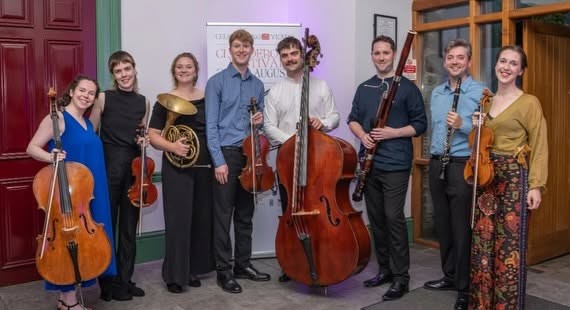
William Curran, Hannah Miller, Patrick McErlean, Siobhán Doyle, Phoebe White, Jamie Howe, Sinéad O’Halloran and Maitiú Gaffney took to the stage for the Schubert. The eight instrumentalists blended beautifully in the slow introduction to the first movement which had a distinctive Viennese quality. Curran on clarinet and Doyle on violin vied well together in the ensuing Allegro as the players explored the work’s dark undercurrents in increasingly remote keys. Curran’s clarinet took centre stage in the second movement Adagio. His performance of the famous melody was achingly beautiful against a beautifully controlled pulsing background on the strings. Curran’s legato phrasing and breath control were flawless. The third movement scherzo broke the spell of the Adagio with a surge of high-octane rhythms and rustic charm. The springy rhythms and typically Schubertian dynamic contrasts were well executed. The lower strings and bassoon were impressive in the Trio section.
The fourth movement is a set of variations on Schubert’s Die Freunde von Salamanka. The variations provided an opportunity for every member of the ensemble to shine, and they all rose to the occasion magnificently. The players created a striking contrast between the nightmarish fifth variation and the luminous sixth. In the final variations all the instrumentalists came together to conjure up an enchanting village band. In the fifth movement, Menuetto, the players struck a nice balance between classical elegance and rustic charm. The slow introduction to the finale with its ghostly tremolos in the lower strings and unexpected harmonic shifts is an extraordinary piece of writing. It needs to sound ominous and unsettling and it did in this performance. The ensuing Allegro was buoyant and energetic and infused with Schubert’s quintessential Viennese charm. The imitative writing in this movement once again allowed all the instrumentalists to show what they could do. The Coda was a blistering tour de force, driving this great masterpiece to its exhilarating conclusion.
Great ensemble playing from all the performers.
Robert Beattie
Performers: Ben Cannon (oboe), William Curran (clarinet), Hannah Miller (French horn), Patrick McErlean (bassoon), Siobhán Doyle, Phoebe White (violins), Jamie Howe (viola), Sinéad O’Halloran (cello), Maitiú Gaffney (double bass)