
 United Kingdom Holy Fool (a play by Rosalind Adler and Lea Sellers): Park Theatre, Finsbury Park, London, 3.9.2026. (JR)
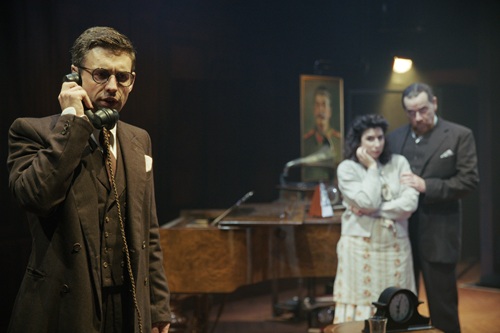
At the height of Stalin’s regime, Dmitri Shostakovich walked a perilous tightrope. Under the constant threat of torture, exile to Siberia or even death, he appeased – but also resisted – a brutal despot. Outwardly compliant, inwardly defiant, Shostakovich composed in code: music that concealed as much as it revealed. There have been a number of books on the subject, mainly of interest to classical music fans, notably a section in The Rest is Noise by Alex Ross and Testimony – The Memoirs of Dmitri Shostakovich by Solomon Volkov, amongst numerous others. There have also been a few plays, such as Collaborators by John Hodge which focused on one night in 1960 when Shostakovich is visited by the writer Nikolai Bulgakov when the two then confront Stalin’s regime.
This play at Finsbury Park’s 200-seat Park Theatre, Holy Fool, takes a longer view at Shostakovich’s life from his earliest days of composition in the mid-1920s until just before his death in 1975, and is a tense, darkly witty play – an exploration of the absurdity of tyranny, the bravery of resistance and, ultimately, the triumph of the human spirit. Apparently, the idea for the play came from a conversation between the two co-writers (who admit they initially knew little about the composer) and Simon Russell Beale (did he perhaps want to play Stalin?).
The play’s unusual title got me thinking and researching – the concept of the Holy Fool, rooted in the Eastern Orthodox and Russian cultural tradition, refers to a character or musical persona who appears eccentric, foolish or socially outcast but possesses a profound, prophetic wisdom. Society might consider them crazy, but they are often insulated from political retribution which allows them, to risk speaking dangerous truths to absolute tyrants. The most famous embodiment of the Holy Fool is the character of the Simpleton in Modest Mussorgsky’s Boris Godunov. Prokofiev included a movement dedicated to the Holy Fool in his film score of Ivan the Terrible for Sergei Eisenstein. Igor Stravinsky, composing in so many different guises and genres, is sometimes referred to as a chameleon-like Holy Fool of the modern era. In opera, one thinks immediately of Richard Wagner’s Parsifal, though here with a Germanic twist: perhaps Parsifal is more of a ‘pure fool’ (‘der reine Tor’). But Dmitri Shostakovich is, perhaps, the ultimate musical Holy Fool.
The set took us from Shostakovich’s modest flat in Moscow, to his country dacha and then to New York and Kansas. Small items of furniture (and pictures of Stalin and Lenin) indicated the period and location, a grand piano was present throughout. The play led us through various stages of Soviet history and we heard the music that Shostakovich was writing, or asked to write, at the time. We learned of the famous denouncement of his opera Lady Macbeth of Mtsensk by Stalin and then a ban on the composer’s music (and that of some of his fellow composers) until he composed his Fifth Symphony, ‘A Soviet artist’s reply to just criticism’.
Praise for the sound system in the theatre: we heard appropriate snippets of Shostakovich’s music (and some Prokofiev, who by happenstance died on the same day as Stalin); the sound quality was excellent as was the synchronisation of the actor’s piano playing. Lighting was, excuse the pun, always spot on.
The acting was convincing and gripping at all times. Benjamin O’Mahoney took over the persona of chain-smoking Shostakovich to perfection, including his sleeping with a packed suitcase in front of his front door – so as not to disturb his family, if he were to be carted off; and his physical disintegration following a heart attack and the onset of lung cancer was impressive. The role of his devoted wife Nina was very well taken by Jenna Augen, witty, forthright and touching. Later in the play, after her death, she took on the short role of a nurse. Fergus O’Donnell took on a number of smaller roles, with a number of accents: very versatile. Finally, Phoebe Pryce (daughter of Jonathan Pryce and the show’s Director Kate Fahy) took on a fictional role, Katya: whilst Shostakovich did have female admirers (and one to whom he proposed), there is no evidence he was admired by (in this play) a plumber’s mate whom he pursues to her final home in Kansas. In the last tender scene, Shostakovich makes a gift to Katya, the bound original score of his Fourth Symphony, which he had buried underneath the floorboards of his home for decades and only dared to resurrect after Stalin’s death. It brought a tear to the eye. Katya is presumably the voice of the Russian people, scathing about Shostakovich’s self-interest and his relevant luxury, questioning about the composer’s initial refusal to join the Communist Party and the reasons for his U-turn.
Russian repression, on the arts and elsewhere, is sadly still alive and kicking; and dictators or presidents around the world continue to terrorise and oppress in different ways; the theme of the play is as relevant today as it was in Shostakovich’s time.
John Rhodes
For more about Holy Fool at Park Theatre click here.
Cast:
Nina – Jenna Augen
Izaak – Fergus O’Donnell
Mitya – Benjamin O’Mahoney
Katya – Phoebe Pryce
Production:
Director – Kate Fahy
Set and Costume designer – William Fricker
Lighting designer – Oliver Fenwick
Sound – Julian Starr