
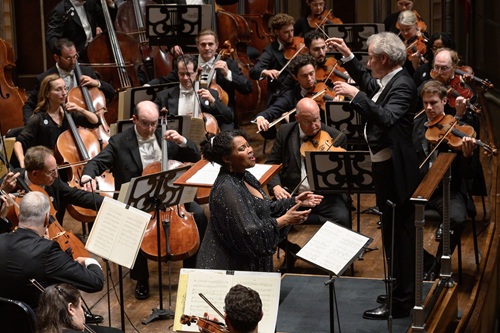
 United States R. Strauss, Shostakovich: Golda Schultz (soprano), Cleveland Orchestra / Franz Welser-Möst (conductor). Mandel Concert Hall at Severance Music Center, Cleveland, 17.9.2026. (MSJ)
R. Strauss – Four Last Songs
Shostakovich – Symphony No.8 in C minor, Op.65
Encore: R. Schumann – ‘Träumerei’ (arr. Josef Strauss)
Perhaps the most startling moment in this concert came at the thunderous climax when the third movement of Shostakovich’s Symphony No.8 crashes headlong onto the rocks of the slow movement that follows. As the orchestra roared, conductor Franz Welser-Möst was barely moving, leading with a mere flick of the wrist. It was a crystal-clear glimpse of what is best about this conductor/orchestra partnership: other conductors gyrate desperately in a futile attempt to provoke orchestras into intensity but Welser-Möst knows that the intensity is built from the quiet moments preceding the climax. He had been building for this moment for the previous forty minutes and didn’t need to push it. It was raging like a monster under its own power.
And that was merely one of dozens of arresting moments in a concert that can only be described as masterful. Welser-Möst has come a long way in his twenty-five years in front of this orchestra, and the concert featured two of the composers who have fueled some of his best moments here.
It opened with Richard Strauss’s Four Last Songs in the third performance led by this conductor that we have heard in Cleveland. The first was back in 2003 with Dame Felicity Lott. In 2013, we heard the songs at the Blossom Music Festival with Ľuba Orgonášová. But here Welser-Möst had the ideal voice: Golda Schultz. In 2003, Lott’s intelligence shaped the music well though the bloom was beginning to come off her voice. Orgonášová had a pretty sound but less flexibility. Schultz offered creamy rich vocal tone but also a sensitivity to detail that joined with Welser-Möst’s ability to wrap orchestral details around her voice.
The first song, ‘Frühling’ (‘Spring’), displayed Schultz’s poise and her sense of being alive to the subtly shifting atmospheres of Strauss’s warm but at times melancholy songs. Toward the end of the second song, ‘September’, the performance began to take on even greater emotion when she tenderly held back a phrase so that the orchestral accompaniment could entwine with her voice. I usually don’t tear up until the final song but this was so involving that even the third song, ‘Beim Schlafengehen’ (‘At Bedtime’), brought a glassy sheen to my eyes. ‘Im Abendrot’ (‘At Sunset’) found Schultz radiant with warmth, even as the harmonies side-slipped ever lower beneath her voice. The flutes trilled like distant birds as the music stilled. In typical form, Welser-Möst tried to defer all the curtain calls to Schultz until she grabbed his arm and dragged him back on stage for another bow. Happily, she will be taking this piece on tour with the orchestra in Europe (provided that orchestra and management can settle on a new contract before the looming 23 September deadline). Schultz is scheduled to return to Cleveland later this season for Beethoven’s Missa solemnis, to be repeated in Carnegie Hall.
The Strauss alone would have made it a concert to remember, but Welser-Möst wasn’t done. After intermission, the orchestra took on Dmitri Shostakovich’s epic Symphony No.8, one of the greatest pieces ever written, one that registers both personal and national tragedies. Interestingly, Welser-Möst opened the first movement without a wild-eyed attack, unlike on some occasions. But this was shrewd psychology: performances that try too hard to impress with the opening gesture tend to render the following quiet music as neutral. Welser-Möst’s matter-of-fact opening threw emphasis onto the quiet music which came alive with seething intensity, and from there the performance built with patience but also with remorseless growth.
The intimate acoustic of Severance Music Center’s Mandel Hall might not seem a likely venue for the giant climaxes of a work like this but it actually intensified them. We had heard Welser-Möst conduct it in the pavilion at Blossom Music Center which gave it a heroic resonance, but the clarity of the smaller hall gave the screeching climaxes of the first movement the terror of horripilation – literally causing goosebumps on the skin. That howl was followed by Roger Walters’s long and eloquent English horn solo, a voice of lament witnessing the unspeakable. Shostakovich wrote this during the depths of World War II and that is part of the music’s witnessed trauma, though the hells of Stalin’s Soviet Union and the composer’s own struggles with it are surely part of the ingredients. This performance embodied it all.
The Soviets were furious at Shostakovich’s dark symphony and were at pains to explain away its harshness, claiming that the second movement mocked Nazi parade marches. It may have satirized those, as well as so much more, but Welser-Möst understood that the movement should not be brought to an explosive head because the main event was yet to come – although Mary Kay Fink’s piccolo solo screwed the tension even tighter. The third movement arrived with perfectly paced motoric rhythms that grew terrifying en masse, as when the low brass took over the main theme while maintaining the quick speed. Hearing those massive brass passages bounce off the back wall of Mandel Hall was thrilling. In the middle section, Michael Sachs scorched his way through the manic trumpet solo, rarely putting a step wrong through the intricate patter. How that man alone can make as much sound as most orchestras is a mystery, and you would think that Shostakovich wrote the passage for him.
Though Welser-Möst is well-known (and sometimes chided) for his reserve, it can’t be denied that when he chooses to blow the roof off, it makes an impact like no other conductor. That came with the closing of the third movement, where timpanist Peter Nichols was given license to sound like the apocalypse itself when he took over the main motif of the movement, leading into the shattering, multi-part climax from which the trombones and tuba jutted into the solemn Largo built on a repeating bass pattern. Mary Kay Fink (piccolo) and Afendi Yusuf (clarinet) brought the shell-shocked solos that followed to disturbing life.
I believe the medical term ‘post-traumatic stress disorder’ was not defined until the 1980s, but Shostakovich pictured it unforgettably in 1943 in the final movement. The music attempts to picture a bucolic postwar peace with an earnest (but nervous!) bassoon solo, expressively shaped by Catherine Van Handel, but the peace is fragile, growing increasingly uneasy as the movement progresses until, like night terrors, the big climaxes from the first and third movements return. After that frightening relapse, the music attempted to resume the movement as if nothing had happened, but Amy Zoloto’s bass clarinet solo and concertmaster Joel Link’s solo violin came across like desperate whistling in the dark. Welser-Möst quickly drew down the remaining threads into a brief, stunned and quiet coda. After a few seconds of tense silence, the house roared when the conductor lowered his arms.
And after such trenchant catharsis, the orchestra offered a moment of sweet consolation when they tenderly played Josef Strauss’s orchestral arrangement of Robert Schumann’s beloved ‘Träumerei’ (‘Dreaming’) from the piano cycle Kinderszenen as an encore, sure to be featured on the upcoming tour.
Mark Sebastian Jordan