
 United States Various, ‘Gaïa’ Recital: Gautier Capuçon (cello), Jérôme Ducros (piano), San Francisco Symphony Youth Orchestra cellists (Timothy Huang, Anthony Jung, Melissa Lam, Ethan Lee, Claire Topper, Cara Wang). Davies Symphony Hall, San Francisco (world premiere concert performance), 16.11.2025. (HS)
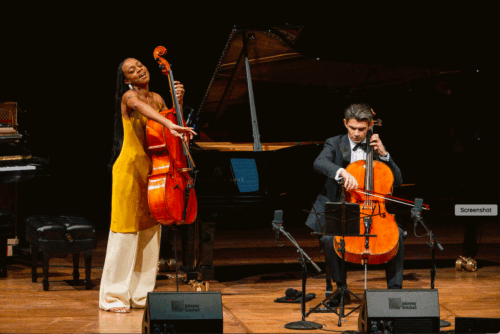
Gautier Capuçon, who ranks among the world’s great cellists, is known for his sensitivity, subtlety and, especially, an ability to shape tone, texture and dynamics to bring out the essence of whatever music he plays. Unfortunately, none of these nuances made their way through ham-handed audio amplification in an otherwise beautifully imagined world premiere concert performance of the ‘Gaia’ Recital on Sunday at Davies Symphony Hall.
For ‘Gaïa’, named after the mythical Greek goddess of the Earth, the French cellist enlisted contemporary composers to craft sixteen pieces (most under five minutes) that reflect concerns and appreciations of our planet. He chose some friends, including French composers Bryce Dessner and Michael Canitrot, Italian film legend Ludovico Einaudi and American mainstay Nico Muhly. Notably, he recruited a group of impressive diversity, including South African Abel Selaocoe and six women. A few others were new to him, among them Quenton Blache, who won several composition competitions while earning two degrees at the University of Southern California. He was one of five Black composers represented and one of several other cellists.
For all that, something seemed to be missing. When I got home after the concert I listened to the just-released recording of ‘Gaïa’ on Apple Music. ‘Tàmâr Mĕtūshelāh’ made its magic with the delicate textures of composer Olivia Belli’s lovely meditation on a 2,000-year-old date tree in Israel. Missy Mazzoli’s ‘The Usual Illusion’ painted its subtle portrait of a Fata Morgana mirage with intriguing watercolors of sound, and Quenton Blache’s ‘Of Wind and Rain’, a brisk whirlwind for six cellos, danced elegantly with intriguing zing.
Amped up by a much-too-loud sound system at Davies Symphony Hall, none of those aspects came through. Perhaps the audio technology was necessary to sync with videos and some pre-recorded overlays, but the unfortunate result of miking all of it robbed the music of its essence.
To introduce the theme, Capuçon played Max Richter’s ‘Sequence for Gaïa’ to sync with a film of Capuçon playing it on the high slopes of Mont Blanc, not far from the cellist’s birthplace in Savoie. Striking images show him on several slopes and peaks, and the final sequence films him playing his cello while rappelling down. On the big screen at Davies Hall it was visually mesmerizing. Musically? Not so much. The audio allowed only the general shape of the playing: it obscured Capuçon’s details of touch and texture that can lift it into art. (The video is available free on YouTube click here)
Notably, Capuçon enlisted a number of other artists to be on the stage with him. First was pianist Jérôme Ducros, a longtime collaborator, who demonstrated a sort of musical mind-meld with the cellist. Six members of the San Francisco Symphony Youth Orchestra joined him for four ensemble pieces, and one (Melissa Lam) held her own with him on a duet for two cellos, Einaudi’s ‘Air’. In a particularly charming duet with Capuçon, Ayanna Witter-Johnson sang her pop-tinged ‘Forever Home’, plucking and bowing her cello like an upright bass.
But the difference between what we heard in Davies Hall and what is on the recording was striking. Usually, live performance wins out in such comparisons. Sharing the same space as the artists often makes connections that the predictability of a recording does not. But this time the technology simply got in the way.
That is seldom a problem at highly amplified concerts in musical genres other than classical. A rock trio can create more sheer volume than a Wagner-size philharmonic orchestra. Recently, another cellist – Yo Yo Ma – shared a stage with the extraordinary French-African vocalist Angelique Kidjo at the outdoor Greek Theatre in Berkeley. The music was great, and the amplification didn’t matter because sharing the experience with thousands of attendees counted more than specific musical aspects of classical music, especially in chamber music.
It is dismaying that those refinements were missing in action throughout this presentation.
Harvey Steiman
Featured Image: Cellist Gautier Capuçon playing along with video of him on Mont Blanc © Credit Kristen Loken
Max Richter – ‘Sequence for Gaïa’
Armand Amar – ‘Boreas’
JB Dunckel – ‘Wake’
Gabriela Montero – ‘Sur le lac du Bourget’
Olivia Belli – ‘Tàmâr Mĕtūshelāh’
Missy Mazzoli – ‘The Usual Illusion’
Joe Hisaishi – ‘Prélude’
Ludovico Einaudi – ‘Air’
Xavier Foley – ‘Ambition’
Nico Muhly – ‘Side Piece’
Bryce Dessner – ‘Towards the Light’
Abel Selaocoe – ‘Toro Tsa Kwa’
Michael Canitrot – ‘Never Say Never’
Ayanna Witter-Johnson – ‘Forever Home’
Quenton Blache – ‘Of Wind and Rain’
Jasmine Barnes – ‘Life in Sunshine’
I think this reviewer missed the point, and clearly was not on the same wavelength as most of the audience!
I agree with Steve, the audience loved the performance with all of its creativity! 16 aspiring composers and performances by the next generation of cellists with Gautier as the lead performer was a hard to beat program!