
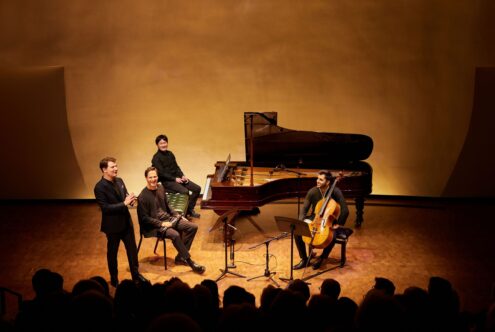
 United States Various: Andreas Ottensamer (clarinet), Kian Soltani (cello), Alessio Bax (piano). Stephen A. Schwarzman Auditorium, Frick Collection, New York, 16.11.2025. (ES-S)
Beethoven – Trio in B-flat major, Op.11, ‘Gassenhauer’
Schubert – Sonata in A minor, D.821, ‘Arpeggione’
Mendelssohn – Selections from Lieder ohne Worte: Op.102, No.1; Op.62, No.6, ‘Spring Song’; Op.67, No.5; Op.30, No.6, ‘Venetian Gondola Song’ (arr. by Andreas Ottensamer)
Brahms – Clarinet Trio in A minor, Op.114
Encore: Rachmaninov – Romance for 6 Hands in A major
The Frick Collection’s music series continued with a thoughtfully conceived program performed by Andreas Ottensamer, Kian Soltani and Alessio Bax. Moving from the poised clarity of early Beethoven through the more intimate worlds of Schubert and Mendelssohn and on to the heightened introspection of late Brahms, the recital traced how nineteenth-century instrumental writing both brushes against and is informed by the expressive territory of the voice. What emerged was less a sequence of contrasting pieces than a gradual shift from outward charm to inward reflection, guided by the distinctive musical profiles of the three performers, all committed chamber musicians.
Andreas Ottensamer, who recently stepped down as principal clarinet of the Berlin Philharmonic to expand his career as both soloist and conductor, brought the soft-edged glow and immaculate control that have long distinguished his playing. Kian Soltani, one of the most prominent cellists of his generation, contributed a clean, well-focused tone, with phrasing that emphasized line and coherence over dramatic accent. Alessio Bax, a pianist of refinement and subtle rhythmic instinct, anchored the ensemble with quiet authority: clear in articulation, lightly pedaled and attentive to coloristic detail. Together, the three offered an approach that, in the over-resonant acoustics of the Schwarzman Auditorium, aimed to favor finesse over exuberance and intimacy over projection.
Beethoven’s Trio in B-flat major, the so-called ‘Gassenhauer’, opened the program with genial precision. Written in the late 1790s and built around a popular street tune in its finale, the work achieved in this luminous reading an equilibrium between Haydnesque earthy humor and polished classicism. Bax set the tone with crisp rhythmic definition and an understated touch, allowing Ottensamer and Soltani to mirror and temper each other’s phrasing. Beethoven often imagines the clarinet and cello in close dialogue, and here that relationship felt finely balanced – Soltani’s lines slightly cushioned, Ottensamer’s delivered with rounded edges and suggestive dynamic nuance. In the concluding variations, the trio emphasized elegance rather than wit, an approach that granted the movement a certain composure, even if it softened some of its ludic edge.
Schubert’s ‘Arpeggione’ Sonata was written for a hybrid, briefly fashionable instrument of the 1820s that soon disappeared from use, leaving the work to be adopted by both woodwinds and strings. Heard here in a cello version that brought out the Lieder-like melancholy of its lines, the piece aligned naturally with the program’s stated focus on instrumental writing that evokes vocal qualities. Soltani framed the opening movement by allowing phrases to unfold without strain, while Bax partnered with a light but firm touch, keeping textures transparent and the harmonic motion purposeful. The central Adagio – spun in long, aria-like lines – proved the high point of their rendition, remarkable in its restraint and sustained sense of suspended time. In the finale, the virtuosic writing remained tempered, its bursts of joy intentionally fleeting, and the performance as a whole felt less like a display piece than a restrained continuation of the program’s lyric thread.
The second duo of the afternoon brought Ottensamer and Bax together for a selection from Mendelssohn’s Lieder ohne Worte, works written across more than a decade and lying stylistically between Schubert’s introspective lyricism and the more saturated expressivity of Brahms. Conceived for piano and heard here in Ottensamer’s own transcriptions, which entrust much of the ‘singing’ line to the clarinet, the pieces revealed a distilled form of Mendelssohn’s melodic gift, touched with the fairy-realm lightness reminiscent of A Midsummer Night’s Dream, at a distance from Schubert’s often tragic melancholy. In Op.102, No.1, Ottensamer paced the long phrases with natural ease, while Bax gave the melody unobtrusive support. The well-known ‘Spring Song’ (Op.62, No.6) unfolded with softened brightness: the clarinet’s timbre rounded off its sparkle, turning the melody into something more airborne than exuberant. Op.67, No.5 introduced a darker hue, its operatic turns shaded with discreet color. The ‘Venetian Gondola Song’ (Op.30, No.6) closed the set with a murmuring gentleness. Its lilting motion emerged not as picturesque scene-painting but as a quietly flowing line guided by understated rubato, recalling Soltani’s earlier comments about the pliant, subtly delayed inflections characteristic of Viennese rhythm.
The recital concluded with Brahms’s Clarinet Trio in A minor, the final stop in an afternoon structured quasi-symmetrically as two trios framing a pair of duos. A century after the novelty of the clarinet’s sound in Beethoven’s time, the instrument had become, by the end of the nineteenth century, a vehicle for the inward and autumnal expressivity Brahms sought. Ottensamer brought to this late work – one of several inspired by Brahms’s encounter with clarinetist Richard Mühlfeld – a warm, centered tone whose focus never wavered, even in the instrument’s darkest register. He traced the opening movement with measured breadth and avoided any hint of mannered rubato. Soltani’s entrance – that urgent, upward-arching cello line – brought a mellow gravity without heaviness, and the exchanges between the two retained a conversational fluidity rather than any sense of contest for prominence. Bax, navigating the piano’s often dense writing, kept textures transparent and harmonic detail audible, supplying the necessary weight without disturbing the ensemble’s balance.
In the Adagio, the clarinet’s long-spun phrases were delivered with understated eloquence, Ottensamer trusting contour and harmony to do most of the expressive work. Soltani matched this restraint with finely calibrated tone, while Bax provided a supple, quietly supportive backdrop that allowed the melodic lines to interleave naturally. The third movement’s gentle, waltz-like lift offered a brief easing of texture before the finale returned to more grounded expressivity. Even in its more turbulent passages, the trio maintained cohesion and proportion, tracing Brahms’s intricate, interwoven writing with poise and gravitas.
As a surprising encore – and one that, amusingly, still preserved the program’s symmetry – the three artists attempted to share a single piano bench for Rachmaninov’s Romance for Six Hands. Bax, ever the modest partner, occupied the lower register, while Ottensamer took the upper one, his right hand carrying the ‘vocal line’ with striking ease and warmth, a fitting close to a meritorious recital.
Edward Sava-Segal
Featured Image: Andreas Ottensamer, Kian Soltani and Alessio Bax © The Frick Collection/Cris Sunwoo