 United States Huang Ruo & David Henry Hwang, The Monkey King: Soloists, Chorus and Orchestra of San Francisco Opera / Carolyn Kuan (conductor). War Memorial Opera House, San Francisco, 16.11.2025. (HS)

Opera excels when all of its main elements – story, music, acting, singing and visuals – come together with vigor and harmony, which very much describes San Francisco Opera’s jaw-dropping The Monkey King. Its world premiere over the weekend delivered a feast of dazzling theatricality, captivating story-telling and glorious singing.
Music by Huang Ruo responds vividly to David Henry Hwang’s free-wheeling libretto based on portions of Journey to the West, the classic Ming Dynasty-era novel. Inventive staging frames superb singing, acting, dancing and puppetry, and it all bubbles over with one delight after another.
The story zeroes in on the Monkey King, Sun Wukong, a character who shares the rebelliousness of such tricksters as Wagner’s Loge plus the abilities of a modern-day movie superhero. The curtain rises on him in a rock where he has been imprisoned for 500 years. A Buddhist chorus intones ‘Power alone is not enough’ as Guanyin, the goddess of mercy, floats above in her lotus-shaped perch. The contrast between her serenity and Monkey’s irritation sets the stage for the story arc, told in a series of flashback scenes that trace his rise to the power of a god – and his fall because of his arrogance.
The marvel of this piece is how much fun can be had in a story that is ultimately about finding enlightenment. Along the way, Monkey shows a snarky wit, devilish smarts, resourcefulness and audacity. In an early narrative, he tells us he was known as ‘The Handsome Monkey King’, noting that he added the ‘handsome’. He finds his spiritual goal only at the end.
The music reflects such contrasts. It is rhythmic and angular in big scenes of conflict as Monkey challenges powerful figures – and often prevails – in the depth of the sea and a heaven populated by gods who are even more arrogant that he. But whenever Guanyin appears to him, floating gently above, the music turns serene, yielding some extraordinarily beautiful moments of repose.
It is also a fusion of East and West, using melodic tropes that allude to Peking Opera and Chinese folk music in a Western symphonic framework. It is propulsive but never harshly dissonant. An orchestra of bel canto-era size, enhanced by Chinese percussion and a wonderful use of the Chinese pipa (played by Silicon Valley-based virtuoso Shenshen Zhang), flourished under conductor Carolyn Kuan. She is something of a Ruo specialist, and she shaped sure-footed music-making that fit flawlessly with the singers and chorus.
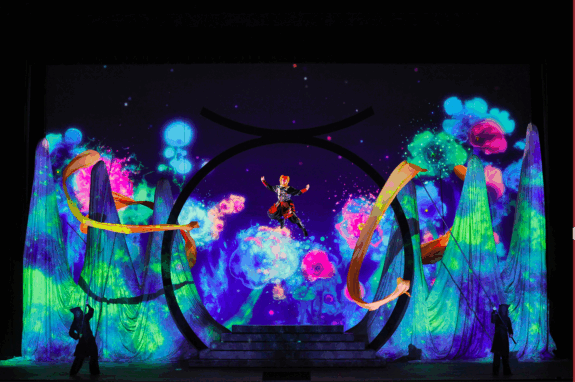
In the second of eight scheduled performances at War Memorial Opera House, it was easy to see why visual aspects have been attracting the most attention. Basil Twist’s ingenious scenery and puppetry added extra life to the action, especially the clever doubling of Monkey with both a dancer and a puppet clothed in the same costumes. A coterie of black-clad puppeteers made the puppet version fly.
Dancer Huiwang Zhang flung himself around in choreography by Ann Yee (with consultation on Peking Opera style by Jamie Guan). All of this segued seamlessly with tenor Kang Wang in the title role, suggesting a monkey attitude with open mouth, scratching himself and twisting his body like a monkey.

Basil Twist was also responsible for the sets, using 4,500 yards of silk and other materials to create such wonders as a pair of undersea jellyfish, a series of steep mountains that fold over to become Buddha’s hand, billowing clouds and a coup de théâtre of six horses that fly to freedom. Anita Yavich’s witty, colorful costumes made each character eye-catching, and projections by Hana S. Kim lit up backgrounds and layers of diaphanous curtains to create credible images that were amazingly fluid. Pulling it all together with a sure hand, Tony-winning Broadway director Diane Paulis conjured up an ideal combination of excitement and clarity.
Across the board, the cast inhabited their roles and delivered outstanding singing. Wang as Sun Wukong was tireless, twirling a fighting stick like a martial arts champ and revealing a rich lyric voice that would be welcome in any Puccini opera. One of the highlights, his graceful aria ‘Land of Bliss’, expressed a peacefulness at having found a serene place and outwitted the Buddha. Only he hasn’t, and he is trapped (by a disappointed Buddha) where we found him at the beginning, for 500 years with a chorus that sings sutras to him constantly.
Mei Gui Zhang lent her silky soprano and dignified presence to Guanyin, who has promised the Buddha to watch over Wukong. She starred as Dai Yu in Bright Sheng’s Dream of the Red Chamber (with libretto by Hwang) here in 2022, and in Monkey King she has some of the show’s most beautiful arias. The most touching one came at the end when, in response to Wukong’s complaints, she asks ‘Have you listened? Have you opened your heart?’, and it leads to his enlightenment, his freedom and a majestic musical finish.
Among the array of gods in ‘heaven’ more concerned with their own power and comfort than anything else, standouts included tenor Konu Kim as the Jade Emperor, bass Peixin Chen as the always-wrong Supreme Sage Laojun and Joo Won Kang as Lord Erlang, tasked with battling Wukong in an elaborate fight scene that ingeniously involved dancers doubling him and the monkey for extra athleticism.
Finally, the contribution of the chorus, 45-strong, cannot be overstated. Singing sutras in Mandarin and engaging in scenes as warriors, residents of heaven and Wukong’s monkey tribe in English, they were busy. And, as usual, flawless.
This is Ruo’s tenth opera, Hwang’s fourteenth and their third together. Most recently, their opera version of Hwang’s Broadway play M. Butterfly debuted in 2022 at Santa Fe Opera. An interview in the program book hints that Ruo and Hwang are open to further operatic adventures for Wukong. After all, there is the rest of Journey to the West as tempting material.
Harvey Steiman
Featured Image: Dancer Hui Wang Zhang (Monkey King’s double) soars as Monkey King learns the secret of immortality © Cory Weaver
Production:
Director – Diane Paulus
Sets & Puppetry – Basil Twist
Choreographer – Ann Yee
Costumes – Anita Yavich
Lighting – Ayumu ‘Poe’ Saegusa
Projection – Hana S. Kim
Peking Opera Specialist – Jamie Guan
Chorus director – John Keene
Cast:
Monkey King (Sun Wukong) – Kang Wang
Jade Emperor – Konu Kim
Guanyin – Mei Gui Zhang
Supreme Sage Laojun – Peixin Chen
Dragon King Ao Guang / Lord Erlang – Joo Won Kang
Crab General / Venus Star – Hongni Wu
Master Subhuti (Buddha) – Jusung Gabriel Park
King of the North – Christopher Jackson
King of the South – Chester Pidduck
King of the East – Jonathan Smucker
King of the West – William O’Neill
Solo Dancer: Monkey King – Huiwang Zhang
Solo Dancer: Lord Erlang – Marcos Vedovetto