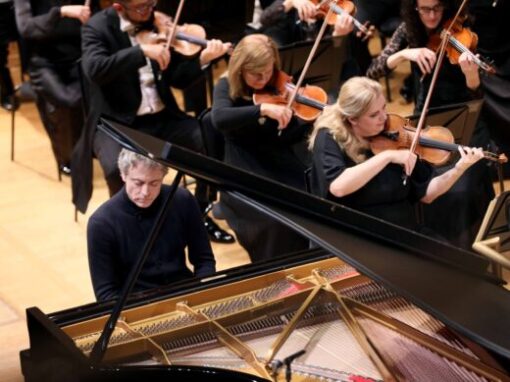
 United Kingdom Liszt, Beethoven, Shostakovich, Tchaikovsky: Paul Lewis (piano), Concerto Budapest Symphony Orchestra / András Keller (conductor). Warwick Arts Centre, Coventry, 2.12.2025. (CP)

Liszt – Les Préludes
Beethoven – Piano Concerto No.3 in C minor, Op.37
Shostakovich – Symphony No.9 in E-flat major, Op.77
Tchaikovsky – Francesca da Rimini, Op.21
With the outstanding performance of Shostakovich’s Seventh Symphony (‘Leningrad’) by the City of Birmingham Youth Orchestra last month still a vivid memory (review here), the opportunity to hear the Concerto Budapest Symphony Orchestra’s interpretation of the Ninth Symphony guaranteed a sizeable audience in the Butterworth Hall.
Some members of the audience had the opportunity to attend a pre-concert talk on the Ninth by the Head of History at the University of Warwick, Professor Tim Lockley. He suggested that after the Seventh and the Eighth – considered by many to be a more effective response to the experience of war – Shostakovich was expected to deliver the third part of a trilogy of war symphonies. A large-scale work was promised, possibly with a vast chorus, but his heart was not in this project and he abandoned the original plan. Composed quickly in 1945 and premiered in Leningrad in the November, the Ninth Symphony is in his own words a ‘merry little piece’ and maybe frivolous, particularly in the opening movement when a piercing piccolo chirps over trombone and percussion. Was this work designed to be a caricature of Stalin? It is quite clownish at times, exuberant and full of joie de vivre.
Concerto Budapest’s orchestra of over 100 musicians, wearing white tie and tails and dark gowns graced the vast platform at the start of a four-concert UK tour at Warwick Arts Centre, Birmingham’s Symphony Hall, London’s Cadogan Hall and Edinburgh’s Usher Hall (having already been to Dublin here). With remarkably crisp brass, exquisite strings and invigorating wind playing, the Ninth Symphony was the undoubted highlight of the evening. Penetrating trombones maintain their assault on the piccolos during the first movement ensuring a spirited sprint before the darker second movement with its evidence of dance-like manoeuvres. The clarinet shines with many long attractive solos – Klenyán Csaba certainly deserved the recognition he received from conductor András Keller. The last three movements run without a pause, the third witnessing the brass asserting themselves still further before a sublime bassoon solo in the largo encourages pulsating double basses to accompany soloist, Mohai Bálint. The march-like Allegretto is the grand finale; those excellent flute, piccolo, bassoon and clarinet players were called to their feet immediately to receive their deserved recognition.
The evening opened with a magnificent trombone fanfare to announce Liszt’s Les Préludes, his most popular of symphonic poems. Soon horn colleagues added to the excitement as the work presents the five sections – ‘Question’, ‘Love’, ‘Storm’, ‘Bucolic Calm’ and ‘Battle and Victory’ – in Liszt’s prelude to the afterlife: a thrilling start to the concert.
Paul Lewis is a foremost interpreter of the works of Mozart, Beethoven and Schubert; he delivered a delightfully subtle and sensitive performance of Beethoven’s Piano Concerto No.3 in C minor devoid of any irritating mannerisms. With a sparkling cadenza in the first movement, pleasing lyricism of the simple melodies in the middle movement and a stimulating climax to the third, here was Lewis at his unpretentious best. He is a joy to watch; his musical dialogue with the double basses towards the end of the slow movement was a charming period of peace and tranquillity with further discourse with bassoon and flute until that final fortissimo chord. Beethoven’s final movement is full of tension, something Lewis uses to his advantage as he combines with the clarinet which attempted to lead the dynamics of the occasion. He need not have worried, the Lewis persistence paid off. Receiving a very warm reception, Lewis will no doubt enjoy repeating his spirited effort twice this week on this tour.
Had time permitted, no doubt Keller would have accepted the request for an encore, but this was a packed programme with further surprises after the final work – Tchaikovsky’s Francesca da Rimini, Op.32. In 1874 Tchaikovsky was in a deep depression, he had taken cold baths in Vichy to help his state of mind. Having received the libretto for an opera based on the tale of Francesca da Rimini from the Fifth Canto of Dante’s Inferno, Tchaikovsky lost interest in the idea and was advised by his brother to consider a symphonic poem. He worked quickly to finish the piece in 1876, insisting on a large orchestra for the vast brass and wind sections to conjure the full fury of the adulterous relationship between Francesca and Paolo Malatesta. Keller’s clever programming was rewarded with impressive brass entries, beautiful clarinet solos with first and second violins enjoying an intriguing exchange with two flutes before the remarkable flourish which ends the piece – those final eleven chords delivered with fierce intensity.
This compelling concert was not over as Keller was keen to treat his audience to two Hungarian dances, one by Bartók, another by Brahms ensuring a very lively conclusion to a very welcome visit by a top orchestra from Hungary and much appreciated by Warwick Arts Centre patrons.
Clive Peacock
Featured Image: Pianist Paul Lewis playing Beethoven in Dublin with the Concerto Budapest Symphony Orchestra © Mark Stedman