 United States Various – ‘Frenzied Tango’: Aaron Diehl (piano), Cleveland Orchestra / John Adams (conductor), Mandel Concert Hall at Severance Music Center, Cleveland, 19.2.2026. (MSJ)
Ives – ‘From Greenland’s Icy Mountains’ (from Symphony No.4)
Timo Andres – Made of Tunes
Adams – Frenzy: a short symphony
Piazzolla – Three Tangos (realized by John Adams)
Parts of John Adams’s recent Frenzy: a short symphony sound like the soundtrack to an imaginary David Lynch film. Other parts resemble the score of a 1940s Warner Brothers cartoon that somehow broke out of the studio and went feral. And even when the textures of the work settle down to quieter moments, that nervous pulse is still there underneath it all.
I have been a fan of Adams since my teenage years, and I was in this concert hall in 1991 when he conducted the Cleveland Orchestra for the first of many times. I asked him in the green room after that 1991 concert if he would return one day with his Fearful Symmetries, a gloriously diabolical work He balked, saying that he was afraid he would be tarred and feathered and run out of town on a rail. Turns out that all these years later, he brought a work cut from the same cloth as Fearful Symmetries and was hailed with a standing ovation.
Frenzy: a short symphony was premiered two years ago by dedicatee Sir Simon Rattle, and it captures the glitter and decay of pop-culture Americana (symbolic of the nation’s cultural decline) over the course of the composer’s lifetime, updating what he started in Fearful Symmetries. It brings to this listener’s mind images of roadside motels and neon signs at dusk, midnight shadows on the Las Vegas strip or even Dennis Weaver’s hapless Everyman struggling up a desert mountain and pursued by a murderous trucker in Duel, an early Steven Spielberg film. While only the closing pages go full-tilt into a frenzy, the whole work is information-overload sculpted into a piece of art. It is vintage Adams, riveting in effect and sharply characterized in the Clevelanders’ brilliant performance.
One of the best things about Adams is that he doesn’t use his prominence to hog the spotlight. The largest work on this program, one that Adams has championed, is by a younger American composer, Timo Andres, born in 1985. Made of Tunes is a half-hour-long piano concerto that sounds influenced by Adams although it very much lives in its own world. There is also a resonance that captures imagery from popular culture in the United States, but Andres’s world is one of bright morning or afternoon sky as opposed to the neon dusk of Adams. It is no less full of scattered energy, however, as restless, percussion-drenched passages proved. While the piece is made of tunes, melodies and fragmented hooks, the accumulated debris from the orchestra is often at odds with the jazzy, partially improvised piano part, handled with assured mastery by Aaron Diehl, the work’s dedicatee. This piece also premiered just two years ago.
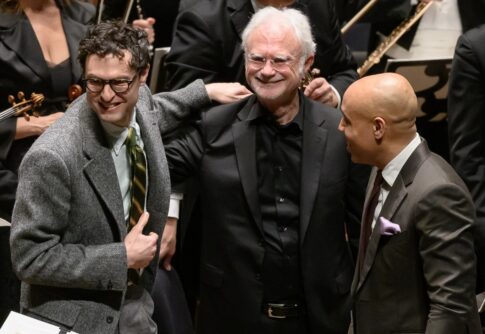
The first movement opens with an arresting introduction by the orchestra, with brass and percussion prominent. Once the piano enters, the pace picks up energetically, hand-struck timpani looping a driving rhythm. American sounds provoke American images, more like desert highways in the bright sun than Adams’s darker world. The second movement is a set of spacious variations that build up to a terrifying tsunami of percussion, which Adams let roar. In the stunned aftermath, Diehl entered with gentle chords, for the first time in the piece not assailed by distractions from the orchestra. It was a startling, moving moment, and the work ended mid-statement, as if closing such a tender moment would be too cruel. The piece was received with cheers for the performers and for Timo Andres, who was present. Diehl continued his vibrancy with an encore of James P. Johnson’s ‘Steeplechase Rag’, delivered at a dizzying pace.
The concert closed with a built-in set of encores, Adams’s reworkings for full orchestra of three tangos – ‘La Mufa’, ‘Oblivion’ and ‘Libertango’ – by South American composer Astor Piazzolla. The pieces were originally written for Piazzolla’s own small ensemble, but Adams has put in the work necessary to not just orchestrate but to re-imagine the miniature masterpieces in an expanded soundworld, which nonetheless still rang true to the composer’s originals. In places, this involved an almost scientific precision of orchestral color: for instance, using a bowed vibraphone doubling a clarinet and then an oboe to evoke the lyrical yet piercing texture of Piazzolla’s own bandoneon, an instrument related to the accordion but darker and more intense. For the double bass solos in ‘Libertango’, Adams had the entire bass section of the orchestra tear into it, which they did with delight. This was the world premiere performance of these versions, and one would expect them to prove very popular with orchestras.
The concert had opened with the third movement Fugue from Charles Ives great Symphony No.4, a work that used to be championed here by Christoph von Dohnányi but hasn’t been heard in its entirety for far too long. Adams let the Clevelanders play with their customary poise but refused to over-polish this direct music, letting it speak plainly but movingly. It was an ideal entry to a perfectly programmed concert.
Let’s hope Adams will live until at least 179 years old and keep coming to Cleveland with programs like this.
Mark Sebastian Jordan
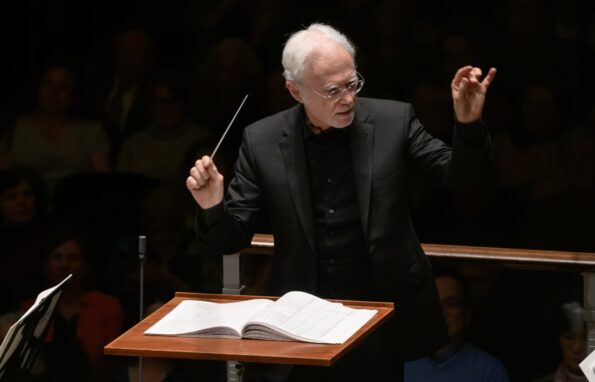
Featured Image: John Adams conducts the Cleveland Orchestra © Yevhen Gulenko/TCO