
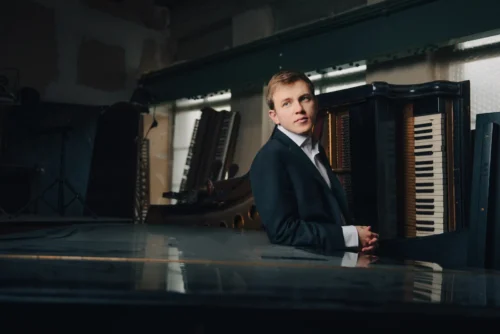
 United Kingdom Furrer, R. Schumann, Gervasoni, Beethoven: Filippo Gorini (piano). Wigmore Hall, London, 15.4.2026. (CC)
Beat Furrer – Studie IV (2025, UK premiere)
Robert Schumann – Davidbündertänze, Op. 6 (1837)
Stefano Gervasoni – Sonata for Piano (2024, UK premiere)
Beethoven – Piano Sonata No.31 in A-flat, Op.110 (1821/2)
It was good to see Filippo Gorini, whose recordings of Bach’s Die Kunst der Fuge and late Beethoven Sonatas on Alpha have been so impressive.
The first of two UK premieres, Studie IV of 2025 by Beat Furrer (b.1954) launched the concert. This, as well as the Gervasoni that launched the second half, is part of Gorini’s Sonata for 7 Cities project, Composed for Gorini’s Hong Kong residency, Furrer’s Studie IV is a demanding work for both performer and listener: the jittery dyads of the opening, marked ppp, leggiero, Sprechend, and quaver/eighth note 120 create a limited pitch space that is expanded by sudden accents way lower, and way higher. Although Modernist in demeanour, many of the gestures are taken from High (Lisztian) Romanticism and repurposed. Bell-like descents proliferate, part of Furrer’s playing with the piano’s resonance. One could make parallels with Rebecca Saunders’s Piano Concerto, then, in that appropriation of gestures from an earlier period form an acknowledgement of the piano’s history.
Nothing can prepare one for Furrer’s coda though: ‘eerily sparse’ is how Simon Brackenborough’s programme notes describe it, and that is exactly right. It did feel structurally unsatisfying, though: a game (Studie) of two halves.
Robert Schumann’s Davidbündlertänze is a piece that can bring out greatness: I think of a Royal Festival Hall performance by Pollini (back in the 1980s: not the much later performance there that went somewhat awry) and, again live, Mitsuko Uchida. For all of its many strengths, Gorini’s interpretation is not yet in that exalted league. It was, however, a strong reading, honouring the Florestan/Eusebius contrasts that form the heart of this piece (and Schumann’s persona in general, but they seem particularly strong here). An interesting link between the Furrer and the Schumann was the way both play with piano resonance, in markedly different situations; but in highlighting this, one becomes aware of Schumann’s modernity.
Gorini allowed Schumann’s multiple (not just dual) personas to shine through, from the almost explicitly Brahmsian (linking ‘Balladenmässig’, No.10, clearly to Brahms’s Rhapsody in G minor, Op.79/2) to a Schumann Lied on piano. Another aspect was an identification of an inner voice ‘heartbeat’ that animated the music, as part of a continuous awareness of Schumann’s linear machinations.
All of that said, the final impression was that this was a very fine interpretation, but one still in the making, as if in its final stages of polishing. Technically, there was so much to enjoy, not least Gorini’s superb staccato in No.6 (‘Sehr rasch und in sich herein’), while his cantabile was often ravishing (No. 14, ‘Zart und singend’).
The second half brought the second UK premiere (with the composer present): the Sonata for Piano of 2024 by Stefano Gervasoni (b.1964).
‘Music is the sound of thought which emotions set in vibration’ is emblazoned on the composer’s website. Born in Bergamo, Italy, in 1962, Gervasoni was advised to study composition by Luigi Nono, no less. Brian Ferneyhough and Helmut Lachenmann have both been influences. So it is only right to expect music that is uncompromising. And so it is.
The Sonata for Piano was premiered by Gorini in Vienna (the Mozart Saal of the Konzerthaus) in February 2025, In it, while acknowledging that it is no longer possible to honour the form as exemplified by the First Viennese School (Haydn, Mozart, Beethoven), Gervasoni says that his piece ‘is based on a profound reflection on the architectural values of this form and their role in shaping the expressiveness of the musical content that takes form within it.’
Expanding, he notes the continued fascination with sonata, via Berg through to today via those such as Boulez and Ives: ‘The reason for such enduring interest and fertility, in my opinion, lies in the fact that the sonata is an extraordinary mechanism capable of tempering expression and forcing it into objectivity, placing it at a distance while simultaneously bringing it into focus.’
Form as generator of objectivity from a subjectivist starting point is the crux here. There is also the responsibility of writing a sonata, launching ‘an exercise in ethical discipline in confronting this form: not a single note must be wasted, no expressive value can be squandered.’
This is the first time the composer has used this ‘formal title’ of sonata in his output (not counting the ‘reconstruction’ of Monteverdi, Sonata sopra Sancta Maria of 1999/2000, for orchestra), although he has referenced older musics: Sviete Tihi of 2005/6 for two pianos and two percussionists, carries the subtitle, ‘Capriccio dopo la Fantasia’.
The Sonata for Piano is cast in one movement and lasts around 22 minutes. That awareness of linear writing, so strong in the Schumann, was heard here, too, in multiple ways, including the way Gervasoni destabilises his right-hand melodies via the left-hand activity, Within that friction, Gervasoni (and Gorini, in the realisation of the score) find much beauty.
Gorini ensured the composer’s sudden shifts were maximally effective; he also ensured that Garvasoni’s repeated patterns retained the composer’s individuality (repeated they may be, Minimalist they are not). Garvasoni is a virtuoso composer in that, within a specifically Italian-Modernist (read ‘hard-hitting’) milieu, he can inject a sudden consonance. An arresting gesture (as was a shift to a specifically chordal passage), a part of a tool kit rather than any directional arrival. And when those repetitions return in a toccata, the same act of patterning creates accruing momentum and volume.
This is a major piece from the pen of a major composer. Taking this and the Beat Furrer as exemplars, Gorini’s Seven Cities project clearly bears ripe fruit.
Filippo Gorini’s recordings of Beethoven’s Diabelli Variations and Op.106 (‘Hammerklavier’) and Op.111 for Alpha (along with his Die Kunst der Fuge, itself the basis of another project) are highlights of his discography so far. So with 106 and 111 in the can, it is good to hear Gorini’s thoughts on the A-flat major, Op.110. This was a rigorous yet lyrical interpretation: interesting he emphasises the left-hand accompaniment in the first movement in the earlier passages (as Pollini was wont to do, incidentally). There was an impetuosity to Gorini’s playing that was absent elsewhere in the recital but it was coupled with great technical mastery: the infamous cross-handed passage in the second movement Allegro molto was the best I have heard it. Gorini’s dynamic range seemed increased, though, perhaps to contrast with the Adagio ma non troppo; but it was perhaps a touch too much for the Wigmore Hall’s acoustic.
Beethoven’s equally (in)famous ‘Bebung’ passage in this sonata emerged as a unique moment, a profound unsettling of the norm. Intra-movement contrasts provided the basis of Gorini’s reading of the latter stages of the sonata: the completely desolate Adagio ma non troppo (achingly beautiful) and the more objectively stated Fuga. Rests carried real weight in this performance: a testament to the concentration created by Gorini.
One encore, a Waltz in A-flat by Brahms. But what a revelation in the music of Stefano Gervasoni, and what a privilege to hear the UK premiere of the Furrer.
The fine Wigmore Hall recital was streamed live and is available currently here.
Colin Clarke