 United Kingdom Bren Gosling’s, Invisible Me: Southwark Playhouse Boorough, London, 10.4.2026. (JH) ****
There is something quietly radical about Invisible Me, a play that turns its gaze towards lives too often pushed to the margins and asks us, simply, to look again. In a theatrical landscape frequently preoccupied with spectacle or urgency, Bren Gosling offers something more modest but no less purposeful: a humane, actor-driven piece that wears its heart lightly.
Invisible Me unfolds through a trio of interwoven monologues, each prompted by the looming milestone of a 60th birthday. The structure is at once theatrical and literary. Three voices circle one another, sometimes overlapping, sometimes echoing, in a manner reminiscent of Alan Bennett at his most companionable. Only at the close do they finally converge, stepping out of their separate orbits into a shared space.
The characters are sketched with an appealing clarity. Lynn, a recently divorced hotel cleaner, lives alone following the death of her mother and the collapse of her marriage. Jack, a gay widower, remains suspended in grief after the loss of his husband. Alec, a gregarious divorced taxi driver, masks his own loneliness with banter, estranged in practice if not entirely in feeling from his children. Each, in different ways, finds themselves confronting not just ageing, but a creeping sense of social invisibility — that unsettling realisation that one has slipped from the centre of things without quite noticing when or how it happened.
Gosling’s writing is warm, witty and consistently attentive to this condition. The opening movement of the play is tinged with melancholy: a quiet acknowledgement of solitude, of routines hardened into isolation, of lives narrowed almost by stealth. Yet the play resists both bleakness and self-pity. Instead, it charts — gently, deliberately and with humour — the characters’ tentative re-engagement with the world. They experiment, falter, recalibrate. Encounters are by turns awkward, comic, bruising and unexpectedly tender. The humour, often understated, lands with a pleasing naturalness; it is laughter born of recognition rather than contrivance.
This is a play concerned not with grand transformation but with incremental courage: the decision to say yes, to show up, to risk embarrassment in the hope of connection. By the time the three narratives draw together, orchestrated by Lynn with a kind of quietly benevolent determination, the effect is less one of narrative climax than of emotional alignment.
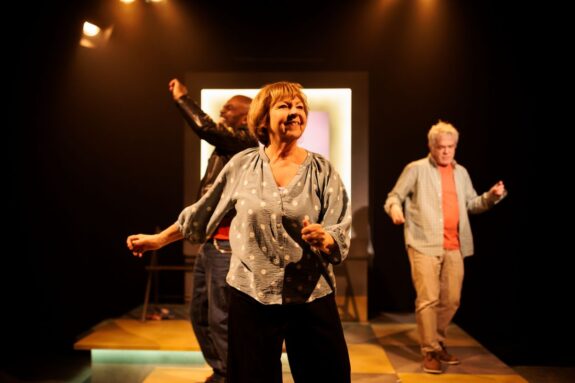
That convergence takes place in the play’s final scene: an over-55s disco set to the music of the characters’ youth. It is a moment that could easily tip into sentimentality but is handled with enough restraint to feel earned. There is joy here, certainly, but it is a joy edged with complexity. For Lynn and Alec, the ending gestures towards renewal, a shared language of memory and possibility. For Jack, drawn reluctantly into the dance, the note is more ambivalent: a suggestion of movement rather than resolution, of life continuing even if grief remains.
The staging is deliberately minimal, placing the burden — and the opportunity — squarely on the performers. This is emphatically an actor’s piece. The three leads move fluidly between narration and embodiment, slipping in and out of scenes while sustaining the integrity of their own arcs. The transitions are handled with an ease that belies the technical precision required, and the result is a production that feels both tightly controlled and emotionally open.
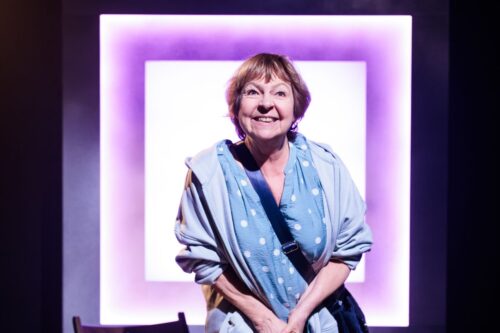
Tessa Peake-Jones gives a finely calibrated performance as Lynn, charting her journey from timidity to a more surprising, self-possessed confidence. Her transformation — which takes in an unexpected turn towards dominatrix role-play — is handled with humour but also with a sense of hard-won agency. Kevin N Golding brings an easy charm to Alec, the ‘cheeky chappie’ persona gradually giving way to something more vulnerable as he confronts his own ageing and emotional dislocation. James Holmes, as Jack, anchors the production with a quieter, more inward performance, his grief never overstated but persistently felt.
At just over an hour, Invisible Me is closer to a chamber piece than a full-bodied drama. The most striking thing is its tone: humane, attentive, quietly hopeful. In an era of louder, more demonstrative theatre, Gosling’s play makes a case for something smaller, gentler and kinder. It does not seek to dazzle. Instead, it invites us to listen — and, in doing so, restores a measure of visibility to those who fear they have lost it. And from their enthusiastic applause at the close, the multi-generational audience clearly appreciated this.
Jane Havergal
Featured image: Tessa Peake-Jones (Lynn), Kevin N Golding (Alec) and James Holmes (Jack) © Harry Elletson
Cast:
Lynn – Tessa Peake-Jones
Jack – James Holmes
Alec – Kevin N Golding
Creatives
Writer – Bren Gosling
Director – Scott Le Crass
Set and Costume designer – David Shields
Lighting designer – Jodie Underwood
Sound designer – Julian Starr
Invisible Me is at the Southwark Playhouse Borough until 2nd May 2026 and for more information click here.