
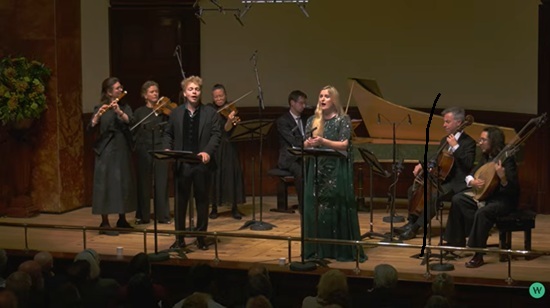
 United Kingdom Handel: Lucy Crowe (soprano), Hugh Cutting (countertenor), The English Concert (Nadja Zwiener [violon I], Manami Mizumoto [violin II], Joseph Crouch [cello], Sergio Bucheli [theorbo], Georgia Browne [flute], Tom Foster [harpsichord]). Wigmore Hall, London, 11.6.2026. (CSa)
Handel – Mi palpita il cor, HWV132c; Violin Sonata in D, HWV371; Troppo cruda, troppo fiera, HWV198; Conservate, raddoppiate, HWV185; Alpestre monte, HWV81; Trio Sonata in G minor, HWV390a; Langue, geme, sospira, HWV188; A mirarvi io son intento, HWV178
Before Handel became the composer of grand English oratorios and royal celebrations, he was a young man discovering his voice in Italy – absorbing the elegance of Italian melody, the drama of opera and the expressive possibilities of the human voice. His Italian cantatas, written for intimate aristocratic gatherings rather than the public stage, reveal his fascination with the theatre. To bring Handel’s musical and emotional complexities to life require singers who possess not only formidable vocal techniques, but also genuine dramatic insight. Soprano Lucy Crowe and countertenor Hugh Cutting provided both in spades in an intensely rewarding Wigmore Hall programme of operatic miniatures, eloquently and authentically supported by the musicians of the English Consort. Although it was the first time that these two remarkable singers had appeared together at Wigmore Hall, it was not the first time they had collaborated. In an acclaimed production of Rodelinda at Garsington last year, director Ruth Knight cast Crowe as the terrifying heroine and Cutting as her trusted friend Unulfo.
Cutting, a former Cambridge choral scholar and Kathleen Ferrier award winner who in his youth fantasised about getting a part in a Harry Potter movie, has described his voice as ‘a sturdy falsetto’. He leaves it to others to speak of its steely power and velvet beauty, or to point out his luminous stage presence and instinctive ability to occupy the drama behind the music. In the recital’s opening Mi palpita il cor (‘My heart is pounding’), a cantata in which Handel transforms the language of unrequited love into an urgent cri de Coeur, Cutting lived and breathed the music and conveyed its tragic message with complete credibility.
After an animated reading of Handel’s Violin Sonata in D, where Nadja Zwiener’s 18th-century Baroque instrument, supported by Joseph Crouch on cello and Tom Foster’s harpsichord, breathed, paused, ornamented and sang like an additional soloist. Cutting then returned to the platform and joined by soprano Lucy Crowe, performed the duet Troppo cruda, troppo fiera (‘Too cruel, too proud’). Crowe has a pure-toned and agile voice, with a radiant upper register, and, like Cutting, the ability to reveal the theatrical essence of Handel’s music and to inhabit the inner world of the character. Their two voices were finely matched and beautifully blended, and their vocal balance perfectly weighted in lines like Infiammate saettate, ma lasciatemi spera (‘Set me alight and shoot arrows through me’): a gorgeous moment in an erotic dialogue complaining of the hardships imposed by love. The duet Conservate, raddoppiate (‘Preserve, Re-double’) completed the first half of the evening. Weaving together and imitating each other’s phrases, Crowe and Cutting combined in an intensely expressive and perfectly balanced conversation.
After the interval, Crowe returned to the stage which in Handel’s imagination became a bleak alpine landscape, where she stood emotionally stranded, addressing her absent lover and reflecting on the depths of her suffering. In gloriously lyrical voice, she gave the opening aria of the cantata Alpestre monte a lonely yearning and genuine sense of despair. She easily conquered but ultimately transcended the complex ornamentation and melodic leaps demanded by the music in a dramatically compelling performance.
After a sprightly rendition of another of Handel’s chamber works, his Trio Sonata in G minor, both singers executed the final two cantatas on the programme exquisitely. Both Langue, geme, sospira (in which a dove languishes, moans and sighs for its companion) and A mirarvi io son intento (‘I am absorbed by your beautiful eyes’) demand huge displays of technical skill and precision as well as sensitive characterisation. Crowe’s luminescent soprano, light and almost airborne, soared, circled, and glided around Cutting’s countertenor, creating a vivid sense of dialogue and human tension between the two voices. The breathtaking loveliness of the final fifteen minutes of the formal recital was only surpassed by the encore: the last duet from Handel’s Theodora – Streams of pleasure ever flowing, in which the voices of these two exceptional artists intertwined to celebrate much more than the mere earthly fulfilment of Handel’s heroine and her beloved Didymus, but their divinely-inspired spiritual release.
Chris Sallon