 Czech Republic Rossini, Moïse et Pharaon, ou Le Passage de la Mer Rouge: Narodni Divadlo Moravskoslezské Opera and Ballet/ Lukáš Kovařík (conductor). Antonín Dvořák Theatre, Ostrava, 12.6.2026. (GT)
The origins of this opera were laid in 1812 when Rossini initially planned an oratorio based on biblical themes, which became his opera Ciro in Babilonia; however, this led him to conceive another stage work, which emerged in his three-act Mosè in Egitto, staged in Naples in 1818, an azione tragico-sacra biblical drama for Lent. Nine years later, now living in Paris, the composer saw that the mood in opera was towards creating grand stage works reflecting the times of revolution and rapid societal change, inspiring him to write his well-received Le siège de Corinthe in 1826. In Paris, he resolved to expand the stage work with a French-language version by adding a ballet in the third act (using music from his own Armida) and adding a fourth act, telling of the dramatic flight of the Hebrews to the Promised Land and the crossing of the Red Sea. Rossini tackled the inflexions of the French language and introduced more popular harmonies, giving a richer coloratura to the singing. So successful was Rossini’s revised opera that it remained in the repertoire until 1865.
The four-act opera portrays Moïse’s struggle to free the Israelites from Egyptian bondage and, through the Ten Plagues, leads them to the parting of the Red Sea. The new libretto by Giuseppe Luigi Balocchi and Victor-Joseph Étienne de Jouy enriches the biblical narrative with new characters and introduces an emotional subplot with the forbidden love affair between the Pharaoh’s son Amenofis and the Hebrew woman Anaïs.
Act I is set in Memphis, Egypt, where, following a prelude that hints at liberation and freedom, the chorus of the Hebrews calls for God to show them the way to the Promised Land. Moïse (Andrii Kharlamov) tells them that God is on their side and that he will guide them there. Eliézer (Raman Hasymau), Moïse’s brother, returns from discussions with the Egyptians and says that their way is forbidden after Osirid, the High Priest (Pavel Divin), opposes their return. Fire from heaven breaks out, and we hear the cataclysmic eruption of a volcano in a devastating finale as darkness overwhelms Egypt.
Act II opens with a dramatic prelude with uplifting ideas from the orchestra leading to the beautifully sung Egyptian chorus, and after light returns following the invocation to Jehovah by Moïse, there is a moving quintet of thanksgiving. The Pharaoh’s son Aménofis (Martin Javorský) is already married, and despite the issue, a highlight was the aria by the Pharaoh’s wife Sinaida (Veronika Kaiserová). Act III opens in the Temple of Isis with a gracefully solemn ceremonial ballet enacted in the Pharaoh’s court, leading to the renewed conflict between Moïse and the Pharaoh.
The fourth-act prelude and the duet between Anaï and Aménofis lead to Anaï being forced to make the choice between the married man Amenofis and God; ultimately, she chooses to be with her people and not her Egyptian lover. The choral invocation to God in an extended passage of the Hebrew Prayer leads to the passage to freedom, opened with Moïse leading his people to safety through a great ring which descends while behind them the Egyptians are drowned against savagely violent music, and the opera ends with the Hebrew Prayer as the Israelites reach safety.
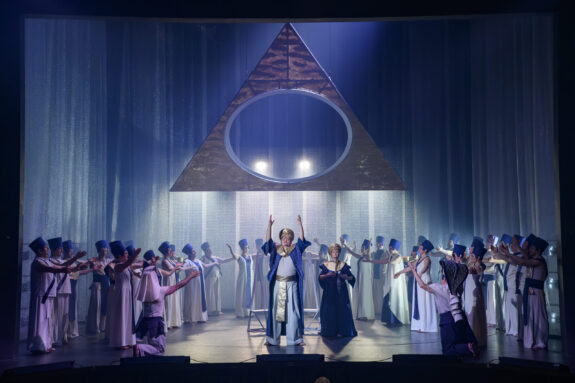
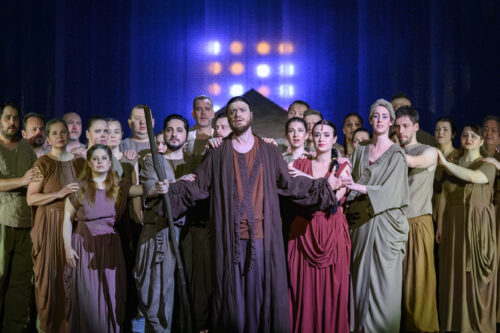
The sets by Kristina Komárková were minimal, with a focus on period images and symbols. The first act featured a large triangular stepped platform, which served as the gathering place for the Hebrews to hear Moïse. Another element was a great triangle with an aperture, displaying a glowing ray of white light, and the large ring seen in the finale. This minimal scenery allowed the drama to focus on the narrative and singing, especially the choral sections. Martin Krupa’s media projections and the bright backstage lighting enhanced the action. The scenes depicting the flooding of the Nile used colourful, dramatic video projections and became a highlight against the dramatic orchestral playing. Barbora Rašková’s costumes for the Egyptians were sumptuous and beautiful, with extraordinary headgear for the Pharaoh and his entourage; the ladies’ costumes were exotically sensational. The Hebrews wore slave-like attire. Rašková’s choreography was dramatic and often exciting, especially in the great choral scenes. The ballet reflected the customs of the time, using hand signs for the emotion in Egyptian dancing. A notable aspect was the frequent use of the auditorium for entrances and exits. Both Egyptians and Hebrews entered from the stalls, bringing the singing into the audience and enhancing the drama.
The Pharaoh of Miloš Horák was excellent both vocally and in characterisation, as was his wife Sinaida, taken magnificently by the outstanding mezzo-soprano Veronika Kaiserová. However, at the heart of the whole show was the Moïse of Andrii Khalamov with his magnificent noble bass, and perfectly characterised, as was his sister Marie, portrayed by the attractive soprano Betty Makarahinsky. Martin Javorský as the Pharaoh’s son Amenofis was excellent yet inconsistent in his middle voice; his characterisation was at the centre of the performance. The finest female voice of the evening was the outstanding Anaïs of Lada Bočková, both in her beautiful high soprano and most notably in the tragic fourth act when she has to decide between serving God or her lover, she was the consummate actress torn between the devoted lover and the agony of giving him up for God. Not surprisingly, in this opera, from the very beginning, the choral singing was outstanding, and was often spectacular, and like the orchestra, the chorus is a remarkable asset of this opera company directed by Juij Galatenko.
The orchestra was magnificent in the colourful and often pulsating tunes by Rossini, bringing out the stirringly foot-tapping energetic drive of the score together with the dynamics and phrasing masterfully led by Lukáš Kovařik. In all, this production is a remarkable success for the music direction by David Švec, by leading his production team of highly talented scenographers, choreographers and technicians who created an innovative staging introducing innovations and technology to this rarely staged opera. The production is one of the triumphs of the Ostrava opera company and will remain it’s repertoire in the 2026-2027 season.
Gregor Tassie
Featured Image: [front] Daniel Kfelíř (Pharoah) and Veronika Kaiserová (Sinaida)
Production:
Direction – Vladimir John
Set design – Kristina Komárková
Costume designer and Movement director – Barbora Rašková
Lighting design and Video projection – Martin Krupa
Chorus director – Juraj Galatenko
Dramaturg – Juraj Bajús
Cast:
Moïse – Andrii Kharlamov
Pharoah – Milos Horák
Aménofis – Martin Javorský
Eliézer – Raman Hasymau
Osirid – Pavel Divin
Ofid – Vit Šantora
Sinaida – Veronika Kaiserová
Anaï – Lada Bočková
Marie – Betty