 United States Aspen Music Festival 2025 [14]: Klein Music Tent, Harris Hall, Aspen. (HS)

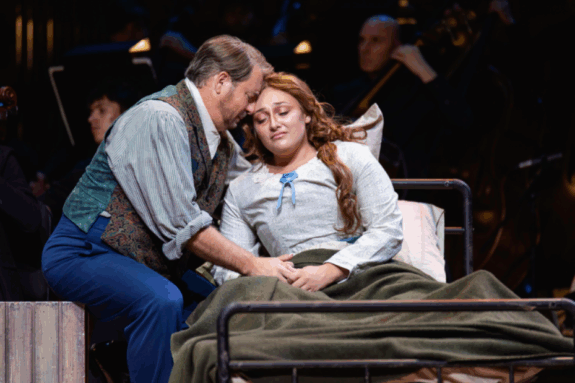
In a season with some of the best opera offerings in recent years, the Aspen Music Festival topped things off Tuesday with the ‘arena’ version of Puccini’s evergreen La bohème. The 2,000-seat Klein Music Tent often distorted the balance between the orchestra and a strong cast, led by one of the world’s best lyric tenors, Matthew Polenzani. He and a team of accomplished young singers too often were forced to belt it out to be heard over the orchestra sharing the stage with them. Quieter moments came through best, as did a stage full of chorus and extras in an exuberant Act II.
They managed to play out the drama with realism and panache in the semi-staged, concert-style presentation. Credit director Katherine M. Carter with finding deft ways to enhance their acting.
The orchestra under Enrique Mazzola, the Lyric Opera of Chicago’s music director, caught the Puccini musical dialect with appropriate inflections and perfect tempo adjustments, even if the singers had to double-down on high notes. In the Act I duet between Polenzani (as Rodolfo) and soprano Kayla Raw Stein (singing Mimì) it was almost as if Mazzola forgot that the orchestra was right behind the singers rather than deep in an orchestra pit, and that the sets could project the voices. On the other hand, the robust sound was just what the doctor ordered for the heart-tugging scene of Mimì’s death at the end. Those orchestral thrusts injected the drama impressively.
It should be noted that there was no apparent amplification for the voices, a welcome choice when luxuriously refined orchestral textures brought out the more intimate moments. Fortunately, subtle adjustments in volume in Acts III and IV made things better. Especially good were Rodolfo’s Act IV duet with Marcello (baritone Yichen Xue), in which they comfort each other on the loss of their girlfriends, and the entire Act III sequence when Rodolfo and Mimì decide to part but remain together until spring.
Act II, filled with an oversized chorus, a children’s chorus and a host of uncredited Paris citizens, took full advantage of the big performance space. Getting it all to mesh set up a delightfully outrageous ‘Quando m’en vo’ aria from soprano Virginia Mims. Her feistiness contrasted perfectly with Stein’s shyness. Baritone Jason Edelstein as the flamboyant musician Schaunard and bass-baritone Peter Barber as the droll philosopher Colline completed the Bohemian group nicely. As the landlord Benoît and Musetta’s rich admirer (and foil) Alcindoro, Abraham Isai Cruz-Ramirez hit all the right notes as older fuddy-duddies.
Wednesday evening in Harris Hall, longtime Aspen favorite Robert McDuffie added to the season-long subtheme of offbeat recitals. The Concerto for Violin, Rock Band and Strings by Mike Mills reprised an Aspen debut performance in August 2016 when it was done with a full orchestra. Mills, the bass guitar player of the alt-rock ensemble R.E.M., wrote the piece for McDuffie – they have been friends since high school in Macon, Georgia. McDuffie has the Southern flair to make the most of an amalgam of country fiddling, rock rhythms and classical virtuosity in the solo part.
A string quintet balanced well against amplified guitars and solo violin, none of it too loud nor too tame, with no percussion but plenty of vitality in this series of six movements with song titles. The one that made the biggest impression was ‘Stardancers’ Waltz’, which began with the bass guitar bouncing up and down octaves in rhythm. As it expanded upon a catchy tune, the music found its way around all the instruments delightfully.
In another, Mills on piano and McDuffie on violin rendered ‘Nightswimming’, a mid-1990s R.E.M. recording, as an intimate duet. (If Mahler can insert his songs into symphonies, why not Mills?) ‘Sonny Side Up’ and the finale, ‘You Can Go Again’, raised the ante with harder-core rhythms, to the excitement of a good-sized audience of both gray-hairs and younger ones.
For contrast, Brahms’s Violin Sonata No.1 opened the show as gently as the concerto amped it up. The encore, ‘Losing My Religion’, R.E.M.’s biggest 1990s hit, got their fans singing.
Aubree Oliverson, who made a name for herself here as a youngster, returned on Thursday for a center-stage recital. In a program that ranged from Handel and Bach to Stravinsky and Messiaen, Oliverson demonstrated how she has developed into a musician to be reckoned with. Still in her twenties, she displayed silvery tone, technical savvy and a musical wisdom that sets her apart from her peers.
She attacked Bach’s Chaconne from the Partita No.2 in D minor with aplomb. Each four-measure turn emerged naturally and inevitably, yet still felt fresh. Kreisler’s Praeludium and Allegro had stature and flair, and the showpiece Rondo Capriccioso by Saint-Saëns was a tour de force, deftly backed by a quintet of current students.
John Williams’s arrangement of the Gardel tango ‘Por una cabeza’ could have used more sinuousness, but her take on Stravinsky’s Divertimento (a violin-and-piano version of the ballet The Fairy’s Kiss) was spellbinding as she savored the rhythms. The encore reflected the sincerity and beauty of a violin-and-piano arrangement of Florence Price’s ‘Adoration’ (originally for organ.
Monday’s debut by pianist Scott Dunn was less scintillating. He had arranged some of his favorite movie music from the 1940s and 1950s (what he terms ‘the golden era’ of film scores) for solo piano, including music by Bernard Herrmann, Elmer Bernstein, Alex North, David Raksin and Leonard Rosenman.
The clear standouts were Aaron Copland’s own piano reductions of excerpts from Our Town and Raksin’s original ‘A Song After Sundown’ (from the noir film Too Late Blues). Dunn’s piano arrangements of Herrmann’s extraordinary title music for Psycho or the jazzy flavor of North’s work on A Streetcar Named Desire might have brought revelations. I missed their familiar instrumentations and visuals, suggesting that more enhancement (as Liszt did for his adaptations of opera music for piano) might have helped. Dunn’s arrangements of Raksin’s theme from Laura and three short scenes by Elmer Bernstein from To Kill a Mockingbird made for more evocative listening.
Harvey Steiman
Featured Image: Matthew Polenzani (Rodolfo) and Kayla Rae Stein (Mimì) in La bohème © Blake Nelson
18.8.2025, Recital: Scott Dunn (piano), Harris Hall.
Herrmann/Dunn – Prelude from Psycho for solo piano
Copland – Three Piano Excerpts from Our Town
E. Bernstein/Dunn – Three Scenes from To Kill a Mockingbird for solo piano
Rosenman/Dunn – Five Scenes from Rebel Without a Cause; Finale from East of Eden for solo piano
North/Dunn – Six Sequences from A Streetcar Named Desire for piano
Raksin – ‘A Song After Sundown’ from Too Late Blues
Raksin/Dunn – Theme from Laura
19.8.2025, Puccini, La bohème: Soloists, chorus and orchestra of Aspen Opera Theater / Enrique Mazzola (conductor), Klein Music Tent.
Creatives:
Stage director – Katherine M. Carter
Costumes – Caitlin Cisek
Lighting – Josh Hemmo
Cast:
Mimì – Kayla Rae Stein
Musetta – Virginia Mims
Rodolfo – Matthew Polenzani
Marcello – Yichen Xue
Schaunard – Jason Edelstein
Colline – Peter Barber
Benoît / Alcindoro – Abraham Isai Cruz-Ramirez
Parpignol – Brett Hunter
20.8.2025, Recital: Robert McDuffie (violin), Derek Wang (piano), John Neff, William Tonks (guitars), Mike Mills (bass guitar, piano), Harris Hall.
Brahms – Violin Sonata No.1 in G major, Derek Wang (piano)
Mike Mills – Concerto for Violin, Rock Band and Strings
21.8.2025, Recital: Aubree Oliverson (violin), Yanfeng Tony Bai (piano), Harris Hall.
Handel – Violin Sonata in D major
Stravinsky – Divertimento
Gardel/John Williams – Tango (‘Por una cabeza’)
J. S. Bach – Chaconne from Partita No.2 for Unaccompanied Violin in D minor
Viardot – Berceuse from Six Morceaux
Kreisler – Praeludium and Allegro
Messiaen – Thème et variations
Saint-Saëns – Introduction et Rondo capriccioso: with Yvette Kraft, Christy Kim (violins), Hope Hyink (viola), Hannah Jeong (cello), Peter Shane Savage (bass)