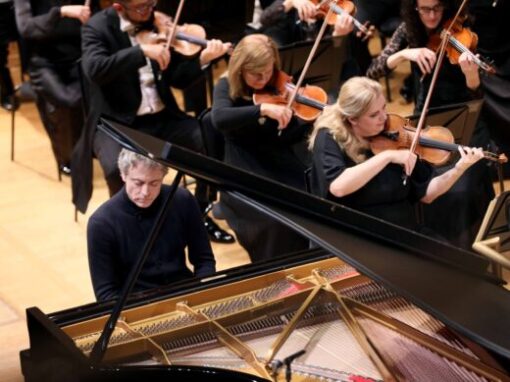
 Ireland Tchaikovsky, Beethoven, Liszt: Paul Lewis (piano), Concerto Budapest Symphony Orchestra / András Keller (conductor). National Concert Hall, Dublin, 29.11.2025. (RB)

Tchaikovsky – Francesca da Rimini, Op 32
Beethoven – Piano Concerto No.3 in C minor, Op.37; Symphony No.5 in C minor, Op.67
Liszt – Les Préludes, S.97
This concert featuring the Concerto Budapest Symphony Orchestra (CBSO) formed part of the National Concert Hall’s ‘International Orchestra and Recitals’ series. The CBSO is one of Hungary’s oldest ensembles with more than 100 years of history. Under András Keller’s leadership it has undergone a major period of artistic growth and development, and it is now one of Europe’s leading orchestras. The redoubtable Paul Lewis was the soloist in Beethoven’s C minor Piano Concerto.
The concert opened with Tchaikovsky’s symphonic poem, Francesca da Rimini. The piece was inspired by the fifth canto of Dante’s Inferno in which the poet encounters Francesca’s ghost. She recounts the tale of how she fell in love with her husband’s brother, and how her husband then killed them both when he discovered the affair. Francesca and her lover were both consigned to hell because of their adulterous passion and buffeted continually by whirlwinds.
Keller and the CBSO’s performance of this work was electrifying. Keller captured the audience’s attention from the outset as dark and sombre tones from the lower strings and brass depicted Dante’s descent into hell. The depiction of hell’s whirlwinds was an extraordinary virtuoso display. The CBSO’s strings and woodwind captured the swirling elemental fury of the scene while the brass echoed out the cries of the damned. Keller ensured a seamless transition to the slower central section as the music gradually subsided. Klenyán Csaba played the mournful clarinet solo beautifully as we were finally able to hear the voice of Francesca in a moment of quiet. The bittersweet love theme that followed was gorgeous, and it was impossible not to become swept up in the surging Romanticism of the music. In the final section, Keller worked the music up once again into a cauldron of white heat before the final hammer blows brought the piece to a thunderous conclusion.
Paul Lewis joined Keller and the CBSO for the Beethoven C minor Piano Concerto. Lewis has recorded all of Beethoven’s piano concertos and sonatas to critical acclaim and he is one of the leading Beethoven interpreters of his generation. I was struck by Keller’s Classical restraint in the opening orchestral exposition and the CBSO’s close attention to phrasing and dynamics. It was clear from his first entry that Lewis was in complete technical command of the material. Every phrase was beautifully shaped and articulated, and Beethoven’s runs and arpeggio figurations were dispatched with complete authority. Lewis seemed to find the perfect balance between the drama and the poetry in the score. There was an excellent rapport between Lewis and his orchestral partners although in one of the very quiet parts of the development section the voicing of the material was unclear. Lewis’s performance of the cadenza was an incendiary virtuoso tour de force although even here the focus was on the musical ends rather than on display for its own sake.
Lewis coaxed a gorgeous luminous tone from his Steinway at the beginning of the Largo slow movement. His performance was rapt and poetic and he showed himself a consummate chamber musician when accompanying his woodwind partners. The finale had wit, energy and rhythmic bite. I was struck by Lewis’s tight articulation and perfectly executed phrasing. There was excellent interplay between the soloist and his orchestral partners as themes were passed seamlessly between them. The central theme of the movement was a heart stopping moment of exquisite lyricism. The final transition to the major key was a moment of pure joy as soloist and orchestra joined forces one final time to drive the work to its triumphant conclusion.
The second half of the concert opened with Les Préludes which is Liszt’s most famous symphonic poem. Liszt associated the score with an ode by Lamartine in which life is presented as a series of preludes to death. The work is in one movement although there are five distinct sections: ‘Question’, ‘Love’, ‘Storm’, ‘Bucolic Calm’ and ‘Battle and Victory’. The piece is built on a single short motif which is transformed across each of the five sections. Once again there was much to admire in this performance from Keller and the CBSO. Keller’s pacing of the material was exemplary and the transitions between the different sections were well handled. I was impressed with the shifting kaleidoscope of orchestral colour and the rich sonorities. Keller clearly had a firm handle on structure and I was impressed with the degree of clarity which he brought to the piece. The CBSO did a sterling job depicting the shifting moods and scenes and there was some brilliantly executed virtuoso playing from the strings and brass.
The final work on the programme was Beethoven’s ever-popular Fifth Symphony. The ‘fate’ motif which opens the work is probably the most famous phrase in the whole of Classical music. In this performance from Keller and the CBSO it did not land as cleanly as it might. Aside from this, the rest of the performance was a masterclass in how to perform this great pinnacle of the repertoire. The opening movement was taken at a blistering pace and coursed with energy and visceral excitement. Keller had a keen eye for detail and was attentive to unifying motivic relationships within the movement. The articulation in the strings was excellent, and I was particularly impressed with their clarity of line. The brass made the various iterations of the ‘fate’ motif sound like an ominous portent of doom. The lower strings brought Classical cultivation to the opening of the Andante second movement. Keller kept the music flowing and seemed to find the right balance between the Classical and Romantic elements in the score. The extended meandering phrases in the cellos were particularly beautiful.
The Scherzo third movement opened gently with the shadowy hushed theme in the lower strings. There was an immediate and striking dynamic contrast with the ensuing ‘fate’ motif in the horns. The contrapuntal trio was played with immense clarity, and I loved the imaginative sonorities which Keller coaxed from his players when the scherzo returned. Keller did an excellent job creating an air of expectation and mystery in the transition to the final movement. The finale was exhilarating with the strings and woodwind doing a magnificent job driving the music forward. The brass captured the triumphant character of the music perfectly. The coda was taken at a blistering edge of your seat pace bringing this great staple of the repertoire to its triumphant conclusion.
World-class playing from Keller, Lewis and the CBSO.
Robert Beattie
Featured Image: Pianist Paul Lewis playing Beethoven with the Concerto Budapest Symphony Orchestra © Mark Stedman
I was fortunate enough to have attended this very performance tonight at Edinburgh’s Usher Hall. It was simply the best performance I’ve seen in years, by miles, and I’m a regular classical concertgoer. Does anyone know if a recording has been made of the Concerto Budapest, Paul Lewis, & András Keller, at some point during this concert run?