 United Kingdom Schubert, Grieg and Prokofiev: Joshua Bell (violin), Alasdair Beatson (piano). Wigmore Hall, London, 13.2.2026. (CSa)
Schubert – Violin Sonata in A, D574 ‘Duo’
Greig – Violin Sonata No.3 in C minor, Op.45
Prokofiev – Violin Sonata No.2 in D
Mozart, Elgar and Ravel: James Ehnes (violin), Andrew Armstrong (piano). Wigmore Hall, London 16.2.2026.
Mozart – Violin Sonata in B-flat, K454
Elgar – Violin Sonata in E minor, Op.82
Ravel – Violin Sonata No.2 in G
How lucky we are in London to have two of the world’s greatest violinists performing just days apart at Wigmore Hall. To hear Joshua Bell shortly followed by James Ehnes may scarcely be remarked on by Wigmore Hall regulars, gently inured to the exceptional, but it is a singular achievement for the venue, and one only made possible by the visionary stewardship of its Director, John Gilhooly. Neither Joshua Bell nor James Ehnes are strangers here. Bell has appeared on the Wigmore’s stage as a soloist or conducting and playing with the Academy of St Martin-in-the-Fields at least 20 times in the past, and Ehnes on innumerable occasions in the last 10 years either as a soloist or with the eponymous Ehnes Quartet.
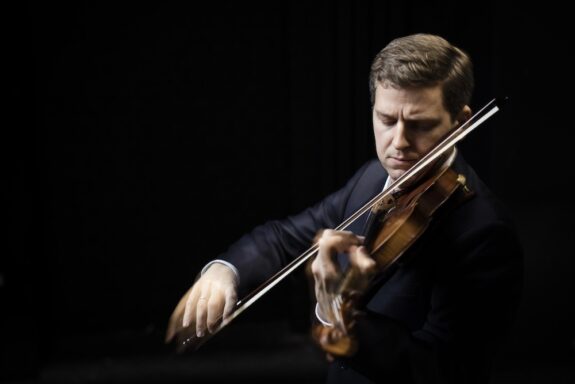
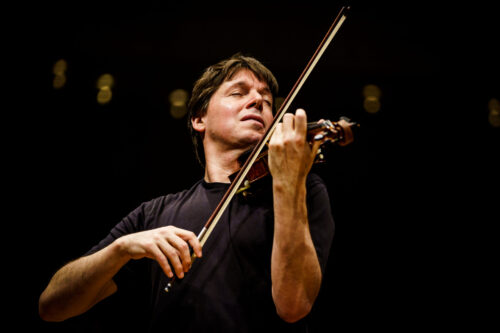
Both play on ‘Golden Period’ violins from the Cremona workshop of Antonio Stradivari: Bell on the famously twice stolen 1713 ‘Gibson ex-Huberman’ and Ehnes on the 1715 ‘ex-Marsick’. And both men are recognised for their virtuosic brilliance and share broad classical repertoires spanning the last three centuries. Yet in platform presence, musical interpretation and sound these two players could not be more different. Bell, almost 60 years old and wearing an open neck black silk shirt, still cuts a boyish, somewhat unconventional figure whose stage persona mirrors his expressive, charismatic playing style. His use of rubato phrasing, vibrato-rich tone, and dramatic intensity lend a Romantic, heart-on-sleeve lyricism to his performances. By contrast, Ehnes, recently turned 50, is a collar and tie man who favours conservatively cut suits. His style is less overtly demonstrative, with an emphasis on purity of sound and structural elegance.
In his recital last week, Bell teamed up with the versatile Scottish pianist Alasdair Beatson in a programme of sonatas by Schubert, Grieg and Prokofiev. The concert was the last in an initial tour which took the two artists to Verbier, Barcelona and Oslo. We have the match-making skills of their mutual pal, cellist Steven Isserlis to thank for their exciting new collaboration. The evening opened with Schubert’s Violin Sonata in A major, D.574, appropriately nicknamed ‘Grand Duo’ to emphasise the equal partnership between violin and piano. And an equal partnership it was! The opening Allegro, a honeyed, full-throated song without words from Bell’s violin was counterpointed with balance and precision by Beatson. Then came the teasing second movement Scherzo, full of unexpectedly irregular phrasing and playful key changes, followed by a graceful and warmly played Andantino. The ebullient and capricious final Allegro was given an expansive, almost luxuriant reading, suggesting a sketch for something bigger in scale, perhaps the violin concerto that Schubert never wrote.
Edvard Greig’s atmospheric Violin Sonata No.3 in C minor began with a sense of dark foreboding, like a gathering Nordic storm. In a superbly modulated account of the first movement Allegro Bell’s violin surged with impassioned force while Beatson’s steady hands churned beneath it. Dark clouds gave way to a delicate, lyrical Allegretto played with great emotional intensity, and weeping portamento bowing over the propulsive drive of the piano gave the Finale a fervent, heartfelt energy.
After the interval came a work originally written for flute but later adapted for violinist David Oistrakh: Prokofiev’s Violin Sonata No.2. Oistrakh admired its ‘Pure, singing line and noble simplicity.’ Although there are hints of slight modernity and moments of acerbic bite, the work is essentially classical in form and deeply romantic. The playing here was finely articulated and a model of clarity. The serene, flowing opening Moderato contrasted nicely with the mischievous, incisive Scherzo. In the Andante, Bell’s cantabile was all tenderness, and a crisp, elegant exchange between the players in the final Allegro brought the sonata and the published programme to an end. There was however the promise of ‘further music to be announced from the stage.’ This took the form of some mouth-watering lollipops, starting with Tchaikovsky’s nostalgic Mélodie, Op.42, No.3 and a sugar-rush rendition of Henryk Wieniawski’s Scherzo-Tarantelle, Op.16, in which fast string crossings and extraordinary bow control were delivered at blistering speed. Received with rapturous applause and shouts of approval, the audience clearly required a moment of calm. ‘Wieniawski is the Chopin of the keyboard, but Chopin is the Wieniawski of the violin’ announced Bell, before embarking on Nathan Millstein’s arrangement of Chopin’s Nocturne in C-sharp minor. Its sweet and beautifully wrought melody was a perfect way to say goodnight.
Earlier this week, in a programme of striking stylistic breadth, James Ehnes and his longtime friend and recital partner Andrew Armstrong strode onto the same stage to play works by Mozart, Elgar and Ravel.
Mozart’s Violin Sonata in B-flat K454 was written in such haste that he failed to complete the piano part and had to improvise much of it at its first performance in Vienna in 1784. Completed later, the sonata famously treats both instrumentalists as equals. This was evident from the stately first notes of the slow introduction and the sparkling Allegro that followed. The cantabile line in the central theme could have been overemphasised, but Ehnes and his partner, rejecting a more romanticised interpretation, focused on classical precision, clarity and form. The second movement Andante sang with serene beauty, but emotion was never permitted to overflow its boundaries. The third movement, a charming and good-humoured rondo, was shaped as a genuine dialogue, each phrase answered with wit and sensitivity.
Ehnes’s controlled, understated approach proved ideal for Elgar’s late Sonata in E, a very English work in which passion simmers characteristically beneath the surface and emotion gains strength precisely through restraint. The duo perfectly captured the brooding undercurrent and fervent surges which marble through the opening Allegro. The second movement Romance was infused with great poignancy, while the biting rhythms of the third movement, marked Allegro non troppo, was expressively phrased, but never overstated.
After the interval, we emerged from the wistful shadows of the Malvern Hills to the lightness and transparency of French music in the early 20th century. The Violin Sonata No.2 by Ravel calls for precision and economy, and this performance accentuated these qualities. A delicate first movement, achieved by the clarity of Ehnes’s top notes and some featherlight bowing, gave way to ‘Blues’, a witty and very Parisian homage to American jazz played and plucked with élan. The Finale – a very fast Perpetuum mobile – was executed with astonishing accuracy and skill bringing the second half of the recital to a formal conclusion. But it merely served as an outlier for some musical pyrotechnics unveiled after the published part of the programme. Following in the footsteps of Joshua Bell and Alisdair Beaton three nights earlier, Ehnes and Armstong dazzled the usually sedate Wigmore Hall audience with the intricacies Wieniawski’s Scherzo-Tarantelle, Op.16, followed by a nimbly articulated and playful ‘Guitarre’ by the German-Russian composer Moritz Moszkowski.
Bell’s spontaneous lyricism and Ehnes’s poised precision offered two very different visions of the violin, and each concert was unforgettable in its own way. Yet, in the quiet, storied routine of Wigmore Hall programming, even performances of such brilliance seem unremarkable – just another night in a space where artistic excellence has become the norm.
Chris Sallon
Featured Image: James Ehnes © Ben Ealovega