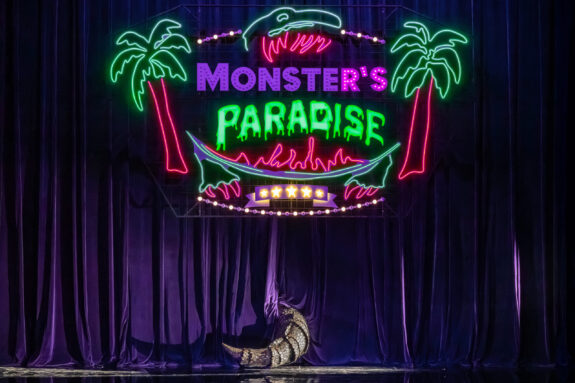
 Germany Olga Neuwirth, Monster’s Paradise (world premiere): Soloists, Chorus, Alsterspatzen (children and youth chorus) of the Hamburg State Opera, Hamburg Philharmonic State Orchestra / Titus Engel (conductor). Hamburg State Opera, Hamburg, 11.2.2026. (DM-D)
At any point in time, more or less people are worried about the events that make the news. I vividly recall the terror attacks that happened in Germany in the autumn of 1977; 9/11 is another landmark event. Right-wing populism is currently worrying, Russia’s war with the Ukraine, and the current political landscape and especially the key political players in the USA. The arts tend to reflect such concerns, either seeking to paint an ideal world so as to facilitate escape from real life, or by attempts at documenting events as realistically as possible, or through the distancing devices of a range of modes of humour, including satire and parody. In this context, Monster’s Paradise is the response of two leading contemporary intellectual artists, composer Olga Neuwirth and literature Nobel laureate Elfriede Jelinek, to the current state of the world in what is their third collaboration over the decades on an opera. The work was commissioned by Hamburg State Opera, where it was premiered on 1 February 2026.
Neuwirth and Jelinek call their work a Grand Guignol Opéra, i.e., an opera in the style of the French horror theatre Grand Guignol.
The events of Monster’s Paradise were framed by two central characters, avatars of Neuwirth and Jelinek in the form of two female vampires, Vampi (Jelinek) and Bampi (Neuwirth). They commented the plot and the characters, as Cassandra-like seers who tell the truth but whom nobody believes. They were represented by a soprano (Sarah Desrise as Vampi) and a mezzo-soprano (Kristina Stanek as Bampi), and each of these was doubled by an actress (Sylvie Rohrer played Vampi, Ruth Rosenfeld played Bampi). Communication criss-crossed between those four individuals in all possible constellations and directions. The distancing effect of this framing device was evident from the start, when Rohrer-Vampi-Jelinek says something to the effect that in a recent conversation with God, God told her off for still not writing in such a way that many people could understand what she was on about.
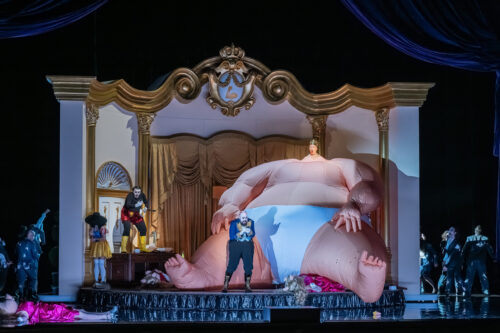
Vampi and Bampi showed us the American President, residing in his Oval Office, sitting behind his desk on a toilet of solid gold, attended by two farcical submissive loyal servants. He was dreaming about turning himself into a Papa King (reference to Jarry’s Ubu Roi). Later his body was inflated to huge size, grotesquely so, because the body was naked and orange in colour apart from underpants and because the head did not inflate and became tiny in relation to the humongous body. In yet another scene he was seen riding on a golf cart, in an orange fat suit in underwear. His followers were a horde of zombies. Gorgonzilla, a monster reminiscent of the Godzilla creatures of respective films, who came into existence through some recent atomic disaster, was the only thing/creature able to overcome the tyrannical King-President and eventually did so by eating him up (and suffering bad stomach-ache as a result).
However, even Gorgonzilla (later referred to as God Zilla) was unable to save the world from destruction through climate change. The final section of the opera was a filmed sequence where Vampi and Bampi were seen atop a makeshift raft, on a vast sea, with gentle waves, and with the top part of the landmark Hamburg concert hall, Elbphilharmonie, as a half-drowned ruin in the background. They were playing a baby grand piano, and the longer the scene lasted, the more obvious it became that the piano was in fact a mechanical device, or haunted – anyway, it played on its own, and Vampi and Bampi found it increasingly difficult to keep up with it. The piece they were playing was Schubert’s Fantasia in F-minor, for four hands. Art, in its most classical form, survives everything?!
Jelinek’s libretto was intellectually demanding, a clever, imaginative, witty and often funny tapestry of quotes, references and allusions to a wide range of world literature (I remember a quote from Goethe’s Faust I, ‘Die Erde hat mich wieder’ (The earth has me again). Neuwirth’s score was similarly multi-faceted, combining music for conventional orchestra with drumkit, electronic guitar and various recorded sound effects. Together, these formed into an intriguing soundscape with references to the history of world music as wide as the literary references of the libretto. Die Fledermaus was mentioned in some reviews, I detected material from Wagner’s Das Rheingold.
The voices of the actresses, Rohrer and Rosenfeld, both speaking and singing, and the operatic voices of Defrise (Vampi) and Stanek (Bampi) blended in very well indeed with the soundscape. Anna Clementi provided the voice of Gorgonzilla, electronically contorted to sound like the typical film monsters of the Godzilla kind, or Lego movie villains. Vanessa Konzok was the performer in the monster suit, with an intricate pattern of movements that made the monster come across almost as graceful, despite its nature as a monster – certainly much more graceful than the King-President and his zombie followers.
Georg Nigl presented an astonishing physical and especially vocal tour de force as the King-President. The core of his voice was in the baritone range, and some of his lines were indeed delivered in that region; he was equally at ease with, and clearly relished, the combination some occasionally beautiful sounds with yelps, cries, shrieks, shouting, and expanding the vocal range to at least mezzo-soprano levels. The countertenors Andrew Watts and Eric Jurenas contributed crazed, weirdly and slimily submissive loyal servants. Video of English actor Charlotte Rampling as ‘The Goddess’ was projected on to the walls of the opera house on the sides above the orchestra pit. She was seen in close-up on her face, in a halo of golden light, providing concerned words of wisdom.
Titus Engel held the music together admirably. The production team around the new head of Hamburg State Opera, Tobias Kratzer, was clearly inspired by the material of score and libretto, and delivered an assured production, making resourceful use of the full range of technical options on offer in the house; choreographed chaos never deteriorated into real chaos – another indication of the high level of directorial skills on display. With Monster’s Paradise we have an extremely topical further answer to the question of how art can deal with the present.
Daniel Meyer-Dinkgräfe
Featured Image:
Andrew Watts, Eric Jurenas, Georg Nigl, Sarah Defrise, Kristina Stanek, extras
© Tanja Dorendorf
© Tanja Dorendorf
Production:
Libretto – Elfriede Jelinek and Olga Neuwirth (based on an idea by Olga Neuwirth)
Director – Tobias Kratzer
Co-director –Matthias Piro
Set and Costumes – Rainer Sellmaier
Video – Jonas Dahl, Janic Bebi
Live-Electronics – Markus Noisternig
Sound design and Samples – Oliver Brunbauer, Olga Neuwirth
Sound director – Julien Aléonard
Lighting – Michael Bauer
Chorus director – Christian Günther
Children’s and Youth chorus director – Priscilla Prueter
Dramaturgy – Christopher Warmuth
Cast:
Vampi – Sarah Defrise / Sylvie Rohrer (actor)
Bampi – Kristina Stanek / Ruth Rosenfeld (actor)
The King-President – Georg Nigl
Gorgonzilla – Anna Clementi / Vanessa Konzok (performer)
Mickey / The King’s double / Angel of Death 2 – Andrew Watts
Tuckey / Angel of Death 1 – Eric Jurenas
A bear – Ruben Drole
The Goddess (Video) – Charlotte Rampling
Drumkit – Lucas Niggli
E-Guitar – Seth Josel
Live-Camera – Raven Sieker, Bjarne Mosdzen