
 United Kingdom Bruckner: Philharmonia Orchestra / Lawrence Renes (conductor), Royal Festival Hall, London, 19.2.2026. (JR)
Bruckner – Symphony No.8, WAB 108
I must admit I had been looking forward to seeing and hearing Sir Donald Runnicles conduct in London. Runnicles has spent a great deal of time in his career abroad, in San Francisco, Atlanta and in Germany (Berlin and Dresden currently), but he also conducts regularly in Scotland. He is quite a rare sighting in London – there is even, amusingly, an online blog, founded by Finn and Tam Pollard, entitled ‘Where’s Runnicles?’. So I was more than disappointed to learn that, due to illness, Runnicles would be a no-show. The orchestra announced that Dutch-Maltese conductor Lawrence Renes was to take his place. Renes had stepped in to a London Philharmonic Orchestra concert of Bruckner’s Seventh Symphony in 2017 when Stanisław Skrowaczewski passed away: the reviews of Renes’s conducting were very positive and described him as a fine Brucknerian. On the evidence of this concert, I can only agree. (Renes recently conducted a Bruckner Seventh Symphony with the Royal College of Music Symphony Orchestra, which I sadly missed).
But first I must start with a quibble. No need (thankfully) for an overture, or a concerto to start the evening, allowing the audience to focus its whole attention on just one major work, without distractions and interval drinks. It also allows the orchestra to concentrate on one single work in rehearsal. Why then do we have to listen to an orchestra member (Scott Dickinson, in this instance, Principal Viola) introduce the programme, with generalities about the orchestra and long quotes about the work taken verbatim from the programme and from his ‘interview’ in the programme? It was far too long for me and too banal. Dickinson often spoke too quickly (he had a lot to get through and apologised for its length), and he was often unintelligible.
Bruckner’s Eighth is rather unique in that the rustic Scherzo is the second movement with the profound Adagio as the third. Of more discussion was what edition of the symphony would we hear, would it be the Leopold Nowak (1887 or 1890) or the Robert Haas (1939)? Dickinson said that, due to the change of conductor, they had to change editions of the symphony from Nowak (which Runnicles would have conducted) to the Haas (which Renes clearly prefers and knows – no score needed). More notes, Dickinson quipped, meant we were getting more music for the same money. Oh dear!
Musicologist Robert Haas, in 1939, created a hybrid score by combining material from Bruckner’s own two major autograph versions (1887 and 1890); he restored some cuts that Bruckner later revised. Nowak, in 1955, in the Bruckner Gesamtausgabe tried to adhere closely to what Bruckner had written in the manuscripts, without editorial blending. Most conductors, nowadays, seem to prefer the Nowak edition, a shorter, leaner score. I have to say that the quieter transitional passages which Haas introduces lack focus and my mind wandered in them. I also prefer the tighter feel to the Nowak.
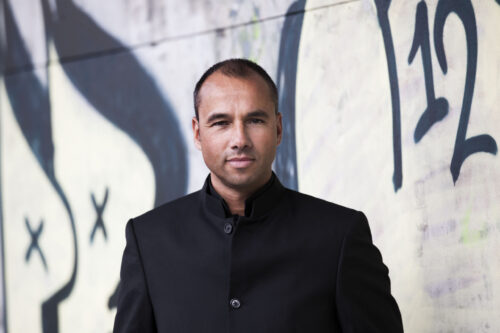
Having said that, the performance of the symphony was nothing short of glorious and much of that must be due to Renes’s muscular conducting. His grasp of the structure of the work was palpable, and he revelled in the frequent volcanic eruptions in the work. The Scherzo oozed rhythmic energy, the three harps glistened. The long Adagio started very slowly and I feared the conductor was going to ignore the composer’s express direction Feierlich langsam, aber nicht schleppend (Ceremonially slow but don’t drag); thankfully, Renes soon imposed a slightly faster tempo. He built up the many climaxes with great skill, and the Wagner tubas shone. Indeed, the orchestra played magnificently across all sections, blended woodwind, firm strident brass, thundering timpani (Simon Carrington), mellow horns (led by Lasse Mauritzen) and the percussionist enjoying his two cymbal clashes: and all held together by the lithe and energetic Leader, Zsolt-Tihamér Visontay.
I am now thinking of starting a new blog entitled ‘Bring back Renes’ – or even, ‘Where’s Renes? Perhaps the Philharmonia will invite him back in a coming season with, say, Bruckner’s Fourth? I live in hope; but also hope Sir Donald, restored to full health, will return to a London podium very soon.
John Rhodes
I totally concur with you that this was a glorious Bruckner 8th Symphony and by far the greatest I have ever heard in concert. Sitting in the choir seats I was able to observe the incisive and elegant conducting of Lawrence Renes who demonstrated himself to be a first-rate Bruckner conductor. Yet on finding out just before the concert that Donald Runnicles was not conducting due to illness I was going to ask for a refund; but then thought I would try out this conductor whom I had never heard of. Thank God I did!
The first movement was perfectly paced. The second movement had such a rhythmic thrust. The Adagio was utter perfection and never dragged; the last movement again was perfectly paced and concluded with an overwhelming intensity. I just wish it had been broadcast for posterity as it was all so wonderful and the entire audience was gripped.
I was sitting behind Simon Carrington and so I really felt his powerful timpani playing pounding through my body and soul, along with the glowing gleaming brass: a night to cherish and remember. The only fault I had was with the introductory talk.
So I totally agree with you regarding that the windbag diatribe by Scott Dickinson which was completely unnecessary, and especially before such a long symphony. It is now a current fashion to have patronising and condescending speeches before concerts that seem to stem from a desire ‘educate the masses’. Audiences have their programmes to consult so they don’t need someone telling them what is already in the programme.
Absolutely right about the speech before the concert started. Far too long and full of banal generalities. I hope this isn’t going to be a feature of Philharmonia concerts, or I’ll be arriving 10 minutes late in future.
I could not agree with this review more …
This was a magnificent performance of a magnificent symphony.
I had never heard the work before and have continued experiencing its potency and questioning, courage and willingness to stare into the abyss … and beyond.
Also, totally agree about the unintelligible talk beforehand. No offence to the player who spoke. That is not their job or expertise.
If the arts establishment or admin insisting this unnecessary innovation then the “powers that be” need to invest in vocal coaching. Not a word was audible from where I was sat. Though the orchestra sounded utterly magnificent.
Please don’t patronise your audience and please don’t waste your precious resources.
I am fully capable of appreciating such amazing work when the work of the orchestra and conductor are so excellent. No need to undermine such artistic achievement with such vapid bubble babble .
Otherwise, BRAVO everyone …
There was once a performance on two pianos of a piano reduction by Josef Schalk which had the Adagio second, at Hertford College, Oxford, 2007. But it is the lone exception that proves the rule: there is no question nor even controversy about the order of the movements: It was and is always and everywhere Scherzo second, Adagio third. This is not Mahler 6. And yes, it was a great performance!
Jim for S&H: Thank you for the correction and the review has been changed to reflect any originally incorrect statement.
I enjoyed the performance a lot. I also appreciated a lot of what the Principal Viola said before the performance. Yes, it was perhaps too long and he spoke a little fast, but it was all perfectly audible from where I was; perhaps this is something for the orchestra management to look at before the next such talk. I think though that it must be possible to raise one’s objections to the talk without becoming demeaning, as has happened on this page (mainly below the line). Honesty does not preclude kindness.
[edited]
An outstanding event – apart from that perhaps well-intended, often incomprehensible speech. Nevertheless, so glad I was there for the Bruckner.
The OAE also introduced a pre-performance ‘welcome/introduction to the music’ before their last QEH concert conducted by the inimitable Ádám Fischer (*****). As at the RFH it was utterly redundant and annoying… The LPO with George Benjamin last week didn’t follow suit but ironically a few choice words from Mr. Benjamin especially before his own composition would probably have been well received by an albeit rather ‘select’ audience (i.e. rather small…).
I should like to point out that I am referring to the ‘welcome’ immediately before the performance in the hall not the rather entertaining pre-concert event in the foyer which the OAE has been staging very successfully for quite a while – pre-concert talks instigated during the William Glock era at the BBC and continuing at the BBC Proms until Covid (and not revived since alas) have often been educational in the best sense of the word.
As others have said – a magnificent performance of an amazing symphony . We did not know Lawrence Renes , but after this we will haste to attend any concert where he is conducting. Would travel far to hear him conducting Bruckner symphony 7. The standing ovation was totally justified
I wasn’t present at this concert, though my wife was, and heard this splendid performance and the chamber concert that preceded it. I am a retired member of the viola section of the Philharmonia, and sadly I was unable to be there the other evening.
I have always enjoyed reading John Rhodes’s reviews: fair and well expressed. But I have to say that I am sad to see these comments about the introduction by Scott Dickinson. Scott is one of the best professionals in our business: a tremendous player and a first rate colleague. It takes some guts to stand up at the start of a concert and speak. I was never asked to do this in my 50 years as a player (thank God!). So I am sad to read John’s remarks, but far more by the opprobrium heaped on him by the comments that followed this review.
I have heard a number of these introductions by members of the orchestra recently. I have been hugely impressed by them all. They take a huge amount of courage. In my humble opinion the musicians and the orchestra are to be commended for beginning proceedings in this way. I hope they will continue, though I fear that those reading comments such as those above may be tempted to keep themselves below the parapet in future. That would be a shame.
Well said, Mike!