 United Kingdom Wagner, Siegfried: Soloists, Orchestra of the Royal Opera House / Sir Antonio Pappano (conductor). Broadcast live (directed by Peter Jones) from the Royal Opera House, Covent Garden, 31.3.2026 and viewed at the Chelmsford Theatre, Essex, 5.4.2026. (JPr)
Unfortunately, I come to bury Barrie Kosky’s Siegfried, not to praise it as (too?) many seem to have done. Seeing this latest instalment in the ongoing new Covent Garden Ring cycle I could not avoid what other commentators have written about it; all I can add is that they obviously saw and heard something different to me. Perhaps the cinema experience is different to that in the opera house but for me the camera never lies. Fundamentally, I believe the issue is that for a number of decades Wagner’s operas – Longborough notwithstanding – are such rare events in this country. Unless you travel to see them elsewhere (Germany?) or watch the occasional livestreams (The Met’s Tristan und Isolde?), you are not going to see enough to truly appreciate the good from the bad.
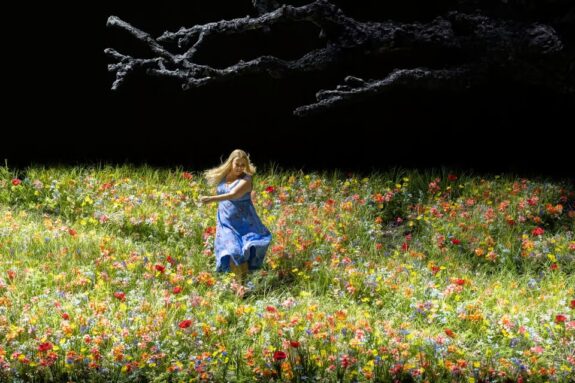
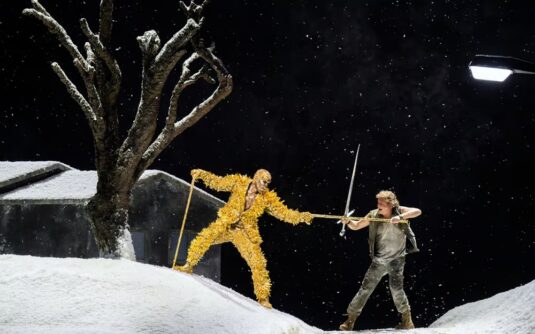
Apparently, we are in Barrie Kosky and set designer Rufus Didwiszus’s post-apocalyptic world, but I have no real idea what the director is trying to ‘tell us’ with this minimally staged Ring and we heard nothing from him during this broadcast. Act I had its moments, staging-wise, but was more like an opera based on TV’s legendary comedy Steptoe and Son (remember them?). It was dominated by Mime and Siegfried’s rather cramped-looking tree house and had two, admittedly ingenious, Rowland Emett-inspired whimsical machines for forging Nothung which were created by scouring junkyard detritus (from 74 Oil Drum Lane?). The second act for some reason best known to Kosky was sourced from Act III of almost any production of La bohème with a hut, loads of snow, a tree, a Waiting for Godot bench, a lamp post and nothing else. The opening scene of Act III was played like a costumed concert version in front of a screen before Brünnhilde’s supposed fire-surrounded rock became a meadow of wildflowers which filled the stage, along with a familiar-looking charred tree that the ever-present elderly, naked Erda – who earlier appeared as the head gardener – retreats into (as a portaloo?) before the opera reaches its conclusion.
It is the over-use of that Erda figure recalling past events that causes me increasing concern particularly because Peter Jones’s close-up camerawork for the screen was rather voyeuristic at times. If Illona Linthwaite playing the silent – if sometimes miming – Erda is willing to be on the stage for most of the opera’s more than four hours is a credit to her resilience but it was as uncomfortable watching her hesitantly negotiate – fully naked remember – the uneven snowy landscape of Act II, as it was to see her absurdly representing the Woodbird with talons and feathers stuck on her before being cuddled by Siegfried. In Act III we see Erda topless on high atop a voluminous skirt from which the singer giving voice to Erda in her confrontation with Wotan emerges. Please explain why young Erda looks as if she has come off the catwalk at a Paris fashion show and isn’t (half-)naked too? Those who were clothed were mostly unkempt in Victoria Behr’s eclectic ‘collection’ of jumble sale leftovers. The exceptions were the young Erda’s haute couture, Brünnhilde’s sky blue floral print dress and Fafner hobbling on sticks as something of a Dia de Muertos reveller in a spikey gold creation.
I could not fault the musical accompaniment from Conductor Laureate Sir Antonio Pappano and the Orchestra of the Royal Opera House, at least as heard through the excellent sound system of the Chelmsford Theatre. Pappano appeared to accept the idea of Siegfried being the scherzo of the Ring rather too literally at times. He seemed to whip through the score, ramp up the tension and emphasise dramatic intensity, whilst challenging his singers at times to keep up with his forward momentum (or so it seemed to me watching the broadcast).
As this Siegfried went on, I was longing more and more for an ‘ohne Worte’ version as it was spoilt for me by some of the singing. Although he was making his Covent Garden debut, I have heard Andreas Schager sing live several times, so I am not basing my criticism of his Siegfried simply on this performance heard through loudspeakers. Yes, I too can praise his stamina and the top notes he holds onto for some time (or shortens by cackling), but he does too little acting with his voice and relies much too much on continuous OTT physical movement including some risible dad dancing on one occasion. And those high notes? Well, too often they were just Schager shouting on pitch. He did prove he could bring some greater lyricism to Siegfried and sing lovelier than loud: that was during the melancholic and introspective moments in Act II when only then did he truly seem to bring this complex character to genuine life.
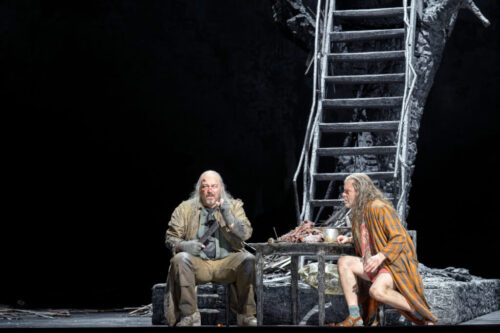
Peter Hoare’s Mime (aka Albert Steptoe) had a penchant for hitting himself over the head – protected by a German-style helmet – with the pieces of the swords he had failed to forge properly. There was a hint of cross-dressing with Hoare’s Mime; he suffered the indignities the oafish Siegfried put him through stoically and got his own back by appearing to urinate into the concoction he aimed to drug him with. Unfortunately, Hoare’s voice was more gruff than obsequious. As an extremely bitter Alberich (in voice and demeanour) Christopher Purves looked to have wandered into this Siegfried dressed in his black rehearsal clothes. Soloman Howard was the cavernous, menacing and amplified Fafner; Sarah Dufresne sounded enchanting as the offstage voice of the Woodbird (though the sights on the stage were less enchanting!); and Wiebke Lehmkuhl was suitably bewildered as the young Erda without the authority in her voice some bring to the role.
It takes even longer for Elisabet Strid’s Brünnhilde to appear in this production than in any other I have seen because – even to the cameras – she is concealed by all the flowers until after ‘Das ist kein Mann!’ and a hand then rose up though them. Strid’s voice was insecure and strident (!) to begin with but gained more radiance as her scene continued. Kosky has Brünnhilde gambolling with Siegfried amongst the flowers in the setting more appropriate to Tristan (Act II), Die Meistersinger (Festwiese) or Parsifal (Karfreitagszauber).
For me the best singing was from Christopher Maltman’s lank-haired, weather-beaten, dishevelled, crisp-munching Wanderer/Wotan defiantly railing against what fate has in store for the gods when all his cunning comes to nought. Maltman marries Michael Volle’s Lieder-like ability to communicate emotions directly through superior use of Wagner’s words while blatantly channelling a great, grizzled predecessor in the role, Sir John Tomlinson.
There is very little linking Kosky’s Das Rheingold (review here), Die Walkϋre (here) and now this extremely disappointing Siegfried apart from the old Erda’s reminiscences. It will be interesting what message, if any, Kosky has for us all as the end of the world as we know it arrives in Götterdämmerung next season.
Jim Pritchard
Featured Image: Elisabet Strid (Brünnhilde) in Act III © The Royal Opera/Monika Rittershaus
Creatives:
Director – Barrie Kosky
Set designer – Rufus Didwiszus
Costume designer – Victoria Behr
Lighting designer – Alessandro Carletti
Cast:
Siegfried – Andreas Schager
Mime – Peter Hoare
The Wanderer – Christopher Maltman
Brünnhilde – Elisabet Strid
Alberich – Christopher Purves
Fafner – Soloman Howard
Erda – Wiebke Lehmkuhl
Woodbird – Sarah Dufresne
Actor (Erda) – Illona Linthwaite
Spot on. Act II is meant to be high summer in a forest so we are given snow and no trees. Fafner the dragon as an old guy with 2 sticks in a gold lamé suit? No wonder Siegfried won the fight. Weakest Wurm slaying ever. And where (apart from the orchestra) was the fire in Act III? GOK why this farrago has been so well received. I thought it was a travesty. David Ames
Jim Pritchard replies: Of course people are free to enjoy what they enjoy but I am putting it down to a sort of mass hysteria because of the relief of there actually being ANY Wagner in London to see and hear and that having paid so much for a ticket it must be enjoyed.
The few still pictures I have seen are quite enough for me to conclude that this staging is another load of complete tosh. I have read the complimentary reviews but fail to see how what they describe can possibly be worthy of praise – a crisp-munching Wotan for Heaven’s sake, to quote but one example
Roll on Longborough and its Tristan.
Jim Pritchard offers an excuse for the favourable reviewers in that there is not much opportunity to see Wagner operas these days, but there is a vast trove available on YouTube, CDs and streaming services. They could even try reading the librettos or Wagner’s stage directions.
I shall be watching (or at least listening) in the cinema tomorrow and there is, of course, the possibility that I shall change my mind.
Jim Pritchard replies: You may enjoy the crisp-munching ‘Waiting for Godot’ scene more than you think, if you do please let us know.
I proffer the lack of Wagner as a reason rather than an excuse; I wonder how many ‘mainstream’ critics or others interested in Wagner saw the recent Met Tristan if they had not been to NY? How many will take the opportunity to see some of the La Scala Ring, the forthcoming Rotterdam concert Siegfried, the Vienna Dutchman and Rienzi from Bayreuth all online or soon to be streaming unless they travel? You will get more of an idea of what is happening elsewhere with stagings and singers if you take these and other opportunities as Alan Thomas suggests.
I agree with the majority of comments.
I actually saw the cinema relay and then attended the final performance in London. It actually was a wonderful afternoon and evening and the nearly 6 hours flew by.
Act 1 I thought was the best I actually loved the interaction between Mime and Siegfried. The riddles scene also was very well done plus this rickety forging machine again followed what Wagner intended.
Act 2 not so good as said the score is full of summer heat and mystery. Apparently BK wanted to show the effects of global warming and odd weather patterns. Wasn’t keen on the Woodbird being mimed by the brave and agile lady who is on the stage for most of the opera. Fafner looked and sounded good but as I said not over-menacing really, not a huge danger. Siegfried left his rucksack and probably the horn behind.
Act 3 was OK, the flowery Parsifal meadow again represents according to BK what a deserted area would look like after such a long period. I assume the fire would be further down the mountain. I loved the innocent gambolling of Siegfried and Brünnhilde.
Singing was excellent in the theatre. The cinema sound was too loud.
A Schager – give him his due – is tireless and energetic, the sound in the theatre yes is loud but its thrilling.
The rest of the cast were excellent.
Poor C Maltman struggling with a chest infection unfortunately.
Pappano and orchestra were magnificent.
So, mixed but on the whole I found it thrilling and funny apart from Siegfried trying to impress the Woodbird with playing on a sweet wrapper!
Interesting the subtitles missed out the famous line ‘This isn’t a man’.
Pity we couldn’t see Brünnhilde having the armour cut off but then again there was no armour to cut off!
I’d still give this 5 stars for the singing and orchestra and most parts of the staging.
The comment about the first act being like an episode of Steptoe & Son is spot on, and was made at the cinema showing I saw yesterday in NZ (24th April). The final act interactions and cavorting between Siegfried and Brünnhilde was what NZers would liken to Fred Dag meets Lynn of Tawa. The only performances I enjoyed were from Wotan and Mother Earth. Overall the costuming and staging was dismal, but typical of today’s preferences. How the devil would Siegfried expect to delight Brünnhilde (in her Primark outfit) dressed as an unwashed sheep shearer – some hero! Then we have the slaying of the dragon. For seven hakes what an absolute let down. Oh how I long for original costuming serious productions. I think The Magic Flute next season with hit the target.
Hello Jim Pritchard, I have just seen the Siegfried and I am fed up with being accused of having a closed mind by not accepting Mr. Kosky’s ‘concept’. Act 2 was particularly gruesome with poor Erda trying not to slip in the snow. Where are the enraged feminists and anti-ageists cancelling Mr. Kosky. My first Ring was Bayreuth, the Solti/Peter Hall. It has been downhill ever since. The rot had already started. Bayreuth didn’t record it as they found it too conventional, meaning it told what Wagner’s libretto was saying.
We, at least I, go to opera for great theatre, great singing and brilliant music, not to be forced to digest someone else’s philosophy. Really it’s Wagner’s work that we go to see/hear it doesn’t need a director’s unsubtle concept forced down our throats.
Thank you Dr Pritchard for being so clear-eyed about this.