 United States Saariaho, Innocence: Soloists, Metropolitan Opera Chorus and Orchestra / Susanna Mälkki (conductor). Metropolitan Opera, New York, 6.4.2026. (ES-S)
On Monday night, the Metropolitan Opera presented the long-anticipated premiere of Kaija Saariaho’s final opera, Innocence, with a libretto credited to Sofi Oksanen and Aleksi Barrière. Set at a wedding reception in the aftermath of a school shooting, the opera brings together multiple perspectives, each shaped by what is remembered, withheld or only partially understood. The libretto is constructed as a tightly controlled mechanism of revelation, gradually exposing the reverberations of a past act of violence. These recollections do not coalesce into a single narrative; they surface unevenly, interrupting the present with increasing force and insistence as past and present remain entangled and understanding is continually deferred. Similarly, Saariaho’s score avoids linear progression, favoring suspended textures and shifting timbral fields, recasting events as recurring memories.
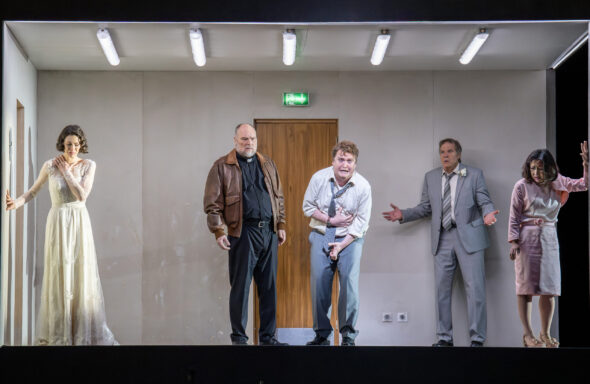
Simon Stone’s staging, first seen at the Festival d’Aix-en-Provence and widely traveled since, extends the opera’s underlying premise into theatrical space. Chloe Lamford’s revolving, two-level, multi-room structure translates this sense of temporal dislocation into a clear spatial articulation, allowing distinct layers of time to remain separate yet continuously co-present. Classrooms, corridors, the wedding hall and the kitchen coexist within the same architectural frame, with scenes of domestic ritual interwoven with those of remembered violence. Characters, dressed in Mel Page’s costumes which ground them in a recognizable social reality, move between these temporal layers with apparent ease. Scenes bleed into one another, reinforcing the sense that the past is neither distant nor resolved but embedded within the present. This fluidity of space and time sharpens the opera’s structural logic, giving form to the libretto’s peculiar process of disclosure. Stone’s visual idiom – detailed, measured and largely devoid of overt theatrical gesture, even in its harrowing rendering of the central traumatic event – anchors the opera in a familiar world while preserving the questions of individual and collective responsibility at its core.
Saariaho’s score sustains this unsettled relationship between past and present through a musical language that privileges continuity of sonic fabric over directed movement. Rather than articulating clear structural boundaries, the orchestra unfolds in layers of shifting timbre and density, with instrumental colors emerging, dissolving and reconfiguring in ways that blur the distinction between foreground and background. Within this texture, certain instrumental lines take on an almost vocal quality, their timbres at times eerie and otherworldly, as if echoing or shadowing voices no longer present. The writing often avoids conventional climaxes, instead building tension through the gradual intensification of density and range so that moments of heightened expression feel less like arrival than like the surfacing of something already latent. Vocal lines, frequently suspended within this soundscape, move between speech and song, their contours shaped as much by inflection and color as by melodic profile. This creates a constant interplay between individual utterance and the surrounding orchestral field in which voices are both carried by and partially absorbed into the orchestral fabric. The music does not resolve the drama but instead embodies memory as something that cannot be fixed, only revisited and re-experienced. Under Susanna Mälkki, closely associated with the score since its first performances, the Metropolitan Opera Orchestra maintained a finely calibrated balance, allowing the score’s intricate layering to register clearly while preserving its essential ambiguity.
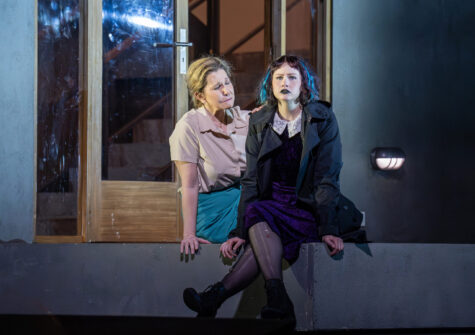
It is in the vocal performances that these overlapping yet distinct perspectives on what has happened come most clearly into focus, even if their emergence is fragile and intermittent. As the Waitress, Joyce DiDonato brought a concentrated intensity and finely controlled expressive range, her mezzo-soprano at once grounded and flexible, capable of narrowing to an almost speech-like intimacy or opening into fuller, more resonant lines without breaking the role’s inward tension. Her diction remained sharply etched throughout, allowing the text to project with directness. She rendered the role with restraint, allowing grief and recognition to both mirror and counterbalance the score’s elusive, open-ended atmosphere.
Jacquelyn Stucker’s Bride projected a poised, luminous lyricism, her tone cleanly focused and evenly sustained, reinforcing the character’s emotional isolation within the unfolding revelations. Miles Mykkanen’s Bridegroom, by contrast, adopted a more inwardly directed sound, his phrasing often tightening under pressure, suggesting a tension that remained largely contained rather than theatrically externalized. Kathleen Kim lent the Mother-in-Law a bright, incisive presence, her upper register carrying a nervous edge, while Rod Gilfry’s Father-in-Law grounded the family dynamic with firmer vocal weight, though the writing afforded both roles limited scope.
Lucy Shelton’s Teacher navigated the boundary between speech and song with taut control, while Stephen Milling’s Priest introduced a darker vocal color, his authority undercut by a certain reserve. Among the students, Vilma Jää’s Markéta stood apart, her folk-inflected vocality cutting through the surrounding textures with an otherworldly directness, at once archaic and disquietingly present. Drawing on Finnish folk vocal traditions, her vocal idiom introduced one of the rare moments in which the opera’s emotional reserve gave way to something more immediate. The other student roles formed a fragmented but carefully coordinated vocal mosaic, their alternation between speech and song across multiple languages reinforcing the work’s refusal to settle into a single expressive register.
Ultimately, Innocence emerges as a work closely attuned to contemporary concerns. Staging, score and performance converge in delineating a space where understanding remains partial and provisional, where questions of memory and responsibility remain open and in which guilt cannot be isolated and absolution is neither offered nor readily imaginable.
Edward Sava-Segal
Featured Image: Jacquelyn Stucker (Bride), Stephen Milling (Priest), Miles Mykkanen (Bridegroom), Rod Gilfry (Father-in-Law) and Kathleen Kim (Mother-in-Law) © Karen Almond/Met Opera
Production:
Finnish Libretto – Sofi Oksanen
Multilingual libretto and Dramaturgy – Aleksi Barrière
Production – Simon Stone
Sets – Chloe Lamford
Costumes – Mel Page
Lighting – James Farncombe
Sound – Timo Kurkikangas
Choreographer – Arco Renz
Chorus director – Tilman Michael
Cast:
Waitress – Joyce DiDonato
Mother-in-Law – Kathleen Kim
Father-in-Law – Rod Gilfry
Bride – Jacquelyn Stucker
Bridegroom – Miles Mykkanen
Priest – Stephen Milling
Teacher – Lucy Shelton
Markéta – Vilma Jää
Lilly – Beate Mordal
Iris – Julie Hega
Anton – Simon Kluth
Jerónimo – Camilo Delgado Díaz
Alexia – Marina Dumont Anastassiadou