 Germany Wagner, Die Walküre: Soloists, Gürzenich-Orchestra / Marc Albrecht (conductor). Cologne Opera, StaatenHaus in Cologne-Deutz, 1.4.2026. (DM-D)

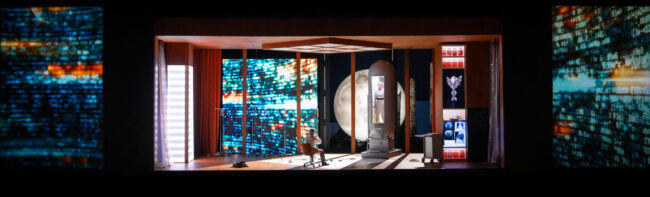
As the audience entered, the stage was hidden behind a screen, which showed projections of a path being forged in torchlight through a wood in black and white. The screen soon turned out to be a sheet of cloth, falling to the ground when the orchestra started playing. Screens on either side of the stage showed live images of the action from different angles, as well as views of off-stage areas. In the course of Act I, these shifted occasionally and briefly to scenes suggesting a hospital or medical laboratory environment.
Hunding was particularly dark and threatening. Sieglinde stood up to him to a good extent and when the sleeping potion she had given him wore off earlier than planned, she beat him up badly with a tree branch and kicked him when he was lying on the ground.
Wotan’s abode for Act II was a simple rectangular room with settee and two armchairs. Back curtain, furniture, walls and Wotan’s suit were of the same dark orange colour. The curtain opened to reveal a full view of the scenario of the first act, a room-high sliding cabinet opened to reveal x-ray screens, visual display screens and vessels used to preserve organic material.
The medical environment came to even more prominence in Act III. We were now in a fully equipped futuristic laboratory, rendering meaningful the lab’s logo which had been seen turning nonstop from early on in the performance. The Valkyries were human breeding machines, giving birth accompanied by their cries of ‘Hojotoho’, or they were midwives, all going about their business with glee. All this came across as something between funny and horrific. Six blonde, rather androgynous adolescents were hooked to infusion equipment, later manipulated to move about like zombies by Wotan through his laptop. Sieglinde looked at those emotionless creatures and realized that both she and Siegmund wore the same uniforms and had the same hairstyle and hair colour. At the end of the opera, Wotan enclosed Brünnhilde in a capsule, standing upright. Paul-Georg Dittrich’s approach for Das Rheingold (review here) focusing on the potential and the power of children gave rise here to Wotan as the scientist in whose lab children are created and manipulated and controlled on an industrial level.
It will be interesting to see how this Ring develops further, also in comparison to the Saarbrücken Ring which has adopted biomedical science as a common theme as well see reviews of Die Walküre here and Siegfried here.
Daniel Johansson sang Siegmund with a clear, fresh voice, sufficiently but not overly baritonal, with sturdy but not exaggerated cries of ‘Wälse’. Strong breath control allowed him to sing the Act I narrations with ease rather than having to resort too much to Sprechgesang. Astrid Kessler was given much to do by way of acting, and she was above all very moving as Sieglinde. Marc Albrecht held the orchestra back as much as possible for her passages, which allowed her very sweetly lyrical voice, which matched the character she portrayed very well indeed, to shine with ease. In more dramatic moments, her voice reached its current limits, but still without impact on intonation and without hard edges. Tijl Faveyts as Hunding impressed with a sonorous, dark bass, able to sustain particularly long phrases – rarely heard in this role.
Jordan Shanahan gave his debut as the Walküre Wotan. It was a major achievement. Shanahan’s voice was clearly ready for the demands of the role. His stamina was never in doubt, there were no signs of holding back at any time and he was able to sing Wotan’s Farewell with superb vocal strength and beauty. Bettina Ranch was appropriately authoritative as Fricka, her voice velvety rich. Trine Møller sang Brünnhilde. Her voice was best in its bright, elegant, and ringing upper register, as she is still developing her lower register. The singers cast as the eight Valkyries clearly relished their respective roles.
Marc Albrecht handled the complex acoustic of the ongoing temporary venue, part of an exhibition halls site, with the experience he has accumulated in that very space. He successfully balanced suggested or desired volume and the needs of the singers and sometimes found alternatives to sheer volume in order to express intensity.
Next season Cologne Opera will return to the theatre due to reopen after almost a decade of often-extended refurbishment. Siegfried will premiere in the ‘new old’ opera house.
Daniel Meyer-Dinkgräfe
Featured Image:
Act III: Jordan Shanahan (Wotan) and Trine Møller (Brünnhilde) © Matthias Jung
Production:
Director – Paul-Georg Dittrich
Set design – Pia Dederichs, Lena Schmid
Costume design – Mona Ulrich
Video – Robi Voigt
Lighting design – Andreas Grüter
Movement coach – Paolo Fossa
Dramaturgy – Svenja Gottmann
Cast:
Siegmund – Daniel Johansson
Hunding – Tijl Faveyts
Wotan – Jordan Shanahan
Sieglinde – Astrid Kessler
Brünnhilde – Trine Møller
Fricka – Bettina Ranch
Gerhilde – Kristi Anna Isene
Ortlinde – Claudia Rohrbach
Waltraute – Regina Richter
Schwertleite – Adriana Bastidas-Gamboa
Helmwige – Emily Hinrichs
Siegrune – Alicia Grünwald
Grimgerde – Tina Drole
Rossweisse – Johanna Thomsen