 Germany The Great Silence: In Faraway Places – Rediscovering Mozart’s Music: Music theatre project by Christopher Rüping, Omer Meir Wellber and Malte Ubenauf with music by Mozart. Soloists, Hamburg Philharmonic State Orchestra / Tohar Gil (conductor). Hamburg State Opera, 2.4.2026. (DM-D)
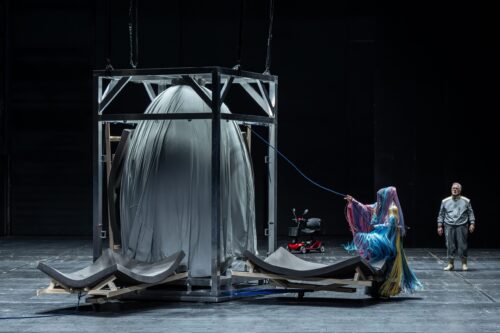
The plot of this music theatre project (Die grosse Stille) was set in a spaceship in some future time. Planet Earth no longer exists, those aboard the spacecraft are the last remaining humans. The set includes random objects referring to human civilization on Earth, including plants, an oversized plaster model of a foot and various paintings. The orchestra pit was covered and thus part of the floor. The musicians were part of the group of humans on board the spaceship, led by the conductor, Tohar Gil, at an e-piano, with two clarinets, two bassoons and two trombones. Every now and then the spaceship humans looked on in awe, assembling when they were able to see the sun outside in different sizes and colours. They accompanied their shared experience by playing and singing the opening of Mozart’s cantata To Thee, Soul of the Universe (KV 429). Entertainment on board the spaceship included the singing of other Mozart songs, assisted by a teleprompt from a portable screen, with voices amplified by an on-stage microphone.
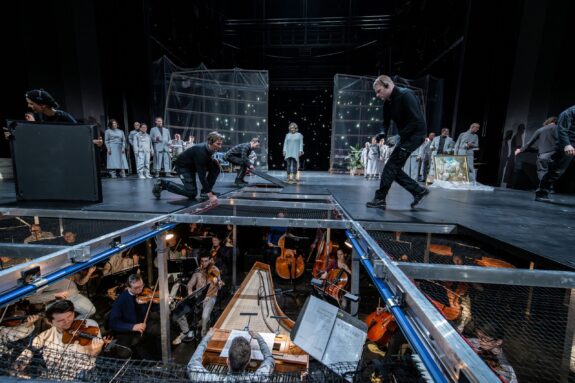
Suddenly and unexpectedly, an alien boards the spacecraft. The humans refer to her as Aliena. Aliena seeks sanctuary and is soon revered as a goddess and in the end brings a large white egg onto the stage which cracks audibly in the otherwise silent moments at the end of the performance (while Gil is still seen moving as if conducting!). Upon Aliena’s arrival, stagehands remove most of the covering of the orchestra pit. The orchestra can now be seen and heard in a full rendering of the opera Apollo und Hyacinthus (KV 38), which Mozart composed when he was eleven years old. On the death of Hyacinthus, flowers grow and blossom from his grave (in our case, from the orchestra pit). Aliena becomes the outsider, Apollo, changing back to Aliena at the end.
The soloists performed alternate characters onboard the spacecraft and in Mozart’s opera: Aliena / Apollo (Ana Durlovski); the spacecraft’s commander and the father / Oebalus (Gregory Kunde); his son / Hyacinthus (actor Damian Rebgetz); his daughter / Melia (Marie Maidowski); the grandfather / Telon (Hubert Kowalczyk); and a female friend / Zephyrus (Kayleigh Decker).
All soloists came across as very comfortable with the production and its perhaps unusual demands. They were given physical space and musical contexts that were clearly defined. The soloists had been well selected in terms of their vocal characteristics in relation to their roles and to each other. Marie Maidowski’s silvery and very flexible soprano was in appropriately strong contrast to the heavier voice of Ana Durlovski, whose vocal lines were also more sharply defined. Kayleigh Decker brought a very warm, gentle mezzo-soprano into the fold. Hubert Kowalczyk impressed with a sonorous bass, and veteran Gregory Kunde’s venture into Mozart, from his worldwide success with the heavier Verdi and Puccini roles, was interesting, exciting and successful.
Tobias Kratzer and Omer Meir Wellber are nearing two thirds of their first year in office as artistic manager and general music director, respectively, of Hamburg State Opera: on the basis of Kratzer’s production of Das Paradies und die Peri, conducted by Wellber, (review here) and Kratzer’s production of Monster’s Paradise, conducted by Titus Engel (review here), and this current project with Christopher Rüping directing and Wellber conducting, I believe the new leadership team is seeking to be innovative and very serious; there is clearly adult thinking and deep reflection involved. Concepts are cogently thought-through, consistent within themselves and staged with full competence and experience in utilizing everything available in a house the size and potential of Hamburg State Opera. There is also a refreshing awareness of their own artistic activity as such, a self-reflective component, which creates a distance that forms a combination of being cheeky, witty, inspired, and certainly thought-provoking. The contextual programme on offer for audiences in relation to each of these Hamburg State Opera’s new productions supports the approach of creating opera that is relevant to the audience and provides ‘food for thought’.
Daniel Meyer-Dinkgräfe
Featured Image: Stagehands remove the covering of the orchestra pit with Omer Meir Wellber (on the podium) and Ana Durlovski with the chorus (on the stage) © Tanja Dorendorf
Production:
Director – Christopher Rüping
Stage design – Jonathan Mertz
Costume design – Lene Schwind
Sound design – Jonas Holle
Lighting design – Benedikt Zehm
Chorus director – Alice Meregaglia
Dramaturgy – Katinka Deecke, Malte Ubenauf
Cast:
A father (Oebalus) – Gregory Kunde
A daughter (Melina) – Marie Maidowski
A son (Tyacinthus) – Damian Rebgetz
A friend (Zephyrus) – Kayleigh Decker
A grandfather (Telon) – Hubert Kowalczyk
Aliena – Ana Durlovski